



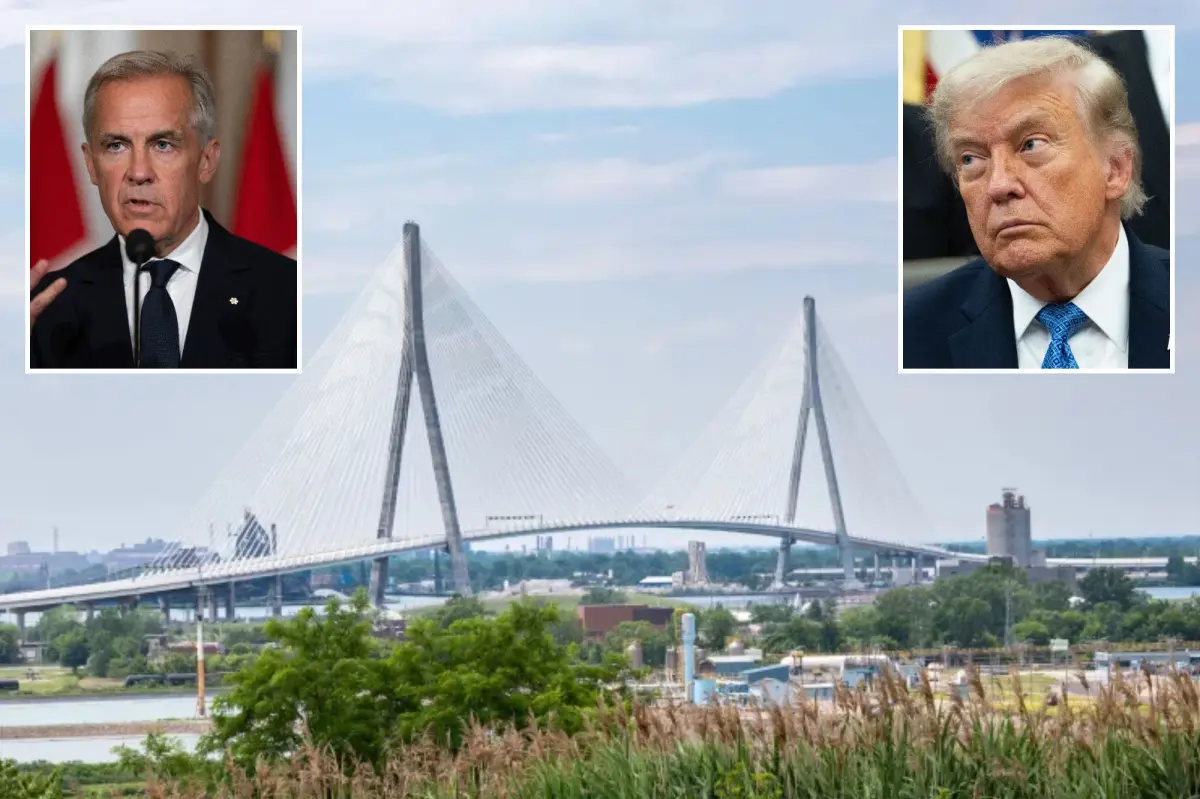
The $4.7 billion Gordie Howe International Bridge, which will link Detroit, Michigan, and Windsor, Ontario, is officially scheduled to open on July 27. The announcement comes after a tense, month-long standoff sparked by President Donald Trump’s threats to block the project just as it neared completion. Although the bridge was initially slated for a mid-June debut, Canadian Prime Minister Mark Carney agreed to delay the ribbon-cutting at the request of the Trump administration, allowing negotiators from both sides of the border to hash out a last-minute deal. While the bridge’s construction was entirely funded by Canada, the newly struck compromise reshapes how the massive project will operate financially, bringing an end to a high-stakes geopolitical game of chicken.
The breakthrough came after intense, fast-paced negotiations between US Commerce Secretary Howard Lutnick and Dominic LeBlanc, the Canadian minister in charge of US trade. According to a source close to the talks, the United States successfully negotiated a deal that grants it 50% of the bridge’s toll revenue, along with the power to veto any toll hikes that exceed 10%. Additionally, the agreement establishes a 15-year regional economic development fund financed by a portion of the bridge’s profits. President Trump took to Truth Social to express his satisfaction, writing that the original agreement was “unacceptable” but that the newly revised terms represented a “great and fair” victory for the American public.
This dramatic political turnaround quickly became a focal point in local politics, particularly in Michigan’s highly competitive US Senate race where Republicans are fighting to secure their congressional majority. Republican Senate candidate Mike Rogers was among the first to hint at the breakthrough during a radio broadcast, proudly sharing that the US had gone from “getting no revenue” to securing a highly lucrative deal. While the surprise revenue-sharing agreement is being hailed as a political victory in Washington, it remains unclear how splitting the toll profits half-and-half will impact Canada’s original 30-year timeline to recoup its multi-billion-dollar construction investment.
Beyond the political theater, the Gordie Howe International Bridge represents a critical upgrade for North American infrastructure. Named after the legendary Detroit Red Wings hockey player, the span is designed to relieve pressure on the privately owned Ambassador Bridge, which is currently the busiest commercial land border crossing in North America. In 2023 alone, the Ambassador Bridge facilitated a staggering $126 billion in trade carried by commercial trucks. A study by the University of Windsor highlights how vital the new crossing will be, estimating it will shave 20 minutes off the average crossing time and save the trucking industry an estimated $2.3 billion over the next three decades.
The sudden friction over the bridge’s opening did not happen in a vacuum, but rather against a backdrop of rising trade tensions between the neighboring countries. Earlier this year, Trump cited a list of grievances against Canada—ranging from its trade talks with China to its dairy tariffs and the exclusion of certain American alcoholic beverages from Canadian store shelves—as leverage for delaying the bridge opening. The controversy was further complicated by Matthew Moroun, the owner of the rival Ambassador Bridge, who met with US Commerce Secretary Lutnick in February shortly after donating $1 million to a pro-Trump political action committee, highlighting the intense corporate lobbying aimed at derailing the new project.
Ultimately, the resolution of the bridge dispute marks a pragmatic truce in what has been an increasingly volatile relationship between the two trading partners. This resolution comes at a critical time, as Trump has previously threatened not to renew the United States-Mexico-Canada Agreement (USMCA) free trade deal and has introduced sharp tariffs on Canadian goods. With the July 27 opening date now locked in, the Gordie Howe International Bridge stands not only as a testament to engineering but also as a physical reminder of the complex, transactional nature of modern diplomacy and the deeply intertwined economies of the United States and Canada.