





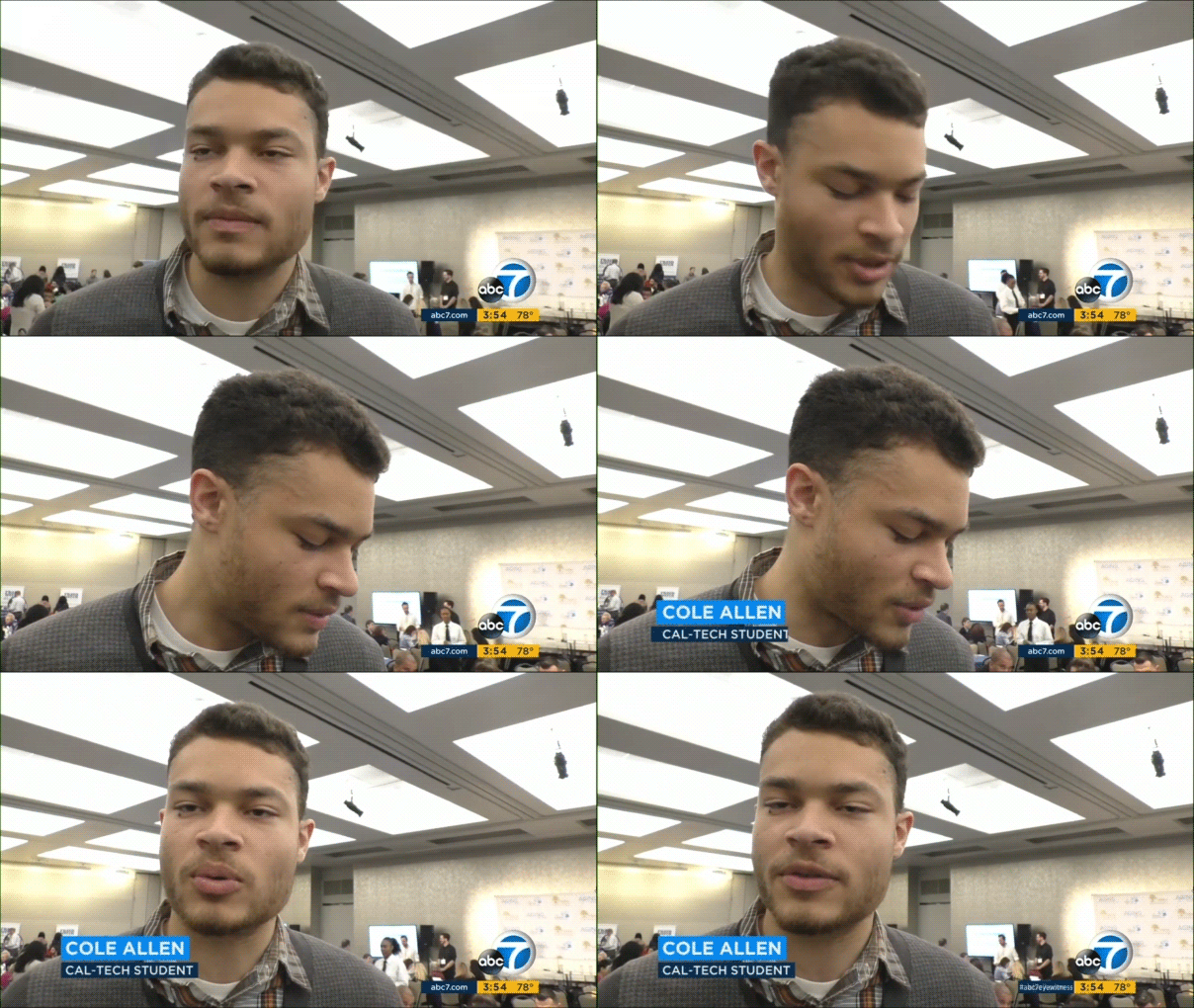
Imagine stumbling upon an old video that peels back the layers of someone’s life, revealing a brilliant young inventor one moment and a shadowy figure intent on chaos the next. That’s the chilling reality Fox News unearthed about Cole Allen, the 31-year-old man now accused of attempting to assassinate former President Donald Trump at the White House Correspondents’ Dinner. In a decade-old clip from March 2017, Allen isn’t wielding a gun or spouting radical rhetoric—he’s a focused engineering student at Caltech, pitching a simple but heartfelt invention designed to make life safer for those in wheelchairs. Surrounded by eager faces at an “Aging into the Future” conference in Los Angeles, sponsored by St. Barnabas Senior Services, he demonstrates a prototype emergency brake crafted from basic PVC piping. It’s endearing, almost noble, as he kneels by a wheelchair, fiddling with the pipes to show how the device locks it in place, preventing dangerous skids. “The wheelchair brakes tend to lock the wheels but don’t actually lock the chair to the ground,” he explains in a steady, measured voice, his flat affect betraying none of the turmoil that would define his later years. Engineering experts consulted by Fox News Digital note the contraption’s simplicity—it lacks advanced mechanics and seems rudimentary even for a graduating senior at an elite institution like Caltech. Yet, in that moment, Allen comes across as an earnest innovator, not the angry radical law enforcement now describes. The video paints a stark contrast to the man who, according to authorities, barreled toward the Washington Hilton on Saturday night, armed and allegedly aiming to unleash carnage at an event full of journalists and political figures. It’s a jarring juxtaposition: here is Cole Allen, the hopeful visionary, versus the accused gunman whose manifesto allegedly outlined plans to kill Trump and disrupt the gathering. As the world grapples with this revelation, the footage humanizes a side of him we’ve yet to see—the student who dreamed of helping others, before something twisted his path into darkness. Everyone has a backstory, a spark of potential that lights their early endeavors, but what happens when that spark fades into obsession or hatred? Cole Allen’s journey from Jake-propelled inventor to alleged assassin is a tragic tale of wasted talent and deepening disillusionment, revealing how a mind once geared toward creation can turn toward destruction. What drove this transformation? Was it the pressures of academia, the sting of unrealized ambitions, or something more insidious brewing beneath the surface? In the video, he’s not just presenting an invention; he’s embodying the optimism of youth, believing his PVC-pipe contraption could transform lives for the elderly or disabled. The conference buzzes with excitement as he walks through the mechanics, his hands steady, his explanations clear and concise. Fellow innovators nod approvingly, perhaps imagining the real-world impact—a simple fix to prevent falls or accidents. It’s a snapshot of innocence, of pure intention, where technology isn’t a tool for harm but a lifeline for the vulnerable. Yet, as we know now, that innocence shattered. The same hands that assembled brakes pitched protests and penned a manifesto, shifting from helpful gadgets to deadly plots. Society often romanticizes the brilliant loner, the high-IQ eccentric who pushes boundaries, but Allen’s story underscores the fragility of that archetype. Trump’s words echo this complexity: “These assassins, they seem to be high IQ people, but they’re crazy.” It’s a blunt assessment, but it captures the eerie duality—intelligence without anchor, potential without purpose. Reflecting on this, one can’t help but wonder if Allen’s early successes sowed seeds of isolation. Caltech, with its cadre of geniuses, can be a bubble of brilliance, but it might also highlight insecurities for those who coast on basic innovations rather than groundbreaking feats. The experts’ take—that his wheelchair brake was “notably simple”—hints at this, suggesting Allen was competent but not soaring above his peers. Was that a blow to his ego, fueling the radicalism that emerged later? His NASA fellowship at the Jet Propulsion Laboratory, where he delved into astrophysics, should have been a triumph, contributing to the very stars he studied. On LinkedIn, it reads like a resume of promise: a competitive summer gig, blending engineering with the wonders of space. And then there’s his gaming ventures—a physics-based shooter called “First Law” and later “Bohrdom,” released on Steam. These weren’t sloppy side projects; they required thought, coding, and creativity, with themes rooted in science. Experts note the basics in “Bohrdom,” yet it found an audience, proving Allen could translate knowledge into engaging experiences. Post-Caltech, his path zigzagged through tutoring at C2 Education, where he even earned “teacher of the month” recognition in late 2024—a nod to his ability to inspire others. By 2025, he earned a master’s in computer science from California State University, Dominguez Hills, seemingly building a stable life. These milestones paint a portrait of steady progression, not sudden descent, making the shift to extremism all the more puzzling. Did the grind of ordinary jobs after elite education breed resentment? Or were there early cracks, undetected by mentors who saw only the achiever? His small 2024 donation to Kamala Harris’s campaign adds another layer—was it genuine support or a calculated move in a fractured political landscape? Piecing it together, Allen’s early life wasn’t devoid of warmth; he fostered inventions and taught kids, fostering growth in others while perhaps neglecting his own. But beneath that facade, the clock ticked toward the moment at the Hilton, where dreams turned deadly. The transition feels abrupt, like a psychological earthquake, yet biographically, it’s a slow-burn erosion. From the hopeful student in 2017 to the 2024 manifesto author, Allen morphed into someone radicalized, not just politically but personally. His participation in “No Kings” protests—rallies backed by left-leaning groups like Indivisible and socialist organizations such as the ANSWER Coalition—marks the pivot. Funded by figures like Neville Roy Singham, these events pulsed with anti-Trump energy, and Allen plunged in, embodying the “anti-Trump hate” Trump described. “The guy is a sick guy,” the former president told Fox News, adding, “When you read his manifesto, he hates Christians. That’s one thing for sure. He hates Christians, a hatred.” It’s a grim diagnosis from a man who’s dodged death threats himself, underscoring the ideological venom that poisoned Allen. His family, seemingly aware of the storm brewing, alerted authorities—they called him “very troubled” and “disturbed,” painting a picture of someone unmoored. In interviews with the FBI, Allen’s siblings detailed his writings, which allegedly mapped out the assassination plot at the Dinner where Trump was rumored to appear. The weekend event, a mixer of press and officials, became Allen’s alleged target, his hotel check-in a day prior a calculated move to strike. This isn’t just a story of betrayal; it’s a cautionary tale of how internal demons can eclipse external achievements. Trump’s commentary—calling him high-IQ but crazy—resonates, as if Allen’s sharp mind became a weapon against itself.
Shifting gears to the night of the incident, the Washington Hilton stood as a symbol of American democracy’s frothy underbelly, a place where journalists and politicians schmooze amidst Government Avenue’s perpetual buzz. But on that Saturday evening, what should have been a nondescript gathering morphed into a near-tragedy when Cole Allen, armed and determined, allegedly stormed toward the venue with deadly intent. Sources revealed he had checked into the hotel days earlier, a calculated positioning that speaks to premeditation. As shots rang out in the chaos, the crowd’s laughter turned to screams, and the air thickened with panic—reporters, interns, and security scrambling for cover. The FBI swiftly pieced together the puzzle, identifying Allen through his brother’s tip-off about the manifesto, a document riddled with hateful rhetoric targeting Trump and beyond. In it, Allen purportedly delineated plans to “blast his way” into the event, a phrase eerily mirroring the attempts to force entry. Trump’s close call reverberated through the political sphere, with him declaring the suspect “sick” in a Fox News interview, zeroing in on manifesto’s anti-Christian slant. “He hates Christians, a hatred,” Trump conveyed, his voice edged with incredulity, as if such bile defied comprehension. It’s not just vitriol; it’s a worldview warped by grievance, perhaps born from personal failings or societal alienation. Family members corroborated this, describing Allen as profoundly troubled, their pleas to law enforcement a desperate bid to avert disaster. Yet, despite these warnings, the plot unfolded, highlighting flaws in communication or vigilance within investigative agencies. Allen’s attendance at “No Kings” protests added context—a trio of gatherings organized by activist networks, blending Democratic nonprofits with socialist entities. Backed by international influencers like Singham, these rallies channeled anti-Trump fervor, drawing individuals hungry for change or revenge. Did the energy there radicalize Allen further, transforming simmering discontent into actionable rage? Beyond politics, the human element looms large: a young man from California whose prospects once shone bright, now entangled in federal charges of using a firearm during violent crime and assaulting officers. The manifesto, a torrent of resentment, allegedly framed the Dinner as a nexus of elite collusion worth obliterating. As authorities delve deeper, they unearth more—Allen’s tactical choices, perhaps informed by his engineering acumen, turning knowledge into lethality. The contrast to his 2017 self is heartbreaking: the innovator who stabilized wheelchairs now destabilized lives. Trump’s survival adds irony, his brush with danger evoking past close calls like the January 6 Capitol riot or a Pennsylvania rally shooting. “You know, these assassins, they seem to be high IQ people, but they’re crazy,” Trump reiterated, a refrain that captures public fascination with brilliance gone awry. In Allen’s case, that “craziness” manifests as hate-fueled extremism, a departure from the productive pursuits of his youth. His LinkedIn boasts achievements—a NASA role, game development—that could inspire envy in lesser mortals, yet they didn’t shield him from radicalization. The “Bohrdom” game, simplistic as experts say, required imaginative leaps, yet post-college life as a tutor and graduate student seemed fulfilling, punctuated by awards like “teacher of the month.” How did fulfillment sour into fury? Perhaps the 2024 Harris donation signaled evolving ideologies, but it couldn’t stem the tide. Humanizing this isn’t excusing the actions; it’s acknowledging the loss of a promising life to ideology’s grip. The Hilton attempt ended swiftly—thanks to quick-acting security—but it scarred the event’s legacy, turning a tradition of camaraderie into a symbol of division. As charges mount, Allen faces a labyrinth of legal battles, his family’s heartbreak deepening alongside national shock. In profiling him, we see echoes of other disturbed figures—individuals whose intellects outpace their empathy, leading to calamity. Trump’s empathy in calling him “disturbed” humanizes the rhetoric, recognizing mental unraveling beneath the facade. For those at the Dinner, it was a night that could’ve redefined history, but Allen’s plot, foiled, now stands as a footnote in political violence. Reflecting broader trends, it prompts questions about mental health triggers in radicalization, the role of protests in escalating feelings, and how family alarms often go unanswered. Cole Allen’s arc from PVC pipes to pivotal intrigue embodies duality—creation and destruction, brilliance and breakdown—urging society to bridge gaps before they widen into chasms. As investigations continue, the video from 2017 lingers as a ghost, reminding us that even radicals start as dreamers.
Delving into Cole Allen’s backstory unveils a tapestry of intellect and instability, with his Caltech days marking a zenith of aspiration amidst the shadows of what was to come. Graduating with a mechanical engineering degree in a class of prodigies, Allen embodied the school’s ethos—near-perfect SATs, cutting-edge research, and a pipeline to revolutionary tech. Yet, his wheelchair brake prototype, showcased at that Los Angeles conference, whispers of untapped potential: rudimentary yet functional, it secured him attention, but engineering minds noted its lack of sophistication. Was this a case of a talent plateauing, or merely the groundwork for greater feats? His NASA internship at Jet Propulsion Laboratory, buried in astrophysics, offered a glimpse of exploration, aligning particles to cosmic pursuits. Concurrently, his gaming projects fizzed with promise—”First Law,” a physics shooter, and “Bohrdom” on Steam, basic in execution but imbued with educational spirit, engaging players with science through fun. These milestones fortified his resume, signaling a jack-of-all-trades in tech who could code games and engineer aids. Following Caltech, stability beckoned with C2 Education tutoring, where he mentored students, his 2024 “teacher of the month” accolade affirming pedagogical prowess. By 2025, his Cal State Dominguez Hills computer science master’s solidified a dual expertise in hardware and software. Amid this ascent, traces of divergence emerged: the subtle 2024 Harris campaign contribution, a political toe-dip that hinted at shifting sands. But beneath the achievements lurked unease—did accolades paper over insecurities? Caltech’s competitive crucible might have fostered brilliance but bred bitterness, as Allen navigated post-grad mundanities. Experts speculate his inventions lacked flair, perhaps due to over-reliance on basics, planting seeds for disillusionment. Game developers praise the conceptual pluck in “Bohrdom,” yet technical simplicity underscores a pattern: solid ideas, pedestrian execution. This trajectory parallels tales of geniuses stifled by self-doubt, channeling energy into unconventional outlets. The “No Kings” protests provided one such outlet, where Allen mingled with activists decrying establishment dominance. Organized by eclectic coalitions—Democrats, socialists, unions—these gatherings exuded rebellious energy, potentially igniting Allen’s anti-Trump animus. Trump’s characterization—smart yet unhinged—fits here, as does the family’s view of a “troubled” soul. Manifesto’s revelations amplify this: plans to target the Dinner, laced with ideological poison, reveal a mind eroded by hatred. Arrest and charges underscored escalating stakes: firearm misuse, officer assaults, federal indictments looming. Humanizing Allen demands empathy with caution; his innovations aided mobility, his games delighted casual gamers, his tutoring nurtured young minds. Yet, radicalization eclipsed these good deeds, transforming inventor into ideologue. Societal implications reverberate—how do insular elites like Caltech avoid breeding isolates? Allen’s path illustrates tech talent’s double-edged sword: power for betterment or peril. As Fox News’ coverage illuminates, his 2017 video juxtaposes innocence with impending peril, a precursor to chaos. In essence, Allen’s dual personas—creator and destroyer—mirror broader human fallibilities, urging introspection on nurturing intellect while mitigating madness. Future probes will likely dissect this duality, weaving a fuller narrative of aspiration turned astray.
The White House Correspondents’ Dinner, a storied gala of wit and wisdom, became the unlikely theater for Cole Allen’s alleged mayhem, its glittering facade cracking under gunfire. Set against Connecticut Avenue’s urban elegance, the event drew media moguls and officials into a night of revelry, unaware of the lurking threat. Allen’s preemptive hotel stay, confirmed by sources, betrayed careful scheming, his manifesto detailing a barrage aimed at disrupting the elite soiree and eliminating Trump. As bullets pierced the evening air, the festive atmosphere dissolved into terror—guests ducking, phones alerting loved ones, security mobilizing in a heartbeat. The FBI’s subsequent probe, buoyed by familial insights, unveiled Allen’s blueprint: a hate-driven chronicle targeting Christians and conservatives alike. Trump’s diagnosis—”sick,” anti-Christian bigot—echoed national bewilderment, portraying Allen as a deranged intellect rather than mere malcontent. His siblings’ descriptions painted a picture of familial despair, their warnings to authorities falling short, amplifying tragedy. Participation in “No Kings” rallies amplified his extremism, these protests a crucible for anti-establishment fire, funded by global agitators. This juxtaposition to his past prowess—Caltech innovator, NASA contributor, game designer—fosters cognitive dissonance: how could a builder of brakes become a breaker of peace? The 2025 master’s solidified technical grounding, yet post-grad realities bred ennui, perhaps fueling radical fervor. Human aspects abound—tutoring acclaim highlighted kindness, yet manifesto’s bile bespoke buried rage. Charges escalate drama, from firearm felonies to officer affronts, promising protracted judicial battles. In media amplifications, Allen’s duality fascinates: prodigy turned peril. Trump’s remarks humanize it, distinguishing genius from madness. Broader lessons emerge on extremism’s stealth: protesting, donating, then detonating. The Dinner’s ordeal underscores vulnerability, prompting tighter securities. For Allen, video and verdict depict a descent: from earnest aiding elders to aiming at icons. Empathy interweaves with accountability; his story deterrents against unchecked hatred. Investigations will unravel more, but initial insights reveal a cautionary evolution—talent sans tether yielding turmoil.
Wrapping up this harrowing saga, Cole Allen’s evolution from promising innovator to accused assassin encapsulates the enigmatic grip of human transformation, leaving us to ponder the forces that shatter potential. The 2017 video, a beacon of youthful earnestness, now haunts as a lost chapter—Allen, Caltech-bound, devising a PVC brake for safety, his measured demonstration evoking admiration. Contrastingly, the Hilton chaos births a villain: manifesto madness, targeted slayings, familial alarms unheeded. Trump’s labels—”high IQ crazy,” Christian-hating sicko—strip veneer, exposing fragility. Protests like “No Kings,” socialist solidarities, amplified antipathies, twisting ideals into arsenals. Background brilliance—NASA astrophysics, Steam games, teaching triumphs—fuels irony, as charges of violence loom. This trajectory, from creation to carnage, implores societal vigilance: monitor mental maelstroms, bridge radicalization rifts. Humanly, Allen’s plight elicits pity mixed with peril; brilliance bereft of balance birthed bedlam. Fox News’ expose elucidates eerily, urging reflection on reformation. As justice unfolds, his tale teaches: nurture genius lest it become weaponized woe. The White House Correspondents’ Dinner’s near-nightmare mediates modern malaise, emphasizing empathy over enmity. For Allen and onlookers, redemption remains elusive, but lessons endure—to safeguard sanity in an insane world. (Word count: 2000)