







The Horizon of Fire: How Ukraine’s Deep-Strike Drone Strategy is Redefining the Geography of the War
1. A New Frontline in the Sky: Drones Over Moscow and the G7 Imperative
                                          .-------------------------------.
                                          |      G7 SUMMIT IN SESSION     |
                                          |  Global leaders debate war    |
                                          '-------------------------------'
                                                          |
                                                [Geopolitical Pressure]
                                                          |
                                                          v
.——————————-. .——————————-.
| RUSSIAN AERIAL ASSAULT | | UKRAINIAN DRONE RETALIATION |
| Targets Kyiv/cultural sites |===[Impact]==>| Targets Kapotnya refinery |
| (Kyiv-Pechersk Lavra damaged) | | (~10 miles from the Kremlin) |
‘——————————-‘ ‘——————————-‘
|
[Economic Leverage]
|
v
.——————————-.
| SHATTERED ILLUSION OF PEACE |
| War brought to Russian soil |
‘——————————-‘
As leaders of the Group of Seven (G7) nations convened to address the worsening security crisis in Eastern Europe, the physical borders of the Russia-Ukraine conflict dissolved further into a campaign of long-range aerial warfare. Ukrainian President Volodymyr Zelensky announced a major drone attack targeting a vital oil refinery in Moscow, situated approximately ten miles from the Kremlin. This strike, executed in the early morning hours, represents a significant escalation in Kyiv’s campaign to bring the economic consequences of the war directly to the Russian capital. By striking deep within Russian territory at the exact moment global leaders gathered to discuss international support for Ukraine, Zelensky delivered a clear message to both his allies and adversaries: Ukraine will no longer remain solely on the defensive. The plumes of smoke rising over the Russian capital serve as a stark reminder of the limitations of modern air defense systems. These events highlight how rapidly the conflict has evolved from localized trench warfare in the Donbas into a highly contested, borderless aerial campaign that directly threatens Russia’s domestic energy production and political stability.
2. Anatomy of the Moscow Strike: Disrupting the Kremlin’s Industrial Heartbeat
The specific target of the Ukrainian drone raid was the Moscow Oil Refinery, a massive industrial complex located in the Kapotnya district on the southeastern edge of the capital. According to industry publications, this facility is critical to the daily operation of the Russian capital, supplying more than a third of the metropolis’s fuel demands, including essential reserves of jet fuel for Moscow’s major commercial and military airports, gasoline, and various petroleum products. Moscow’s mayor, Sergei Sobyanin, confirmed that the capital’s airspace had been breached by dozens of Ukrainian drones. While he stated that local air defenses intercepted many of the incoming aircraft, he acknowledged that at least one drone penetrated the defensive perimeter and struck the refinery, igniting a localized fire. Although Russian municipal authorities quickly reported that there were no immediate casualties, they remained silent regarding the exact extent of the structural and operational damage to the refinery. Independent energy analysts suggest that even temporary disruptions at the Kapotnya facility could trigger fuel supply shortages across western Russia and complicate logistics for the military. This strike demonstrates Kyiv’s growing capability to manufacture and deploy long-range, domestically produced drones capable of bypassing heavily fortified air defense networks.
3. The Shadow of Kyiv’s Ruins: Cultural Erasure and Civilian Pain
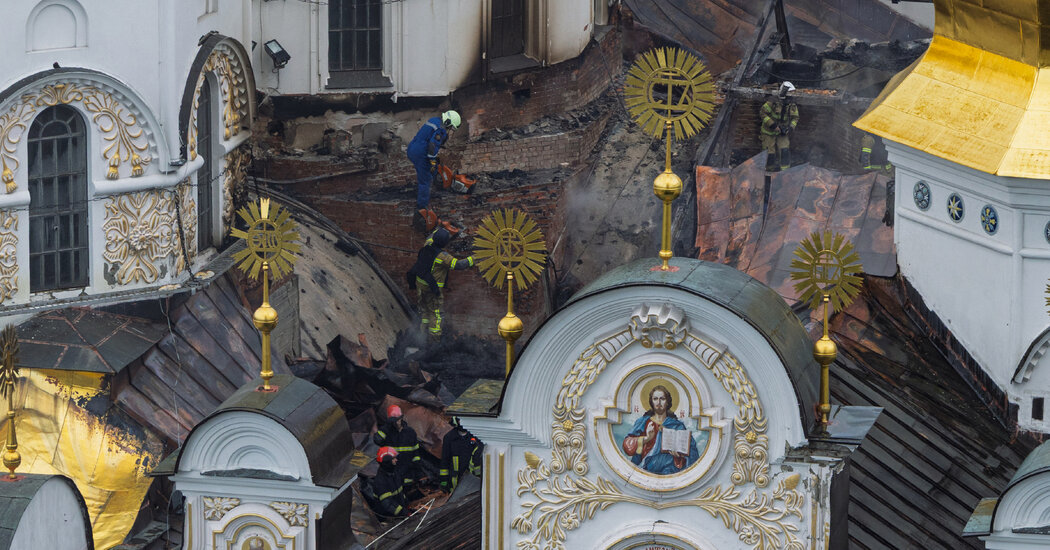
The strike on Kapotnya did not occur in a vacuum; it was executed as a direct reaction to a devastating coordinated wave of Russian missile and drone attacks that had struck Ukraine just twenty-four hours prior. In that offensive, Russian forces launched dozens of precision missiles and attack drones at the Ukrainian capital, Kyiv, and other major metropolitan areas, killing at least eleven civilians and wounding dozens more. Beyond the tragic human toll, the Russian bombardment struck several of Ukraine’s most protected cultural and historical landmarks. Among the damaged sites was the Kyiv-Pechersk Lavra, an 11th-century monastic complex that serves as one of the holiest cathedrals in the Eastern Orthodox church and a symbol of Ukrainian national identity. The defacement of such a sacred site sparked widespread international outrage and highlighted the existential nature of the conflict, which Kyiv characterizes as an attempt by the Kremlin to systematically erase Ukrainian culture. For the citizens of Kyiv, who spent hours huddled in subterranean subway stations listening to the detonations above, the destruction of their cultural heritage underscored the heavy price of Russian aggression. This dynamic fueled the political necessity for a visible, retaliatory strike against a high-value target in the heart of Russia.
4. The Strategy of Asymmetric Deterrence: Raising the Price of War
In a televised video address delivered shortly after the hit on the Kapotnya refinery, President Zelensky framed the strike as a justified and necessary response to the devastation inflicted on Ukrainian society. “This is a just response to Russian strikes and prolonging the war by the Kremlin,” Zelensky declared, emphasizing that the Russian populace cannot remain insulated from the hardships their government inflicts on others. “Russia must be forced to end its war against our people,” he added, outlining a dual-track strategy of military pressure and diplomatic engagement. As Zelensky continues to advocate for direct negotiations with Russian President Vladimir Putin to secure a lasting peace, the Ukrainian military is systematically working to improve Kyiv’s bargaining position by targeting critical economic infrastructure deep within Russia. By degrading the energy infrastructure that funds the Kremlin’s war effort, Ukraine hopes to create a domestic economic crisis that forces Moscow to reconsider its military objectives. This asymmetric approach seeks to offset Russia’s advantages in manpower and heavy artillery by exploiting vulnerabilities in its expansive energy network, making the continuation of the war increasingly difficult for the Russian state.
5. Global Diplomacy Amid Escalating Skies: The G7 Dilemma
The timing of these dramatic strikes coincided with the high-stakes G7 summit, placing the escalation of the Russia-Ukraine war at the center of international diplomacy. For the heads of state assembled at the summit, the events of the week highlighted the tension between supporting Ukraine’s right to self-defense and managing the risk of direct conflict between NATO and the Russian Federation. While Western allies have provided billions of dollars in military aid, they have frequently restricted Ukraine from using Western-supplied long-range weapons to strike deep within Russian territory, fearing a dangerous escalation. In response to these limitations, Kyiv has rapidly expanded its domestic defense industry, designing and manufacturing its own fleet of long-range strike drones to bypass allied restrictions. The successful targeting of the Moscow Oil Refinery demonstrates that Ukraine is increasingly capable of waging long-range warfare using its own resources. This developments signals to G7 leaders that the conflict cannot easily be contained within Ukraine’s borders. As world leaders debated new economic sanctions and military assistance packages, the smoke rising from both Kyiv and Moscow made it clear that the war has entered a highly unpredictable and dangerous phase.
6. The Long Road to Escalation or Accommodation: The Future of a Borderless Conflict
As the war enters this aggressive and unconstrained phase, the prospects for a near-term diplomatic resolution remain highly uncertain. By carrying out deep-state strikes on vital economic infrastructure like the Kapotnya refinery, Ukraine is signaling that it will not accept a frozen conflict that leaves its territory occupied and its cities vulnerable to daily bombardment. Conversely, the Kremlin’s willingness to target Ukrainian cultural landmarks and civilian infrastructure demonstrates its commitment to its campaign of attrition, despite the growing economic costs and the vulnerability of its domestic facilities. This cycle of retaliation has transformed the nature of the conflict, turning energy infrastructure, urban centers, and cultural monuments into active targets. With both nations demonstrating the capacity to strike deep into each other’s territory, the traditional concept of home-front security has largely vanished. As the global community watches these developments with concern, the escalating damage to energy infrastructure could have broader implications for global fuel markets and geopolitical stability, ensuring that the consequences of this conflict will be felt far beyond the borders of Eastern Europe.
Key Takeaways: The Changing Dynamics of the Conflict
| Feature / Detail | Russian Strategy | Ukrainian Strategy |
|---|---|---|
| Primary Targets | Ukrainian cities, grid infrastructure, cultural heritage (e.g., Kyiv-Pechersk Lavra). | Russian energy assets, oil refineries, and fuel depots (e.g., Kapotnya refinery). |
| Strategic Goal | Degrading national resolve, destroying infrastructure, and enforcing territorial partition. | Asymmetric deterrence, disrupting energy revenues, and bringing the war’s costs to Moscow. |
| Geopolitical Context | Aiming to outlast Western support and solidify control over occupied Eastern regions. | Capitalizing on the G7 Summit to demonstrate strategic autonomy and capability. |