



The pre-dawn hours in Windsor, North Carolina, are typically defined by a heavy, mist-laden quietness—the kind of deep rural tranquility that blankets the Roanoke River basin before the rest of the world begins its day. But on a chilly Monday morning at exactly 5:00 a.m., that fragile peace was gently but violently shattered inside the concrete walls of the Bertie-Martin Regional Detention Center, where a routine night shift instantly devolved into a terrifying nightmare of vulnerability, adrenaline, and chaos. Inside the facility, only three correctional officers were on duty to supervise a population of eighty-eight inmates—a stark, daunting mathematical imbalance that underscores the high-stakes precariousness of modern rural law enforcement and correctional staffing. In a sudden, coordinated, and aggressive surge, a group of inmates initiated a violent physical assault on the staff, quickly overpowering the vastly outnumbered guards and successfully seizing control of key secure sectors within the building. Amid the terrifying melee of yelling voices, clanging iron doors, and physical struggle, one of the three guards managed to break away, navigating the chaotic corridors to make a desperate escape and sound the alarm to outer agencies. Behind them, however, two colleagues remained trapped inside, held hostage by an angry and unpredictable population, transforming a routine shift into an active, life-or-death crisis and thrusting the quiet Roanoke community into an immediate state of terror.
Within a mere two minutes of the initial distress signal piercing the morning air, the first responding deputy from the Bertie County Sheriff’s Office arrived on the scene, tires screeching against the asphalt as blue and red emergency lights sliced through the dark country fog. Yet, despite this heroic and incredibly rapid response, the deputy was met with a frustrating and terrifying reality: the facility’s security infrastructure had been completely compromised from the inside, making it impossible to immediately breach the heavy metallic exterior doors safely without risking an immediate escalation or further casualties. Under the urgent, steady leadership of Bertie County Sheriff Tyrone Ruffin, law enforcement agencies from surrounding jurisdictions, state troopers, and tactical teams scrambled to establish a tight perimeter around the perimeter of the detention center. The immediate physical objective was containment—ensuring that the chaos stayed locked within those concrete walls and that none of the eighty-eight inmates could escape into the surrounding community, where families were just beginning to wake up, turn on their coffee makers, and prepare their children for school. As the perimeter tightened, the air grew thick with a quiet, agonizing tension; officers stood with weapons drawn, gazing at the silent exterior of a building that had suddenly become a fortress of uncertainty, harboring two of their own colleagues whose fates remained completely unknown.
To truly understand the weight of those agonizing morning hours, one must contemplate the immense psychological toll endured by the two captive correctional officers, suddenly stripped of their authority, their protective gear, and their security, standing completely at the mercy of the men they were tasked with supervising. For four and a half hours, these guards lived through a terrifying purgatory where every word spoken, every gesture made, and every breath taken required a delicate, survival-driven calculation amidst a highly volatile and unpredictable atmosphere. In small rural communities like Windsor, the relationships inside a jail are often deeply personal; jailers and inmates frequently know each other, or at least share mutual acquaintances, which adds a complex layer of psychological tension and human drama to such a confrontation. Outside, the families of these officers gathered in whispered, tearful circles near the police barricades, clutching their phones and praying for any shred of hope, while the families of the inmates similarly held their breath, terrified that a tactical raid would result in a bloody tragedy. Sheriff Ruffin bore the monumental burden of balancing these human lives, coordinating with state negotiator units to establish a line of communication with the barricaded inmates, aiming to appeal to their humanity and find a peaceful resolution before the situation degenerated into an irreversible bloodbath.
As the clock ticked closer to mid-morning, the grueling work of the trained crisis negotiators began to yield historic, lifesaving results, demonstrating the immense power of patience and verbal de-escalation over brute tactical force. At approximately 9:30 a.m., after hours of delicate back-and-forth dialogue through secure channels, a major breakthrough occurred: the inmates agreed to release the two captive correctional officers, who walked out into the sunlight physically unharmed, though undoubtedly bearing deep emotional scars from their harrowing ordeal. Along with the officers, a group of eighteen inmates was also safely released and accounted for, marking the beginning of a systematic and highly controlled evacuation process that aimed to dismantle the stronghold from within. Shortly after this initial release, another large group of inmates surrendered or was systematically escorted out of the compromised wings, effectively neutralizing the momentum of the uprising and isolating the remaining holdouts who refused to yield. This pivotal moment allowed medical personnel to immediately evaluate the freed guards and inmates, treating minor physical injuries on-site and offering a profound sense of relief to the anxious crowds of family members and law enforcement officers who had spent the morning preparing for the worst-case scenario.
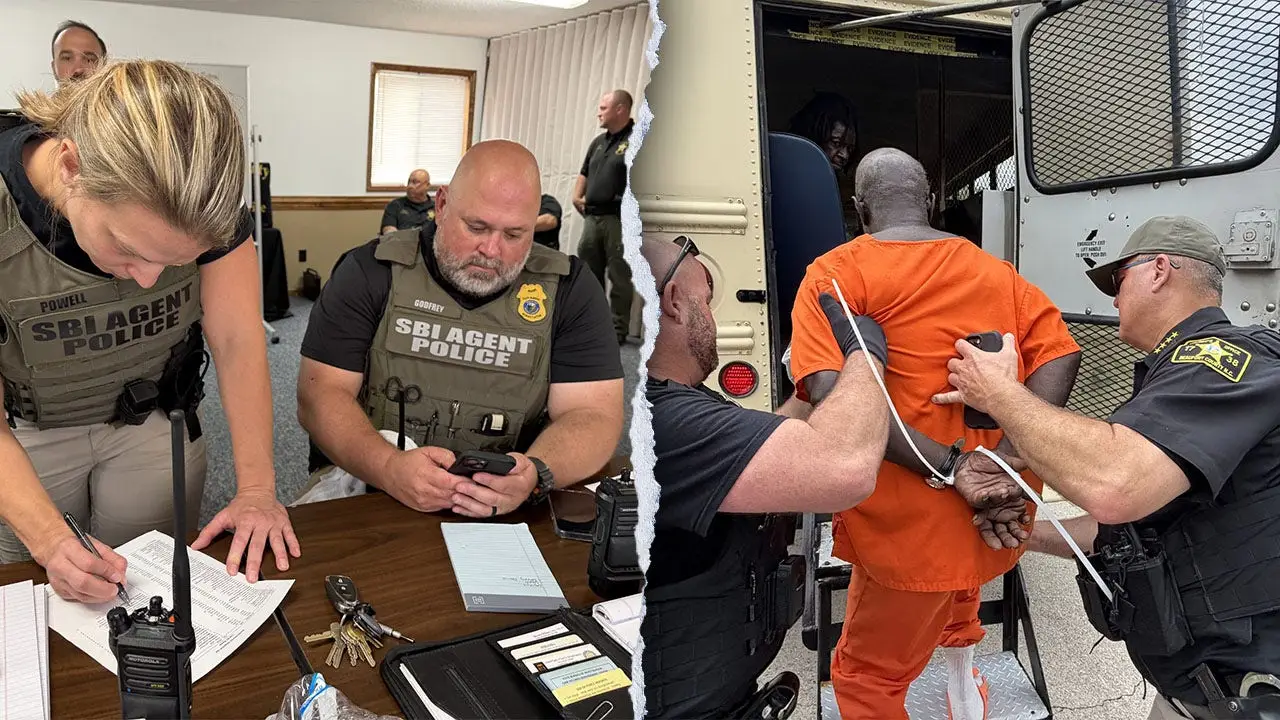
With the majority of the population evacuated and the hostages safely in the care of emergency medical teams, the highly trained operators of the North Carolina State Bureau of Investigation (SBI) were called upon to execute the high-risk task of reclaiming full physical custody of the facility. Entering the dark, littered corridors that had been vandalized during the hours of inmate control, the tactical units systematically cleared every room, corridor, and cellblock, dealing with a lingering group of ten non-compliant inmates who had retreated deep into the facility’s inner sanctum. For several hours, the SBI worked with methodical precision to ensure that no hidden dangers remained, checking for structural integrity, potential weapons, and securing the remaining individuals without resorting to lethal force. By 2:00 p.m., nearly nine hours after the initial 5 a.m. assault began, the SBI officially announced that the facility had been successfully cleared and fully secured, bringing a definitive end to one of the most intense standoffs in recent North Carolina history. In a public statement shared on social media, the agency confirmed that all inmates and staff were accounted for, emphasizing that those injured had received prompt medical treatment and that there was no lingering threat to the residents of the surrounding county.
While the immediate crisis was resolved without any loss of life—an outcome that Sheriff Ruffin and state officials celebrated as an absolute triumph of professional crisis management—the quiet aftermath leaves behind a trail of physical destruction and complex systemic questions. In the wake of the takeover, the Bertie-Martin Regional Detention Center suffered significant structural damage that required the immediate relocation of the entire inmate population to neighboring secure facilities, leaving the Windsor complex locked, silent, and heavily analytical of its own vulnerabilities. For the surrounding community, the incident serves as a stark, sobering reminder of the ongoing crises plaguing rural correctional departments across the country, where severe understaffing, low pay, and aging infrastructure continuously push facilities to the brink of disaster. As investigators from the SBI work tirelessly to pinpoint the exact trigger that sparked this violent pre-dawn uprising, local leaders are left to grapple with the painful reality of how easily a quiet Monday morning can transform into a hostage crisis, emphasizing the urgent need to support the unsung, overworked professionals who patrol the thin line between order and chaos inside America’s local jails.