





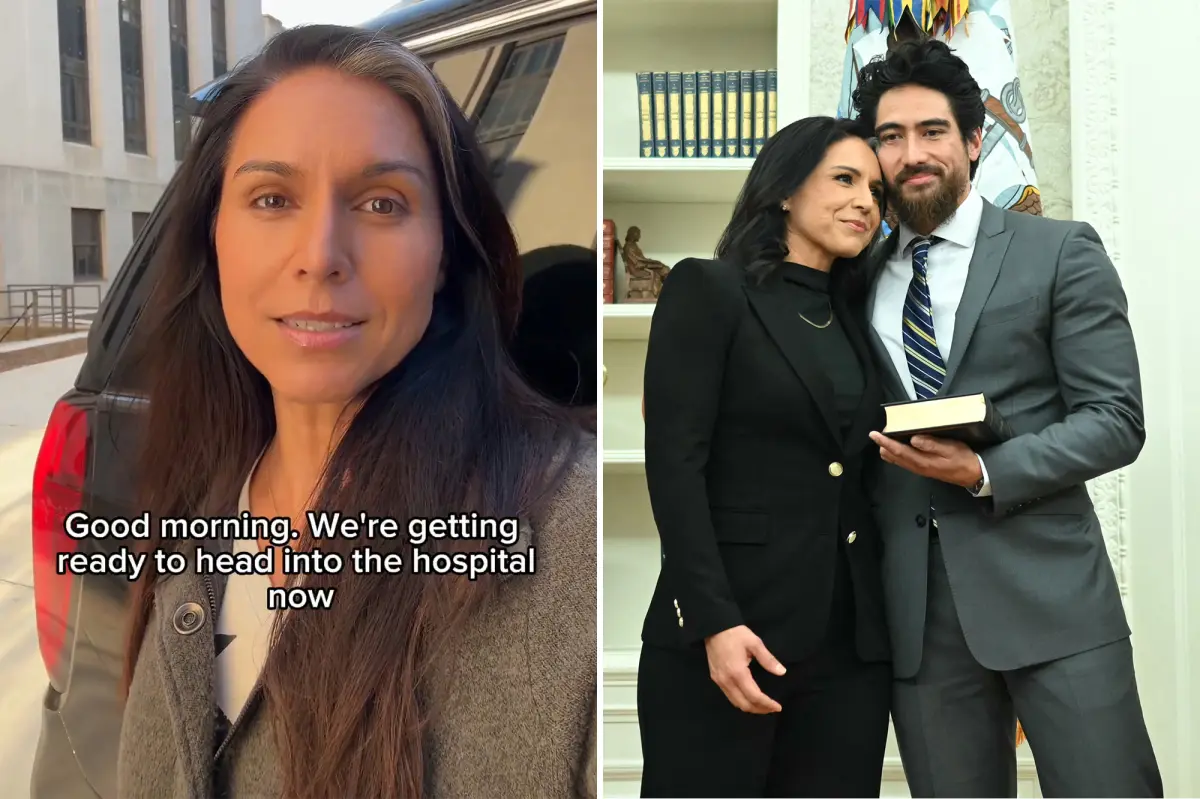
Under the harsh and relentless spotlight of American public life, a deeply personal struggle has quietly unfolded behind closed doors, offering a poignant reminder of the fragile, human heart that beats beneath the armor of political service. Tulsi Gabbard, the outgoing Director of National Intelligence, recently shared a raw and incredibly vulnerable update regarding her husband, Abraham Williams, revealing that he is recovering at home after a grueling, nearly seven-hour surgical procedure to treat a rare and highly dangerous illness. For eleven years, their marriage has been anchored by an unwavering, deeply reciprocal partnership, with Williams serving as Gabbard’s steadfast “rock” through some of the most demanding, turbulent, and transformative chapters of her life. He stood as an absolute constant source of strength while she was deployed to East Africa on a challenging Joint Special Operations mission with the military, remained her emotional anchor throughout several high-stakes, exhausting political campaigns, and supported her transitions as she ascended to some of the highest, most demanding echelons of national security leadership in Washington. Yet, when life presented an unexpected and terrifying diagnosis—a rare, aggressive form of bone cancer—the roles of protector and caregiver were instantly and profoundly reversed. Facing an unprecedented crisis that demanded her full, undivided presence and emotional energy, Gabbard made the monumental decision to step down from the pinnacle of federal power, demonstrating that the quiet, solemn vows of marriage carry far more weight than any title, office, or political legacy. Her announcement was a beautiful, sobering reminder that behind every historic public figure is a baseline of human vulnerability, and that when the storm comes, the true measure of a person is found in who they choose to stand beside in the dark when the cameras are finally turned off.
The medical reality confronting the couple is as daunting as it is exceedingly rare, centered around a diagnosis known as a sacral chordoma. This highly uncommon, slow-growing, yet aggressively invasive form of bone cancer emerges from microscopic remnants of the embryonic notochord, typically developing at the very base of the spine within the sacrum—the critical, triangular bone nestled just above the tailbone. Because of its sensitive location immediately adjacent to delicate nerve pathways, major blood vessels, and the spinal cord, treating a sacral chordoma is a high-stakes, nerve-wracking mathematical equation that requires extraordinary surgical precision. Abraham Williams’ intense operation stretched on for nearly seven hours, during which a highly skilled team of specialists worked meticulously to excise the afflicted bone and a margin of surrounding tissue, striving to eradicate every trace of the malignancy while desperately trying to preserve vital neurological functions that dictate mobility and basic bodily systems. The physiological aftermath of such a major surgical intrusion is an incredibly exhausting and distressing ordeal, marked by severe tissue trauma and neurological shock; Gabbard candidly shared that her husband endured a profoundly “rough night” in the hospital, battling acute post-operative pain before finally being deemed stable enough to return to the quiet sanctuary of their home to rest. Now, as the terrifying, high-stress atmosphere of the operating room fades into the background, the couple begins the long, unpredictable journey of physical rehabilitation and ongoing surveillance, a domestic phase of recovery where the clinical machinery of the hospital is replaced by the gentle, tireless vigilance of a devoted partner managing pain regimens, monitoring wound healing, and offering the emotional scaffolding necessary to rebuild a shattered physical frame, one painstaking day at a time.
To provide her husband with this level of unwavering devotion, Gabbard recognized that she had to step away from her responsibilities as the Director of National Intelligence (DNI), a highly demanding and time-consuming role she had assumed in February 2025. The position of DNI is well known to be one of the most intense and exhausting jobs in the entire federal government, requiring its leader to oversee eighteen distinct intelligence agencies, digest a constant stream of highly confidential global crises, brief the President on urgent national security threats of the highest classification, and maintain a state of hyper-vigilance twenty-four hours a day, seven days a week. In mid-May, during a quiet and heavy-hearted meeting in the Oval Office, Gabbard personally informed President Donald Trump of her husband’s devastating diagnosis and her subsequent decision to submit her formal resignation, effective June 30, 2026. In her official resignation letter, which was later obtained exclusively by Fox News Digital, Gabbard expressed her profound gratitude for the immense trust the President had placed in her during her year-and-a-half tenure leading the nation’s intelligence apparatus, while explaining with heartbreaking clarity the necessity of her departure. She wrote of how Abraham had been her unwavering champion through the highest highs and lowest lows of her public life, and declared that she could not in good conscience ask him to face this terrifying health battle alone while she continued to dedicate her days and nights to the endless, consuming demands of her public office. This act of resignation was a rare and striking demonstration of moral clarity in a town often dominated by ambition, proving that when the structures of our lives are stripped down to their absolute essentials, the duty we owe to the ones we love vastly eclipses our duty to the institutions of power, no matter how prestigious they may be.
To fully appreciate the gravity of Gabbard’s choice to step down at this critical juncture, one must look at the broader, lifelong trajectory of service that she has temporarily set aside to care for her ailing partner. A woman of fierce determination and an exceptionally independent spirit, Gabbard’s entire adult life has been defined by her dual identities as a U.S. Army Reserve officer and a combat veteran, having voluntarily deployed to active war zones where she witnessed firsthand the profound physical and emotional sacrifices demanded of military personnel and their loved ones back home. Her subsequent political journey is equally striking and highly unconventional, marked by her service in Congress as a prominent Hawaiian Democrat, her historic and highly publicized departure from her original party to stand as an independent, and her eventual decision to align herself with the Republican Party. Throughout all of these dramatic ideological evolutions, public debates, and intense electoral battles, she consistently earned a national reputation as a relentless, boundary-pushing fighter who rarely backed down from a confrontation, making her decision to voluntarily resign all the more remarkable to political analysts. Stepping away from her position at the absolute apex of the United States intelligence community was certainly not an act of surrender or a retreat born of professional burnout; rather, it represents a deliberate and strategic redeployment of her legendary combat-tested resilience, focus, and strength toward a deeply private, high-stakes war for her husband’s health. For a lifelong warrior accustomed to defending her nation on a global stage, this dramatic shift from leading eighteen intelligence agencies to managing the minute-by-minute care of one recovering man is a profound expression of quiet bravery, illustrating that some of the most heroic and grueling battles are not fought on foreign sands or in the wood-paneled oversight rooms of Capitol Hill, but in the soft, hushed stillness of a loved one’s healing room.
In response to this sudden and deeply emotional development within his cabinet, President Donald Trump publicly addressed her departure with a profound level of empathy and professional respect that highlighted the universal gravity of her domestic situation. Utilizing his platform on Truth Social, the President remarked that Gabbard was “rightfully” stepping away to support her husband during an incredibly challenging physical ordeal, expressing his absolute confidence that Abraham would eventually prevail in his health battle and emerge from this dark chapter “better than ever.” Trump went on to offer high praise for her impactful, historic tenure, stating that she had done an “incredible job” as the Director of National Intelligence and emphasizing how deeply her sharp insight and strategic leadership would be missed within the upper echelons of his administration. To ensure seamless continuity in the nation’s highly critical defense operations during this transition, the President announced the appointment of Bill Pulte, the current chief of the Federal Housing Finance Agency (FHFA), to step in immediately as the acting Director of National Intelligence. Bill Pulte will now face the highly formidable, unprecedented task of juggling this temporary, national security role while concurrently retaining his massive, existing responsibilities as both the Director of the FHFA and the Chairman of secondary mortgage market giants Fannie Mae and Freddie Mac. This rapid and complex shift of power, while logistically challenging for the incoming leadership and the structures of Washington, serves as a poignant backdrop to the essential, human story at the center of the news: while the grand machinery of global statecraft and the endless demands of national administration continue to grind forward without pause, the life of a prominent public servant has momentarily halted, narrowing its focus entirely down to the quiet care of a husband’s recovery.
As the young couple begins this new, highly collaborative chapter of physical healing far away from the blinding glare of public scrutiny, they find themselves wrapped in a massive, bipartisan embrace of community support, compassion, and shared prayer. Just days before the daunting, seven-hour procedure took place, Gabbard shared an intimate, raw video on social media, filmed as they were putting their bags together to head to the medical facility, expressing her profound humility and deep gratitude for the incredible, unexpected wave of heartfelt messages, spiritual vigils, and warm wishes that had been sent their way. In her characteristically warm and earnest address, she noted that they felt incredibly blessed and deeply comforted to be surrounded by the spirit of “aloha” during this exceptionally difficult, frightening period of instability. In traditional Hawaiian culture, the concept of “aloha” extends far beyond a simple greeting, social nicety, or pleasant farewell; it represents a deep, spiritual framework of mutual respect, unconditional love, profound empathy, and the actual sharing of the vital breath of life, a cultural philosophy that feels incredibly fitting as Abraham embarks on the long, exhausting, and grueling journey to reclaim his physical health. In a modern, highly polarized political landscape that is unfortunately so often defined by bitter ideological division, cynical rancor, and tribal hostility, the universal, warm reaction to the couple’s personal trial serves as a rare, beautiful bridge, reminding us all that when we are confronted with the raw, uncompromising realities of severe illness, mutual sacrifice, and the terror of losing our loved ones, our shared human experience still has the power to transcend our societal differences. As Abraham rests quietly at home and begins the slow, arduous, and daily labor of rebuilding his strength, and as Tulsi stands fiercely by his side not as a powerful military officer or a cabinet-level director, but as a devoted caregiver, partner, and loving companion, their collective journey stands as a deeply moving, enduring testament to the power of human connection, underscoring the timeless truth that the most important and lasting titles we will ever hold are those of husband, wife, and protector to the ones we love.