


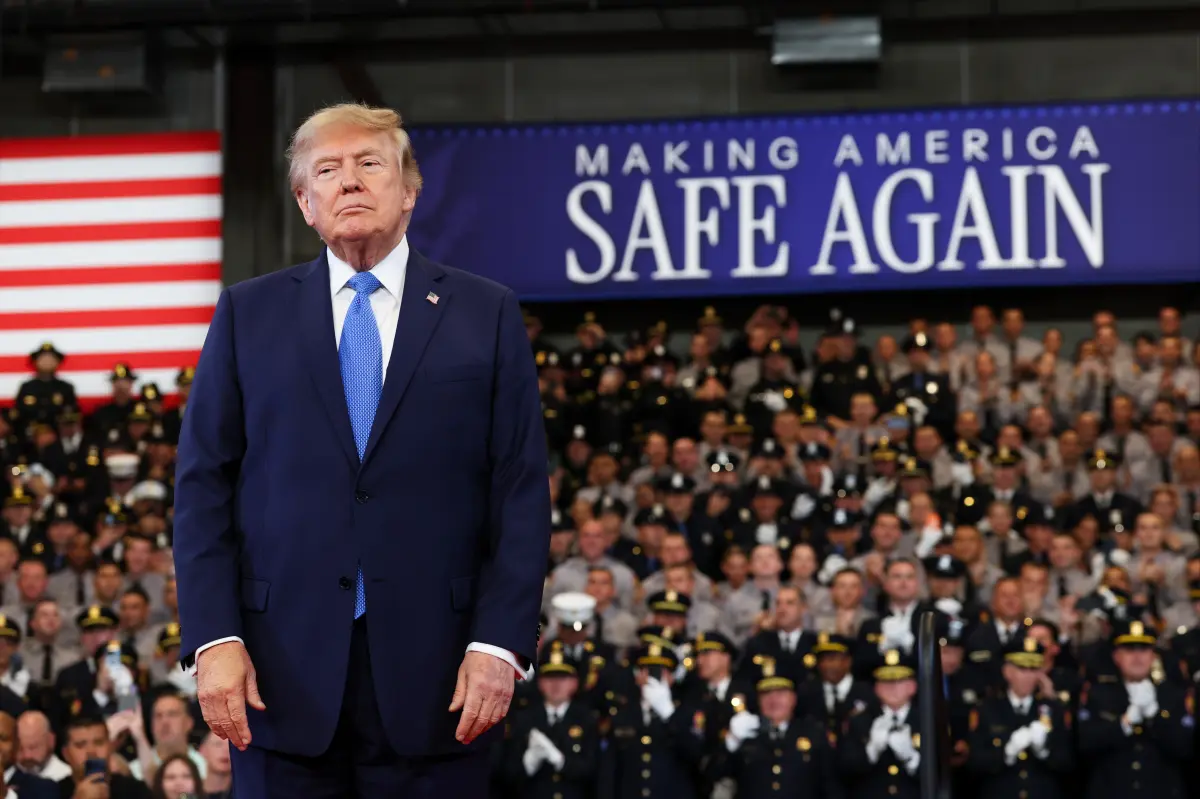
For the past several years, the national conversation about crime has often felt like a tug-of-war between fear and frustration, between statistics and personal experience. But on a crisp morning at the Nassau County Police Academy on Long Island, the President of the United States stepped in front of rows of uniformed officers and declared that the fight has turned a corner. The occasion was not a policy briefing or a bill signing; it was a victory lap rooted in hard data. The FBI’s 2025 Uniform Crime Report had just landed, and the headline was nothing short of startling: violent crime in America had fallen by 9.3 percent in a single year. Murder was down by 18.1 percent. Rape had dropped by 7.6 percent. Robbery had tumbled 18.5 percent. Aggravated assault had declined by 7.2 percent. Even motor vehicle theft, which had plagued cities for years, was down by 22.7 percent. These are the kind of numbers that politicians dream about and rarely get to deliver. Standing before a sea of police uniforms, the President leaned into the moment. “Every single number is the lowest number in recorded history,” he said. “We have the best crime record in recorded history.” The phrase “making America safe again” was no longer just a campaign slogan—it had become a claim backed by a federal report, and in that room, it felt less like spin and more like a collective exhale.
To understand why this report matters so much, you have to remember where the country stood just a few years ago. During the COVID-19 pandemic, crime rates spiked in ways that stunned even veteran criminologists. Murders rose sharply, businesses boarded up their windows, and millions of Americans grew anxious about walking down their own streets. The chaos of 2020 and 2021 left deep scars. Now, however, the pendulum has swung in the opposite direction. The FBI’s latest numbers show not just a slight improvement, but the biggest one-year drop since the report began keeping records. For ordinary people, the statistics translate into something far more tangible than charts and percentages. A 22.7 percent drop in motor vehicle theft means fewer shattered car windows and fewer frantic phone calls to insurance companies. An 18.1 percent drop in murder means more families get to keep their sons, their daughters, their parents. An 18.5 percent drop in robbery means more small-business owners can open their shops without looking over their shoulders. These are not abstract figures; they represent a quiet return to normalcy. The President made sure to point that out, framing the data as a direct consequence of his administration’s priorities. The report, he argued, is proof that when the government stops coddling criminals and starts supporting the police, communities heal. It is a message that resonates deeply with voters who have grown tired of seeing repeated break-ins, violent mugshots, and viral videos of brazen retail theft. For them, this report is more than good news—it is vindication.
Of course, no political event is ever just about statistics, and Friday’s gathering on Long Island was no exception. The President used the occasion to spotlight the policies he believes are responsible for the turnaround. He talked about cracking down on criminal migrants, reducing the number of immigrants attempting to cross the southern border illegally, and sending National Guard troops to support law enforcement in major cities like Washington, D.C. He spoke with visible pride about ending what he called the “war on police” and replacing it with a “very strong war on crime.” But the event was also a campaign stop, carefully staged to highlight the Republican Party’s message ahead of the midterm elections. Behind the President, row after row of officers stood at attention, their uniforms a powerful visual reminder of the contrast he wanted to draw. “We stand with the great people of law enforcement,” he said. That message was aimed directly at the MAGA base, but also at the broader swath of Americans who are less interested in political theory than in simple daily safety. The President’s appearance was timed to raise money and enthusiasm for Bruce Blakeman, the Republican candidate running for governor of New York. And by choosing a police academy as the backdrop, the event turned a wonky federal report into a referendum on who truly stands with the men and women who wear the badge. It was a carefully crafted piece of political theater, but as with all good theater, the emotional core was real.
The President, however, did not stop at praising law enforcement. He used the crime numbers as a springboard to go after his political opponents with characteristic vigor. He revived one of his favorite new nicknames for Democrats: “Dumbocrats.” He mocked those who advocate for defunding the police, a movement that has become deeply unpopular with voters. “Does that play well in this room?” he asked the assembled officers, knowing full well what the answer would be. He then turned his attention to New York’s Democratic Governor, Kathy Hochul. “Hochul has been very, very bad on crime—a nightmare for crime,” he charged. He went even further, claiming that she and the radical left “stand with the gang members, child predators, and violent felons,” while he and his party stand with hardworking New Yorkers. It is the kind of rhetoric that is familiar to anyone who has followed American politics over the last decade, but it gains extra power when delivered in front of an audience of police officers. Every line was met with applause, every jab at the left carefully calibrated to resonate with the people who see the worst of crime on a daily basis. To supporters, the President’s words are common-sense toughness. To critics, they are caricature. But in that room, surrounded by blue uniforms and handshakes, the message was exactly what the crowd wanted to hear. The President is betting that as the midterms approach, voters across the country feel the same way—and that the new FBI numbers will convince them that his approach is not just tough talk, but tangible results.
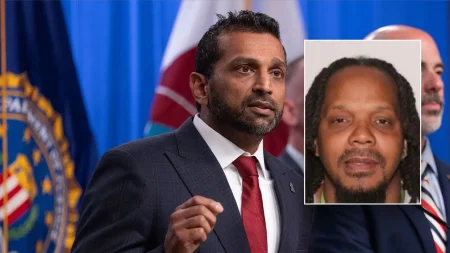
Joining the President on the stage were two figures who added institutional weight to the promise of safety. FBI Director Kash Patel and Attorney General Todd Blanche both stood behind the podium, lending the event an air of federal authority. Patel, who was introduced as the leader of the nation’s premier law enforcement agency, did not just stand there silently; he made sure the public knew that the FBI was proud of the work. “The 2025 crime statistics exemplify the great work this FBI and our law enforcement partners on the front line are doing to crush violent crime,” he wrote in the report’s introduction. For a president who has often been at odds with the FBI and the broader establishment, having the bureau’s top official publicly endorse the administration’s crime-fighting message is a significant political asset. It shifts the argument from partisan debate to bureaucratic fact. The FBI is not usually in the business of making political statements, but its annual crime report is one of the most trusted data sources in the country. When the director says crime is down, and an administration takes credit, it creates a powerful narrative. The presence of the Attorney General, meanwhile, signals that the Department of Justice is fully aligned with the White House’s priorities. Together, the three men projected a unified front: the executive branch, the FBI, and local law enforcement all pulling in the same direction. For voters, that image is reassuring. It suggests that the system is not broken, that change is possible, and that the government is capable of protecting its citizens.
Yet, as the applause faded and the officers returned to their patrols, the bigger story remained a matter of perspective. Crime rates across the country have been declining since the pandemic-era spike, and experts will argue for years about how much of that decline is due to policy, economics, or simply the natural cycle of social order. The President, unsurprisingly, sees the report as a direct result of his leadership, and he promises that even better days are ahead. Democrats, on the other hand, may look at the same numbers and point out that the decline is a national trend, not the product of any single administration. They may also note that the sharpest drops are as much about community-based programs, sensible gun laws, and local policing strategies as they are about border walls and national guards. But on Long Island, nuance was not the order of the day. The President stood with the people who put their lives on the line, thanked them for their sacrifices, and assured them that the country has turned away from the darkness. He saluted the officers, shook their hands, and looked out at a room that mirrored his own understanding of justice. Whether the voters in November believe the numbers and reward him and his party—or whether they hear the echoes of political spin and demand a different narrative—remains to be seen. The FBI report is real. The drops are real. The question is whether the President can turn those numbers into lasting political trust. In a nation still healing from years of turmoil, the desire for safety is universal. The argument is not about whether crime is down; it is about who best can keep it down. And as the six paragraphs of this moment settle into history, one thing is clear: on one bright day on Long Island, the President made the case that he is the answer. For millions of Americans, that is not just a political claim—it is a promise of peace.