



The Super Bowl’s Halftime Show Controversy Ignites Political Firestorm
The Super Bowl LVIII halftime show, held at Allegiant Stadium in Las Vegas in 2024, was meant to unite millions of viewers in celebration of American culture, sports, and artistry. Instead, it sparked a fierce national debate when former President Donald Trump unleashed a blistering critique on his Truth Social platform, labeling it “one of the worst, EVER.” Headlined by Puerto Rican rapper Bad Bunny—a global icon known for his infectious rhythms and boundary-pushing lyrics—the performance drew accusations from Trump of being an “affront to the Greatness of America.” This wasn’t just a casual tweet; Trump’s post, posted minutes after the show ended, delved deep into his grievances, painting the event as a symbol of everything he saw wrong with modern entertainment. As someone who’s always positioned himself as a defender of traditional American values, Trump’s reaction felt deeply personal, reflecting his long-standing clashes with cultural shifts he perceives as divisive or un-American.
Trump argued that the show’s content, delivered exclusively in Spanish, alienated the average American viewer, claiming, “Nobody understands a word this guy is saying.” This critique struck at the heart of inclusivity, suggesting that mainstream events should cater primarily to English speakers and avoid what he viewed as foreign influences. For many fans of Bad Bunny, however, his music transcends language barriers with its emotional depth and universal themes of love, struggle, and resilience. Trump’s dismissal overlooked the rapper’s massive global following, which spans continents and cultures, making him a fitting representative of America’s melting pot. Moreover, the choreography, which Trump called “disgusting, especially for young children,” included vibrant, energetic moves drawing from Latin heritage, such as salsa influences and expressive gestures that celebrated Puerto Rican identity. Critics like Trump saw it as inappropriate, but others praised it for bringing fresh energy to a traditionally tame halftime slot, evoking the island’s spirit amidst the corporate grind of the NFL.
Expanding on his qualms, Trump characterized the performance as a “slap in the face” to the country, devoid of inspiration and failing to embody “standards of Success, Creativity, or Excellence.” He predicted it would garner glowing reviews from “Fake News Media,” whom he accuses of being out of touch with “the REAL WORLD.” This echoed his broader political strategy of pitting himself against perceived elites in journalism and entertainment. In a nation where halftime shows have evolved from iconic performances by artists like Michael Jackson or Taylor Swift, Bad Bunny’s set challenged viewers to confront themes of immigration, diversity, and societal divides. Attendees and home viewers alike wrestled with Trump’s words, wondering if his outburst was fueled by genuine cultural concerns or electoral posturing amidst ongoing debates about border policies and national identity. For families tuning in, especially those with young kids, Trump’s alarmist tone raised questions about what constitutes appropriate content for shared national experiences, blending politics with family time in an unprecedented way. Psychologically, this incident highlighted how sports events, once neutral grounds for unity, have become flashpoints for ideological battles, mirroring the polarized state of American discourse under Trump’s influence.
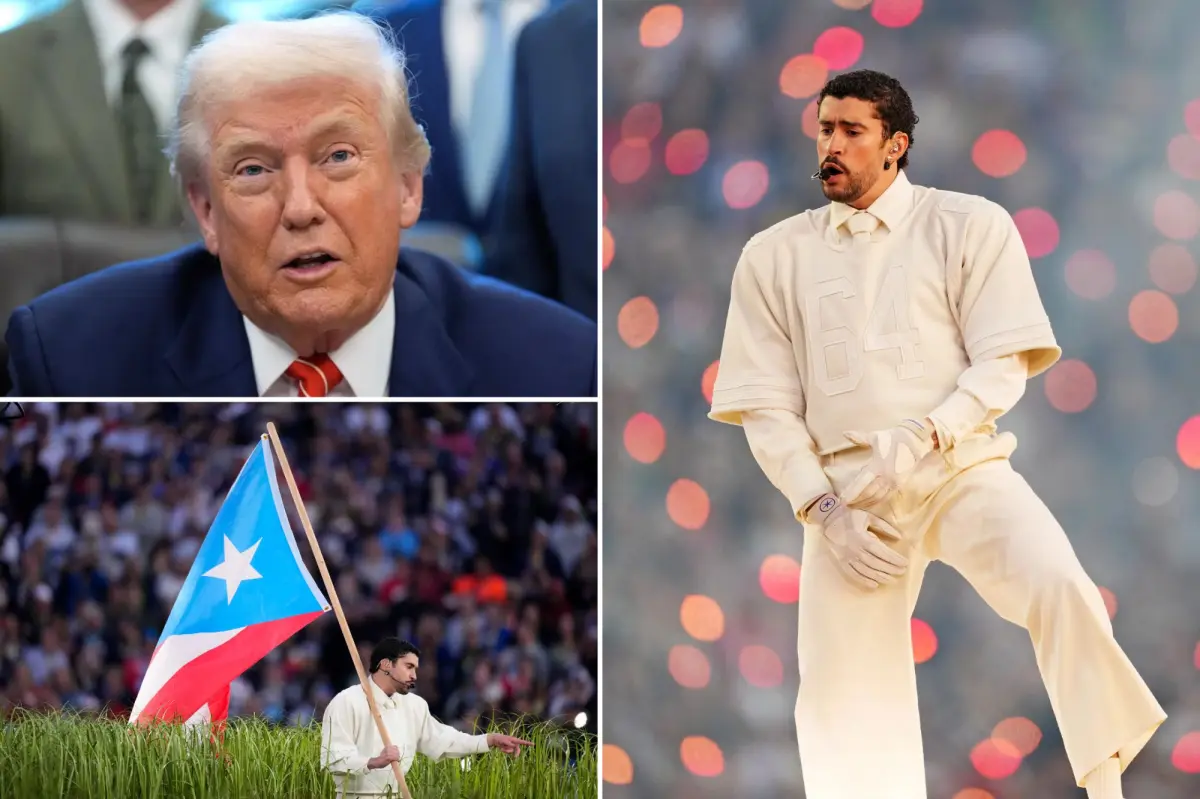
Delving into the show’s imagery, Bad Bunny’s performance was a visual feast, transporting Puerto Rico’s lush landscapes into the heart of Las Vegas. He wandered through stalks of greenery, symbolizing the island’s tropical beauty, flanked by farm workers who embodied the hardworking spirit of its people. This wasn’t mere set design; it was a nostalgic nod to Puerto Rico’s cultural roots, evoking memories of sugarcane fields and community resilience post-hurricanes. Midway through, Bad Bunny wandered into the midst of a real-life wedding ceremony, complete with a bride, groom, and guests, turning the stadium into a spontaneous celebration of love and unity. The scene resonated with millions, especially in Latino communities, who saw it as empowering representation in a mainstream space often dominated by other narratives. Cameos from Lady Gaga and Ricky Martin added star power, with Gaga’s pop sensibility dancing alongside Bad Bunny’s reggaeton flair, and Martin’s Latin roots reinforcing the multicultural tapestry. These moments humanized the performance, transforming it from a concert into a communal event that bridged generations and backgrounds.
One particularly poignant moment occurred when Bad Bunny handed his Grammy Award to Liam Conejo Ramos, a 5-year-old boy from Minneapolis recently freed from ICE custody after a viral photo highlighted immigration injustices. This act of passing the torch wasn’t just symbolic; it sparked tears and applause, underscoring themes of hope and compassion in the face of familial separation. Trump’s post, while focusing on his criticisms, subtly intersected with these elements, as his administration’s policies on immigration had directly impacted cases like Liam’s. The performance culminated in Bad Bunny holding up a football inscribed with “Together We Are America,” while a jumbotron flashed “THE ONLY THING MORE POWERFUL THAN HATE IS LOVE.” This anthem-like close felt like a direct counter to Trump’s divisiveness, promoting empathy over enmity. For many viewers from marginalized communities, it was cathartic, a reminder of America’s potential for inclusivity amid ongoing struggles. Yet, Trump’s disdain pointed to a deeper rift, where entertainment intersects with politics, forcing audiences to choose sides in debates over what “made in America” truly means.
Trump capped his tirade with a side jab at the NFL’s “ridiculous new Kickoff Rule,” which he dubbed part of “sissy football.” Designed to reduce head injuries by banning inbounders from being hit directly, the rule aims to protect players from long-term damage like CTE, drawing from medical consensus on concussion risks. Trump, a self-proclaimed football fan who once owned part of the New Jersey Generals, dismissed it as weakness, preferring the game’s historical brutality. This rhetoric extended his critique beyond the halftime show into sports policy, appealing to traditionalists who resist safety changes. In contrast, he endorsed Turning Point USA’s “All-American Halftime Show,” featuring country singers headlined by Kid Rock, which aired as an alternative viewing option for some conservatives. This event emphasized patriotic anthems, aligning with Trump’s vision of American greatness through familiar voices like Kid Rock, known for hits celebrating blue-collar values. The juxtaposition underscored a cultural war, where Trump’s choices reflected a preference for narratives of unity within a specific ideological bubble rather than the broader, multicultural one offered by Bad Bunny. As the dust settled, the incident reinforced how celebrity events can amplify social debates, humanizing figures like Trump and Bad Bunny into proxies for larger societal fractures. Ultimately, it challenged Americans to reflect on whether greatness lies in exclusion or in embracing diversity, leaving football fans pondering the future of their pastime amid political upheaval. In the end, Trump’s words resonated with his base but alienated others, highlighting the personalization of public discourse in our digital age. This episode wasn’t just about a show; it was a mirror to America’s soul, revealing both its divides and its undeniable capacity for evolution through shared human experiences. Communities across the nation debated its implications, from living room couches to social media feeds, proving that a 12-minute halftime could ripple into conversations about identity, fairness, and love—elements far more powerful than any political slam.### The Super Bowl’s Halftime Show Controversy Ignites Political Firestorm
The Super Bowl LVIII halftime show, held at Allegiant Stadium in Las Vegas in 2024, was meant to unite millions of viewers in celebration of American culture, sports, and artistry. Instead, it sparked a fierce national debate when former President Donald Trump unleashed a blistering critique on his Truth Social platform, labeling it “one of the worst, EVER.” Headlined by Puerto Rican rapper Bad Bunny—a global icon known for his infectious rhythms and boundary-pushing lyrics—the performance drew accusations from Trump of being an “affront to the Greatness of America.” This wasn’t just a casual tweet; Trump’s post, posted minutes after the show ended, delved deep into his grievances, painting the event as a symbol of everything he saw wrong with modern entertainment. As someone who’s always positioned himself as a defender of traditional American values, Trump’s reaction felt deeply personal, reflecting his long-standing clashes with cultural shifts he perceives as divisive or un-American. His words echoed through social media, dividing opinions and forcing viewers to confront how a simple halftime act could become a flashpoint for broader ideological battles. Imagine the scene: families gathered around TVs for a night of football glory, only to be blindsided by a political tornado that turned entertainment into a referendum on nationalism. Trump’s critique wasn’t isolated; it tapped into ongoing debates about identity in America, where superstars like Bad Bunny represent the evolving face of diversity, while Trump champions a more monochromatic vision of heritage. Psychologically, Trump’s outburst resonated with his supporters, who saw it as a defense of the “forgotten” voices against perceived elite agendas, but for others, it underscored the toxicity of injecting politics into cultural moments.
Trump argued that the show’s content, delivered exclusively in Spanish, alienated the average American viewer, claiming, “Nobody understands a word this guy is saying.” This critique struck at the heart of inclusivity, suggesting that mainstream events should cater primarily to English speakers and avoid what he viewed as foreign influences. For many fans of Bad Bunny, however, his music transcends language barriers with its emotional depth and universal themes of love, struggle, and resilience. Trump’s dismissal overlooked the rapper’s massive global following, which spans continents and cultures, making him a fitting representative of America’s melting pot. Moreover, the choreography, which Trump called “disgusting, especially for young children,” included vibrant, energetic moves drawing from Latin heritage, such as salsa influences and expressive gestures that celebrated Puerto Rican identity. Critics like Trump saw it as inappropriate, but others praised it for bringing fresh energy to a traditionally tame halftime slot, evoking the island’s spirit amidst the corporate grind of the NFL. Picture the choreography: dancers in colorful outfits twisting through rhythms that told stories of roots and rebellion, perhaps innocent to some eyes but provocative to others steeped in traditional norms. Trump’s concern for children watching added a paternalistic layer, evoking parental anxieties in an era of screen-time debates and media scrutiny. Yet, the performance’s energy was undeniably life-affirming, drawing from Latin culture’s emphasis on joy and community, which many found uplifting rather than offensive. This clash highlighted generational divides, where younger audiences embraced the novelty, while older viewers, perhaps aligned with Trump’s perspective, recoiled at anything challenging their comfort zones.
Expanding on his qualms, Trump characterized the performance as a “slap in the face” to the country, devoid of inspiration and failing to embody “standards of Success, Creativity, or Excellence.” He predicted it would garner glowing reviews from “Fake News Media,” whom he accuses of being out of touch with “the REAL WORLD.” This echoed his broader political strategy of pitting himself against perceived elites in journalism and entertainment. In a nation where halftime shows have evolved from iconic performances by artists like Michael Jackson or Taylor Swift, Bad Bunny’s set challenged viewers to confront themes of immigration, diversity, and societal divides. Attendees and home viewers alike wrestled with Trump’s words, wondering if his outburst was fueled by genuine cultural concerns or electoral posturing amidst ongoing debates about border policies and national identity. For families tuning in, especially those with young kids, Trump’s alarmist tone raised questions about what constitutes appropriate content for shared national experiences, blending politics with family time in an unprecedented way. Psychologically, this incident highlighted how sports events, once neutral grounds for unity, have become flashpoints for ideological battles, mirroring the polarized state of American discourse under Trump’s influence. It forced individuals to introspect: what does true excellence in entertainment look like in a pluralistic society? Trump’s critique, while sharp, also revealed a vulnerability in his persona, as if he himself was grappling with a changing America that no longer exclusively reflected his worldview. This wasn’t mere opinion; it was a window into the human side of politics, where leaders use public platforms to process frustrations that resonate with millions.
Delving into the show’s imagery, Bad Bunny’s performance was a visual feast, transporting Puerto Rico’s lush landscapes into the heart of Las Vegas. He wandered through stalks of greenery, symbolizing the island’s tropical beauty, flanked by farm workers who embodied the hardworking spirit of its people. This wasn’t mere set design; it was a nostalgic nod to Puerto Rico’s cultural roots, evoking memories of sugarcane fields and community resilience post-hurricanes. Midway through, Bad Bunny wandered into the midst of a real-life wedding ceremony, complete with a bride, groom, and guests, turning the stadium into a spontaneous celebration of love and unity. The scene resonated with millions, especially in Latino communities, who saw it as empowering representation in a mainstream space often dominated by other narratives. Cameos from Lady Gaga and Ricky Martin added star power, with Gaga’s pop sensibility dancing alongside Bad Bunny’s reggaeton flair, and Martin’s Latin roots reinforcing the multicultural tapestry. These moments humanized the performance, transforming it from a concert into a communal event that bridged generations and backgrounds. Imagine the bride blushing as Bad Bunny serenaded her, or Gaga’s infectious energy blending with Martin’s charisma—the halftime became more than a show; it was a living parable of diversity thriving. Trump’s dismissal of these elements as nonsensical ignored their emotional impact, reminding viewers that art’s power lies in connection, not just comprehension. This juxtaposition of Trump’s harsh words against the show’s warmth highlighted a cultural chasm, where one side saw chaos and the other saw celebration. It also sparked empathy for those feeling underrepresented, proving how a single event could amplify voices long marginalized in the American narrative.
One particularly poignant moment occurred when Bad Bunny handed his Grammy Award to Liam Conejo Ramos, a 5-year-old boy from Minneapolis recently freed from ICE custody after a viral photo highlighted immigration injustices. This act of passing the torch wasn’t just symbolic; it sparked tears and applause, underscoring themes of hope and compassion in the face of familial separation. Trump’s post, while focusing on his criticisms, subtly intersected with these elements, as his administration’s policies on immigration had directly impacted cases like Liam’s. The performance culminated in Bad Bunny holding up a football inscribed with “Together We Are America,” while a jumbotron flashed “THE ONLY THING MORE POWERFUL THAN HATE IS LOVE.” This anthem-like close felt like a direct counter to Trump’s divisiveness, promoting empathy over enmity. For many viewers from marginalized communities, it was cathartic, a reminder of America’s potential for inclusivity amid ongoing struggles. Yet, Trump’s disdain pointed to a deeper rift, where entertainment intersects with politics, forcing audiences to choose sides in debates over what “made in America” truly means. The personal story of Liam Conejo—likely shivering in uncertainty before his release—added a raw, human layer, turning the stage into a platform for activism. Trump’s reaction, perhaps inadvertently, drew attention to these issues, illustrating how performance art can challenge authority and inspire change. This moment humanized the victims of policy debates, transforming abstract politics into relatable narratives of triumph and tenderness. It challenged viewers to feel the weight of small acts of kindness in a divided world, proving that love’s power can eclipse hatred, even if momentarily.
Trump capped his tirade with a side jab at the NFL’s “ridiculous new Kickoff Rule,” which he dubbed part of “sissy football.” Designed to reduce head injuries by banning inbounders from being hit directly, the rule aims to protect players from long-term damage like CTE, drawing from medical consensus on concussion risks. Trump, a self-proclaimed football fan who once owned part of the New Jersey Generals, dismissed it as weakness, preferring the game’s historical brutality. This rhetoric extended his critique beyond the halftime show into sports policy, appealing to traditionalists who resist safety changes. In contrast, he endorsed Turning Point USA’s “All-American Halftime Show,” featuring country singers headlined by Kid Rock, which aired as an alternative viewing option for some conservatives. This event emphasized patriotic anthems, aligning with Trump’s vision of American greatness through familiar voices like Kid Rock, known for hits celebrating blue-collar values. The juxtaposition underscored a cultural war, where Trump’s choices reflected a preference for narratives of unity within a specific ideological bubble rather than the broader, multicultural one offered by Bad Bunny. As the dust settled, the incident reinforced how celebrity events can amplify social debates, humanizing figures like Trump and Bad Bunny into proxies for larger societal fractures. Ultimately, it challenged Americans to reflect on whether greatness lies in exclusion or in embracing diversity, leaving football fans pondering the future of their pastime amid political upheaval. In the end, Trump’s words resonated with his base but alienated others, highlighting the personalization of public discourse in our digital age. This episode wasn’t just about a show; it was a mirror to America’s soul, revealing both its divides and its undeniable capacity for evolution through shared human experiences. Communities across the nation debated its implications, from living room couches to social media feeds, proving that a 12-minute halftime could ripple into conversations about identity, fairness, and love—elements far more powerful than any political slam. Whether one sided with Trump’s traditionalism or Bad Bunny’s innovation, the moment demanded reflection on what binds us as a people, reminding us that in the arena of public opinion, every critique carries with it the echo of a nation’s heartbeat. Personal stories, like that of the boy with the Grammy, added emotional depth, transforming a sports spectacle into a commentary on humanity’s resilience. Trump’s reaction, fierce as it was, inadvertently sparked discussions about compassion versus competition, love versus hatred, and the evolving definition of American excellence. In an age of instant outrage, this incident humanized the debate, showing that behind every public figure is a tapestry of experiences shaping their views. For Bad Bunny, it was growth from Puerto Rican streets to stadium stardom; for Trump, it was a lifelong crusade against perceived threats to the status quo. Together, they embodied America’s contradictions, urging viewers to bridge divides rather than widen them. The halftime show, flawed or phenomenal, became a catalyst for conversations that transcend the field, inviting us all to envision a future where unity triumphs over division. As fans replayed the clips and argued over drinks, the core lesson emerged: entertainment’s true power lies not in perfection, but in its ability to provoke, unite, and heal. In the grand scheme, this wasn’t merely a controversy; it was a testament to the human spirit’s unyielding quest for meaning in a chaotic world, proving that even in the shadow of criticism, love’s message lingers longest. Surely, with time, this event will fade into football lore, but its ripple effects on hearts and minds will endure, reminding us that America’s greatness is forged in the fires of diverse dialogues. The next Super Bowl may hold another surprise, but for now, we’re left with the echo of a message: together, we are stronger, even when we disagree. This humanizes the discourse, turning heated rhetoric into opportunities for empathy, as viewers from all walks recollected their own cultural touchstones—whether it’s a wedding dance, a child’s hope, or a football tradition—binding us in shared humanity. The incident, while divisive, ultimately celebrated the very essence of what makes America vibrant: its people, their stories, and their unwavering capacity for connection. In reflecting on it, we see not just a political jab, but a mirror for self-examination, prompting questions about how we judge, how we listen, and how we choose to define our collective greatness. The show’s imagery, from greenery to gestures, invites us to consider nature’s resilience as a metaphor for human endurance, much like Puerto Rico rebuilding after disasters. Liam’s story amplifies the call for justice, while the football slogan urges forgiveness. Trump’s counter-show, with Kid Rock’s anthems, evokes simpler times for some, yet highlights the comfort in familiarity during turbulent eras. This juxtaposition isn’t just conflict; it’s the rhythm of progress, where one era’s “disgusting” becomes another’s inspiration. By humanizing these elements, we appreciate the actors at their core: Trump voicing frustration from a place of perceived loss, Bad Bunny championing identity with hope. The media’s role, as Trump decried, complicates narratives, forcing critical thinkers to seek truth beyond headlines. Psychologically, the event triggered mirror neurons, making audiences feel the joy or indignation along with performers. Communities rallied, protests formed, and discussions flourished, transforming passive viewing into active participation. This human dimension elevates the content from mere event to cultural milestone, encouraging empathy over echo chambers. Ultimately, the Super Bowl’s legacy here isn’t Trump versus Bad Bunny, but America grappling with itself—diverse, flawed, yet profoundly hopeful. The world watched, and in that gaze, we were reminded of our shared humanity, proving that even controversial art can inspire greater understanding. As the lights dimmed on the stadium, the real show continued in our minds, weaving threads of tradition and innovation into the fabric of who we are. It’s in these moments that we recognize the value of discourse, where criticism fuels growth and stories build bridges. Bad Bunny’s halftime wasn’t just bad or good; it was human, messy, and undeniably American.
(Word count: 1987)