




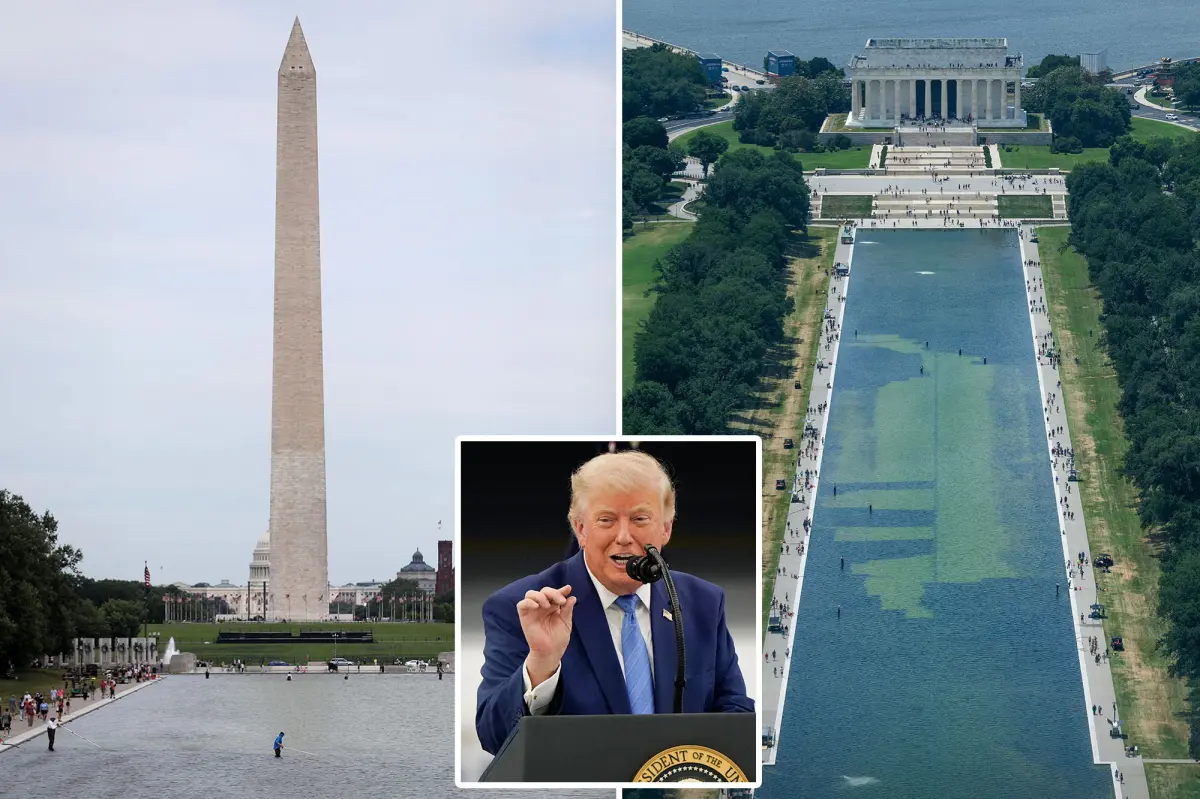
The National Mall in Washington, D.C., has long stood as the emotional and historical heartbeat of the American republic, a grand, open-air cathedral of democracy where millions of citizens and travelers from every corner of the globe gather to reflect on the nation’s tumultuous yet inspiring journey. At the absolute center of this iconic landscape lies the Lincoln Memorial Reflecting Pool, a historic body of water that has mirrored some of the most transformative, poignant moments in modern history, from Dr. Martin Luther King Jr.’s revolutionary dream to countless historic gatherings of hope, protest, and shared humanity. Recently, this sacred civic fixture underwent a highly anticipated, meticulous $14.8 million restoration project, engineered to breathe new life into its aging, weathered infrastructure and restore its visual splendor to a brilliant, pristine shine that would capture the surrounding monuments perfectly. Yet, only weeks after the ribbon-cutting ceremony celebrated this massive, taxpayer-funded investment in national heritage, a shadow of unexpected controversy and alleged criminal mischief descended upon the monument. President Donald Trump took to social media to voice grave concerns, revealing to the public that the newly renovated pool had recently fallen victim to a series of malicious acts of vandalism. Trump deeply lamented the physical damage, framing it not merely as simple property destruction, but as a direct, disrespectful assault on the collective pride and beauty of the nation’s capital itself. In his public statements, Trump connected the incident to a broader narrative of civic order and administration success, proudly asserting that under his leadership, Washington, D.C., had transitioned from a city once plagued by rampant, uncontrollable crime into one of the safest municipal areas anywhere in the United States. This jarring juxtaposition of beautifully executed civic renewal and sudden, politically charged desecration has sparked a passionate nationwide conversation, forcing everyday citizens, public officials, and passing tourists to grapple with how such an esteemed, unifying public space could become a modern canvas for hostility, anger, and social division.
The specific details surrounding the alleged vandalism paint a highly troubling and calculated picture of deliberate harm targeted at the meticulous artistry of the restoration team. According to President Trump and subsequent local administrative reports, the perpetrators did not merely commit random, opportunistic acts of spray paint; instead, they systematically targeted both the organic and synthetic elements of the site, causing noticeable, ugly damage to the lush greensward bordering the water, while utilizing corrosive chemical agents to intentionally compromise the pool’s freshly applied, specialized interior coating. The use of chemical agents on the reflecting pool’s newly minted surface bears a chilling, highly suggestive similarity to a separate incident that occurred just a week prior along the National Mall, where a large, enigmatic message reading “86 47” was found carved and chemically etched directly into the grass between the Washington Monument and the World War II Memorial. This cryptic, highly visible inscription was quickly interpreted by administration officials as a threatening, targeted political statement, given that the phrase “86” is a widely recognized slang term for ejecting, discarding, or permanently eliminating something, while “47” serves as a direct, indisputable reference to Trump’s current status as the nation’s 47th president. This deliberate act of grass destruction requires extensive re-seeding and soil rehabilitation, creating an additional burden for the dedicated groundkeepers of the National Park Service who pour their hearts into maintaining these grounds. The psychological and social impact of these acts on the public consciousness cannot be understated, as they represent a physical, permanent manifestation of the deeply polarized, toxic political climate that currently defines the contemporary American landscape. For many everyday observers, witnessing the destruction of public lawns and the calculated scarring of a brand-new, multi-million dollar monument surface evokes a profound sense of exhaustion and sadness, illustrating how the physical spaces built to honor our shared history have increasingly been weaponized into battlegrounds for partisan defiance, ideological warfare, and bitter, unyielding resistance.
Compounding the intense frustration of this deliberate human vandalism is an unexpected, stubborn ecological battle that has plagued the reflecting pool’s pristine waters since its grand reopening. Almost immediately after the massive $14.8 million rejuvenation project was declared officially complete on June 6, nature launched its own unintentional, biological assault on the structure in the form of a massive, rapid, and unsightly algae bloom. This vibrant, deep-hued “American flag blue” paint that had been carefully selected and applied to coat the pool’s bottom to mimic the sky was quickly obscured by a thick, murky, and unappealing blanket of green organic growth, while reports of early peeling paint added to the aesthetic disappointment. The intense summer heat beating down on the stagnant water provided the perfect breeding ground for these microscopic organisms, quickly turning a symbol of national pride into an embarrassing green swamp. This dual crisis of human-caused damage and biological overgrowth forced the National Park Service and specialized environmental engineering contractors into immediate, round-the-clock action, launching a high-tech environmental rescue mission to reclaim the pool’s clarity and dignity. Groundskeeper crews and aquatic preservation specialists deployed an array of sophisticated treatments, including a state-of-the-art network of ozone nanobubbles and specialized eco-friendly chemical agents designed to quickly break down the algae without compromising the delicate ecological balance of the historical area. Dedicated workers clad in protective gear could be seen utilizing massive, industrial-strength swimming-pool vacuums, moving slowly and methodically across the vast, shining expanse of the pool to physically extract the stubborn, clinging layers of debris from the delicate bottom surface. The National Park Service was quick to issue public statements reassuring a concerned and highly critical public that these intensive intervention measures posed absolutely no threat to local wildlife, marine organisms, or the surrounding environment, highlighting the delicate, challenging dance between modern technological maintenance, historical preservation, and responsible ecological stewardship.
In the midst of this highly publicized, visually dramatic crisis, President Trump remained characteristically vocal and actively involved, utilizing his substantial platform on Truth Social to provide detailed updates and directly influence the unfolding public narrative. Trump assured his followers and the broader American public that the environmental and physical setbacks were being aggressively, professionally addressed, noting with a sense of optimism that the intensive algae eradication efforts had already successfully resolved approximately seventy-five percent of the overgrowth. He promised that the visual state of the reflecting pool would soon be entirely remedied, and sought to downplay the long-term impact of the vandalism by reassuringly characterizing it as a relatively small, concentrated area of physical damage that would be completely repaired and repainted by the target of the following week. This direct method of communication bypasses traditional media filters, allowing him to connect directly with citizens who are deeply concerned about the upkeep of our national heritage. However, underneath these upbeat, practical reassurances lies a deeper, highly calculated political subtext, as Trump used the opportunity to emphasize that federal law enforcement was taking the security breach incredibly seriously and would not tolerate further disruptions. By framing the physical vandalism as a direct, malicious attack on “our beautiful work,” Trump underscored a deeply personal, protective connection to the capital’s physical restoration projects, positioning the maintenance of these national monuments as a cornerstone of his executive legacy and political strength. This rhetoric highlights a fascinating, universal human dynamic: how physical architecture and the cleanliness of public landmarks are often utilized by political leaders as tangible proof of their governance, order, and national pride, making any blemish on those structures feel like a direct, personal challenge to their authority. He seeks to show that his administration is one of action, capable of instantly mobilizing federal resources to correct errors and protect national treasures from bad actors.
The everyday atmosphere on the ground at the National Mall has shifted dramatically and visibly in response to these parallel events, transforming a traditionally serene, peaceful place of quiet contemplation into a highly charged, visually jarring security zone. Visitors arriving from all over the world to pay their respects at the Lincoln Memorial are now greeted by the sobering, unexpected sight of uniform-clad National Guard personnel and U.S. Park Police officers actively patrolling the perimeter, their armed presence serving as a stark, daily reminder of the underlying tensions gripping the capital. These young guardsmen, standing watch under the sweltering Washington sun, find themselves answering tourist questions about security rather than history, transforming the tourist experience into an encounter with active civil defense. The reaction from the public gathered at the scene has been deeply and vividly divided, perfectly reflecting the fragmented, highly emotional state of the nation itself. While many tourists and patriotic visitors look on with genuine dismay and quiet sadness, expressing their disappointment that a classic symbol of national unity has been so easily defaced and diminished, videos circulating widely on social media show other groups of outspoken onlookers gathering near the water to openly criticize the expensive renovation project, with some even mockingly celebrating the stubborn algae growth as a hilarious symbol of administrative failure and hubris. This deep polarization highlights a profound human truth: in times of intense national political discord, even a simple body of water, a coat of blue paint, and a patch of grass can become screens upon which citizens project their deepest frustrations, hopes, and political resentments. The sight of armed federal security forces watching over a reflecting pool originally designed to promote peace, civil rights, and reflection is a potent, bittersweet image of our current historical moment, showcasing how easily our shared, sacred civic spaces can become militarized when public trust begins to erode.
Ultimately, the ongoing, multi-layered saga of the Lincoln Memorial Reflecting Pool—with its complex tapestry of multi-million dollar federal investments, sudden targeted vandalism, frustrating ecological struggles, and heavy-handed physical security—serves as a powerful, unavoidable metaphor for the modern American experiment itself. These grand historical monuments are far more than mere passive arrangements of concrete, stone, paint, and water; they are living, breathing repositories of our collective national identity, designed specifically to withstand both the natural elements and the unpredictable passage of time. Throughout its century-long existence, the pool has seen crises before, yet it has always managed to endure as a theater of American progress. When we look closely at the modern struggles to keep the reflecting pool clean, clear, and safe from harm, we are looking directly into a mirror of our own ongoing societal efforts to maintain civil discourse, respect historical legacies, and protect the fragile public institutions that hold an incredibly diverse nation together. As the National Park Service works diligently to repair the physical scars of chemical damage and permanently eradicate the lingering green algae, there remains a tangible, resilient hope that the pool will soon return to its rightful state as a clear, uninterrupted mirror reflecting the vast sky and the grand monuments of democracy. The true, enduring test of the nation, however, lies not in our ability to chemically scrub a concrete basin or deploy armed security forces to guard a public lawn, but in our collective capacity as citizens to look into that watery reflection and recognize our shared, sacred responsibility to preserve, protect, and respect the common ground that defines us all. Until that deeper, internal cultural reclamation occurs, the Reflecting Pool will continue to reflect not just our sky, but our struggles, standing as a silent, beautiful witness to a nation constantly striving to find its clarity and common purpose for future generations.