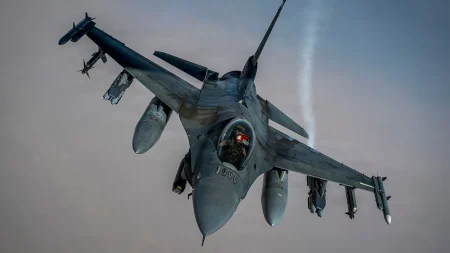



Silent Alarm: U.S. Warnings That an F-35 Sale to Saudi Arabia Could Hand China the Crown Jewels of Airpower
Inside the closed world of American intelligence, a troubling assessment has been circulating in internal reports: if the United States approves the sale of F-35 fighter jets to Saudi Arabia, Beijing may find a way to get its hands on the most closely guarded secrets in the U.S. defense arsenal. The warning, delivered in quiet but unmistakable terms, is creating new friction in a high-stakes diplomatic and military calculation that reaches far beyond the Middle East. For decades, the F-35 Lightning II has been described as the most advanced fighter aircraft ever built—a flying supercomputer with stealth capabilities, fused sensors, and network-enabled warfare technologies that no other nation has managed to replicate. The idea of that technology landing in a country with growing economic and military ties to China is enough to give Pentagon planners and security officials a serious case of sleepless nights. And the intelligence community is now saying, in explicit internal analyses, that the risk is not theoretical. It is real, it is urgent, and it could reshape the global balance of airpower for a generation.
The reports point to a scenario that some officials have privately described as a nightmare: China, through espionage, cyber intrusion, or industrial leverage, could acquire or steal sensitive U.S. warplane technology if F-35 jets are sent to Saudi Arabia. The concern is not simply that a foreign nation might copy the jet’s external shape. Rather, it is that the F-35’s true value lies deep inside its systems—its mission software, radar cross-section controls, data fusion algorithms, advanced jamming capacity, and the intricate network architecture that links every aircraft to a broader battlefield matrix. Those capabilities are the product of more than two decades of research, testing, and engineering that cost the United States hundreds of billions of dollars. Losing even parts of that intellectual heritage could give China new insight into how to counter U.S. superiority in the skies, accelerate its own stealth fighter programs, and potentially close a gap that Washington has relied on for decades. Internal intelligence assessments reportedly emphasize that Saudi Arabia does not currently have full control over the security environment in which such aircraft would be operated, maintained, and stored—and that a number of individuals with access to sensitive military systems could become targets for coercion, financial inducement, or ideological recruitment. The intelligence community’s job is to think about worst-case scenarios, and in this case, the worst case is not distant or improbable.
Part of what makes the warning so significant is the changing nature of U.S.-Saudi relations. Riyadh has long been one of Washington’s most important allies in the Arab world, a major buyer of American arms, and a strategic anchor for U.S. military operations in the region. At the same time, Saudi Arabia has been walking a more independent path in recent years. It has expanded diplomatic and security cooperation with Beijing, deepened energy partnerships with China’s state-owned enterprises, and even conducted joint military exercises with Chinese forces. That growing proximity has not gone unnoticed in Washington. U.S. intelligence agencies have watched for years as China has built its influence across the Middle East, quietly installing technological footholds, expanding arms sales, and positioning itself as a credible alternative to the United States for countries that want to diversify their partnerships. In this context, placing the F-35 in Saudi hands is not the same as selling it to a fully integrated U.S. ally with tightening export controls and allied security frameworks. It is, as one analyst put it, an invitation to a party where someone is already slipping the keys to a safe through the window. The internal reports are said to examine not only Chinese cyber capabilities but also the ability of Chinese intelligence operatives to gain access to maintenance facilities, airbases, or support staff through commercial contracts and joint ventures. Any effective F-35 force requires a delicate ecosystem of maintenance software, diagnostic systems, logistics support, and spare-parts supply chains, and many of those functions can be outsourced or performed by contractors. In an environment where Chinese companies are already active in Saudi infrastructure, data centers, and communications networks, the margins for error are dangerously thin.
The geopolitical timing only adds to the complexity. The proposed F-35 sale is widely seen as part of a broader effort by the Biden administration and its diplomatic partners to reshape the Middle East—using arms sales and security guarantees as leverage to encourage Saudi Arabia to formally normalize relations with Israel, contain Iran, and move the region toward a more stable, U.S.-led security architecture. The F-35 is one of the most valuable bargaining chips Washington has. It is not just a weapon; it is a symbol of alliance, trust, and strategic commitment. Selling it to Riyadh would signal a new level of confidence in the Saudi leadership and could help secure a historic diplomatic breakthrough. But the intelligence community’s warnings complicate that narrative. They raise a fundamental question: what is worth more, a diplomatic agreement or the technological edge that has kept U.S. pilots safe in contested airspace for twenty years? Israel, too, has watched the debate with considerable concern. The Israeli Air Force operates its own F-35 fleet, the only one in the Middle East, and Israeli officials have kept a close eye on any discussions about expanding the aircraft’s presence in the region. While Israel and Saudi Arabia have made quiet and significant progress in normalizing relations, the strategic reality of the region remains fragile. An F-35 in Saudi hands could alter the balance of power in ways that are not easy to predict. Israeli security officials have not publicly opposed the sale, but their silence is not the same as comfort. They understand the same thing that U.S. intelligence officials do: the F-35 is a game-changing platform, and once its secrets are shared, there is no way to take them back.
The broader context of Chinese technology theft cannot be ignored. U.S. law enforcement and intelligence agencies have spent years investigating Chinese efforts to steal American defense technology, from missile designs to aircraft radar systems to submarine propulsion technologies. The Chinese defense industry has benefited significantly from a patient, methodical, and often highly successful campaign of cyber espionage and human intelligence gathering, and U.S. officials have repeatedly expressed alarm at the speed with which Chinese platforms have advanced. The development of China’s J-20 and J-31 stealth fighters, for example, raised eyebrows among Western analysts because of the apparent sophistication of their design and the speed of their evolution. In some cases, investigators believe that Chinese engineers have used stolen data to shortcut years of research. The F-35 is the richest target in America’s aviation history. Its systems contain code worth billions of dollars in research and development, and if even a fraction of that code were to fall into Chinese hands, the consequences would be enormous. Once Chinese industry has access to U.S. stealth coatings, radar-absorbing materials, sensor algorithms, and operational software architecture, American aerial advantage would be increasingly difficult to maintain. The United States could spend more money to develop new fighters, but the cycle of theft and adaptation would continue, potentially leading to a situation where Chinese aircraft approach parity not through independent innovation but through direct inspiration from American secrets. The intelligence reports warning against the F-35 sale to Saudi Arabia are, in this sense, part of a much longer and more troubling pattern.
So where does all of this leave the decision? The White House and the Pentagon are now in a difficult position. There is substantial pressure from Saudi Arabia to finalize the sale, and Riyadh has made clear that the F-35 is at the top of its procurement list. There is also significant support from the U.S. defense industry, which sees the sale as a multibillion-dollar business opportunity that would sustain manufacturing lines, create jobs, and deepen a strategic relationship with a major regional power. But Congress had already raised concerns about defense technology transfers in the past, particularly when it comes to China’s presence in the region. Some lawmakers have pushed for strict end-use agreements, continuous monitoring, and prohibitions on any Saudi maintenance work involving Chinese nationals. Others believe that such safeguards are easy to write on paper but difficult to enforce on the ground. The intelligence community’s internal reports have strengthened the hand of those urging caution, but they have not shut the door completely. In the coming months, U.S. officials will have to decide whether the potential diplomatic and strategic benefits of the F-35 sale are worth the grave risks outlined in those classified pages. It is a decision that goes to the heart of American national security policy—balancing sales, alliances, and technological stewardship against the reality that some secrets, once shared, are never really kept. As the world watches, the answer to this question will not only determine the future of the F-35 but also send a clear message about what America truly values most: short-term influence or long-term supremacy at the cutting edge of war. One thing is certain. The intelligence community has issued its warning. The rest remains in the hands of those who must decide whether to listen.