





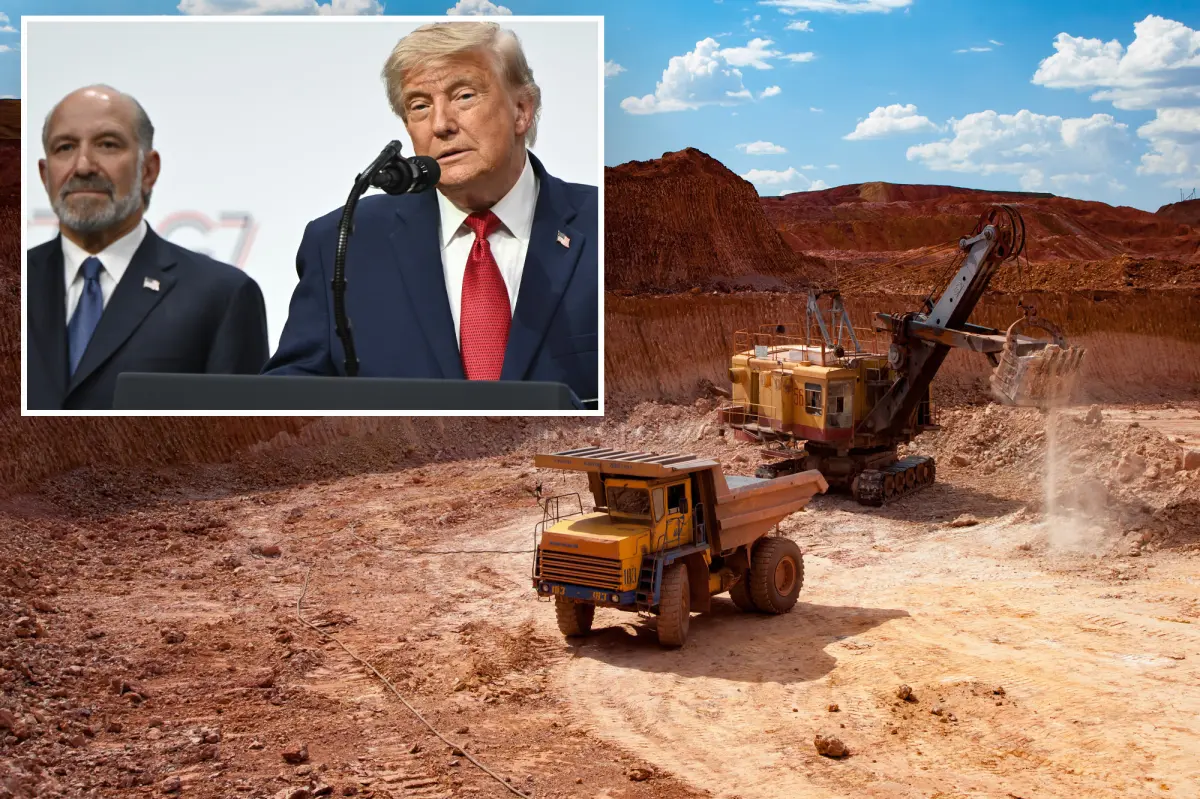
In the remote, wind-swept landscapes of Kazakhstan lies one of the world’s most prized and untouched geologic treasures: a massive reserve of tungsten, a hyper-durable metal essential for fabricating modern microchips, ballistic missiles, and advanced fighter jets. For years, western defense strategists have warned of the dangers of relying on foreign adversaries for such critical minerals, sparking a quiet global race to secure these supply chains. Yet, a recent $1.6 billion mining agreement brokered between the United States and Kazakhstan has illuminated a parallel, highly lucrative convergence of public diplomacy and private family enterprise. According to a striking new report, the monumental deal did more than just bolster American defense infrastructure; it also positioned the adult sons of President Donald Trump and Commerce Secretary Howard Lutnick to reap significant financial windfalls through private investment firms closely tied to their families, raising profound questions about the boundaries of presidential influence, corporate ethics, and family enrichment during Trump’s second term in the White House.
The architecture of this massive deal began taking shape in the luxury suites of Manhattan last autumn, culminating in a dramatic piece of high-stakes diplomacy that bridged the gap between official state business and private commerce. As the United States aggressively sought to decouple its critical infrastructure from Chinese monopolies, Commerce Secretary Howard Lutnick took a leading role, heavily lobbying Kazakhstan’s President Kassym-Jomart Tokayev to award the coveted tungsten contract to Kaz Resources. Lutnick went so far as to write an official letter to the Kazakh leader stating that the Trump administration “fully supports” the mining company and its executive chairman, Pini Althaus. The diplomatic press culminated in September when Tokayev arrived in New York to negotiate at the St. Regis hotel. In a moment that blurred the lines of traditional diplomacy, President Trump himself personally phoned into the high-level meeting to hammer out the final details and cement the geopolitical partnership, proving once again his hands-on approach to international dealmaking.
Behind the scenes of this geopolitical triumph, the financial gears of the Trump family’s private enterprises were turning in perfect lockstep with the administration’s foreign policy. Housed within the gilded, high-security walls of Trump Tower, a boutique investment firm named Dominari Securities—partially owned by the president’s eldest sons, Donald Trump Jr. and Eric Trump—actively positioned itself to capitalize on the emerging deal. Merely six days before the official, state-sanctioned contract was signed on November 6, Dominari joined forces with a select group of investors to acquire a lucrative 20% stake in an entity directly linked to the Kazakhstan mining project. Though both Donald Jr. and Eric Trump were recently hired as highly paid advisers to the firm, and stand to benefit directly from its success, Eric Trump dismissed any notions of impropriety, asserting that he has always maintained the status of a completely “passive investor” who was entirely uninvolved in the day-to-day mechanics of the deal.
Simultaneously, another financial dynasty closely aligned with the administration was mapping out its own path to profit from the federal mineral initiative. Cantor Fitzgerald, the legendary Wall Street investment powerhouse controlled by Howard Lutnick’s family, mobilized its immense financial resources to support the venture. Under the guidance of Lutnick’s sons, Brandon and Kyle Lutnick, the firm stepped in to help one of the lead investors working with Dominari raise a staggering $210 million in fresh capital to jumpstart the mining project. While the $1.6 billion in promised government support has yet to be fully distributed, federal filings indicate that both Dominari and Cantor Fitzgerald have already secured substantial, lucrative transaction fees for their indispensable roles in organizing the capital. Representatives for Cantor Fitzgerald defended their actions by asserting that the firm’s involvement was strictly confined to public market capital raises, completely independent of any direct policy negotiations with the Trump administration.
In defense of these intertwined transactions, the White House has maintained a steadfast narrative of national security, patriotism, and strategic resource independence. White House spokesman Kush Desai forcefully dismissed concerns of nepotism or self-dealing, telling reporters that the sole guiding force behind the administration’s actions is the protection and advancement of the American people’s interests. Desai emphasized that securing critical minerals is a vital national security imperative to counter the rising industrial dominance of China. In a separate effort to distance the Commerce Secretary from his family’s business dealings, representatives for the Commerce Department stated that Howard Lutnick had previously sold his ownership stake in Cantor Fitzgerald and had absolutely no communication with the firm regarding the rare earth minerals project. Even Pini Althaus, the executive chairman of Kaz Resources, maintained that he had never met the Trump brothers during his search for investors, though he candidly acknowledged that the optics of the situation might naturally appear disturbing to observers.
Ultimately, the unfolding narrative of the Kazakh mining deal serves as a vivid case study of a new era of governance, where the pursuit of vital national security objectives and the generation of generational family wealth have become profoundly integrated. To critics, the rapid financial alignments of Dominari Securities and Cantor Fitzgerald around a state-sponsored contract represent a concerning erosion of the traditional ethical guardrails meant to separate public service from private gain. To supporters, it reflects a pragmatic, business-first approach to governance where America’s strategic interests are secured through the highly efficient machinery of private enterprise. As the tungsten mines of Kazakhstan prepare to fuel the next generation of American defenses, the deal stands as a monument to a political landscape where the boundaries of family, finance, and foreign policy are increasingly indistinguishable, leaving the public to ponder the true cost of national security in a hyper-monetized world.