



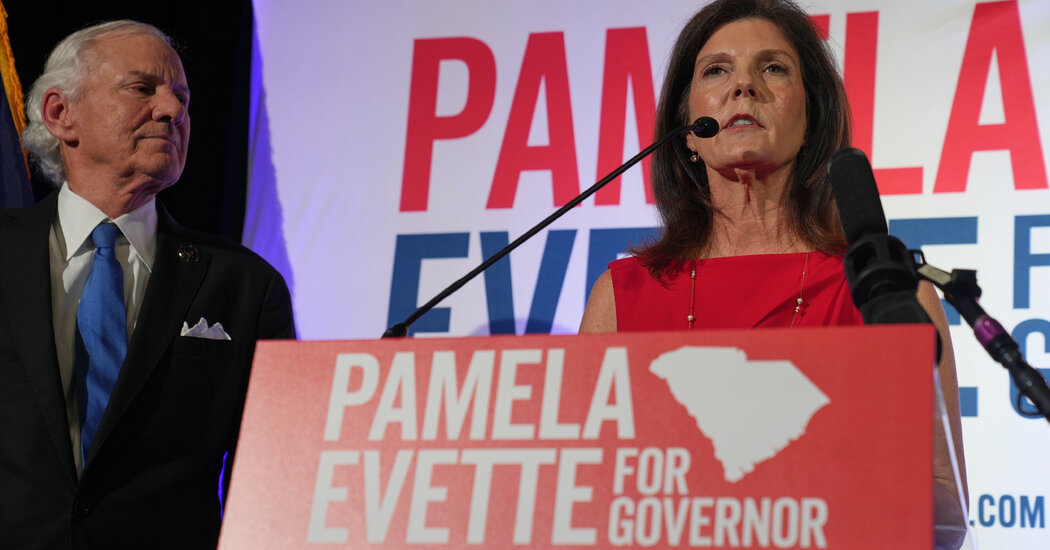
The political landscape of South Carolina, already simmering with Southern heat and high-stakes ambition, was completely upended on a Friday when former President Donald J. Trump delivered a massive endorsement to the state’s Lieutenant Governor, Pamela Evette, in her bid to become the next governor. For months, the crowded Republican primary had been defined by a quiet, anxious waiting game, with candidates holding their breath for a sign from Mar-a-Lago that could instantly reshape their political futures and alter the trajectory of their careers. When the declaration finally flashed across screens via Trump’s Truth Social platform, it felt like a sudden, electrifying clap of thunder, anointing Evette as a “good friend, fighter, and WINNER” in a crowded field of hopefuls. The reaction from Evette’s camp was not just one of professional relief, but of deep, personal validation that resonated on an emotional level. In a public response that highlighted the intensely personal nature of modern political loyalty, Evette traced her entire political awakening back to a single, iconic moment: Trump’s famous 2015 descent down the golden escalator. For her, that televised moment was the catalyst that propelled a private businesswoman into the raucous and unforgiving arena of Southern public service, making this endorsement feel less like a standard political transaction and more like a profound, full-circle culmination of her life’s journey. By receiving this golden ticket, Evette was instantly thrust to the front of a chaotic pack, her campaign injected with the formidable momentum of the Trump brand at a time when early voting was already underway. Yet, the endorsement also served as a stark, humanizing reminder of the immense gravity of Trump’s influence in South Carolina, where his word alone can elevate an underdog, terrify seasoned rivals, and dictate executive power. For Evette, the endorsement is both a protective shield and an immense responsibility, setting up a high-stakes drama where her political survival is now inextricably bound to her unwavering defense of the former president’s legacy, policies, and vision for the American future.
This monumental endorsement arrived at an incredibly tense moment in South Carolina’s legislative history, occurring just days after state lawmakers adjourned an emotionally draining and contentious special session without passing a controversial new congressional map. The redistricting battle had become a crucible of deep racial and partisan tension, aimed squarely at dismantling the state’s sole majority-Black district to secure a permanently red, uninterrupted Republican congressional delegation in Washington. Driven by a wave of similar actions across conservative Southern states emboldened by the Supreme Court’s recent erosion of the landmark Voting Rights Act, the mapping effort was a high-priority mission for the party’s right wing, who saw it as an essential tool for survival. Pamela Evette had positioned herself at the vanguard of this aggressive redistricting push, championing the redrawn lines as a necessary step to consolidate conservative power, even as civil rights organizers and local citizens warned of the systemic disenfranchisement of minority voters. However, the legislative machinery buckled under pressure when the State Senate failed to reach a consensus, retreating from the vote out of a sudden panic that the dramatic boundary changes might backfire politically, trigger insurmountable legal challenges under constitutional law, or confuse voters who had already begun submitting their ballots. This legislative collapse was a bitter pill for hardline state Republicans who had hoped to deliver a clean redistricting victory to their national leaders ahead of the elections. By stepping forward to endorse Evette in the immediate aftermath of this legislative shipwreck, Trump signaled a clear and robust defense of her aggressive tactics, effectively validating her willingness to fight dirty on the redistricting front lines despite the ultimate failure of the bill. In doing so, Trump transformed a legislative defeat into a badge of courage for Evette, reframing her as a relentless crusader who was unafraid to challenge the status quo, even when her colleagues in the legislature blinked in the face of public scrutiny and systemic pushback.
Trump’s endorsement did not just disrupt the candidate field; it also reinforced a deeply entrenched political dynasty by aligning squarely with the wishes of South Carolina’s current governor, Henry McMaster. McMaster, a veteran of the state’s traditional political establishment who is barred from seeking reelection due to strict term limits, has long made it clear to donors and voters alike that he views Evette as his natural and rightful successor to the governor’s mansion in Columbia. The alliance between McMaster and Trump is historic and deeply personal, dating back to when McMaster was the first statewide elected official in the nation to endorse Trump’s initial presidential run in 2016, a loyalty that Trump has clearly cherished and never forgotten. In a fascinating twist of dynastic maneuvering that surprised many political observers, Trump’s endorsement statement went beyond merely backing Evette, taking the unusual step of publicly suggesting that she choose Henry McMaster Jr., the current governor’s son, as her running mate for lieutenant governor. This move represents a highly calculated effort to preserve the state’s existing power structure, binding the McMaster name, the Evette campaign, and the Trump brand into a singular, powerhouse coalition of political power. For the younger McMaster, this public nod is a golden opportunity to ascend the political ladder under the protection of the state’s most powerful figures without having to fight through the mud of a typical campaign. For Evette, accepting this arrangement solidifies her status as the institutional heir apparent, backed by the full weight of the state house machine and elite donors. However, this dynastic coordination also exposes her to sharp criticisms of backroom elitism and nepotism, forcing her to carefully balance her image as an independent, self-made female outsider with her new reality as the chosen representative of a powerful family legacy, navigating a delicate line between populist appeal and establishment coordination.
Behind the headlines of the endorsement lies a deeply stressful and psychological battle among the six candidates competing for the Republican nomination, each desperate to prove their unwavering devotion to the Trump movement. Alongside Evette, the primary features a crowded arena of heavyweights, including U.S. Representatives Ralph Norman and Nancy Mace, State Attorney General Alan Wilson, state Senator Josh Kimbrell, and former business executive Rom Reddy. With the official primary scheduled for June 9 and early voting already underway, the campaign has taken on a frantic, borderline desperate air of performative loyalty, as policy differences between the candidates are virtually nonexistent, leaving personal fealty to Trump as the primary battleground. For months, these candidates have engaged in an exhausting game of political copycat, trying to out-Trump one another through campaign aesthetics, aggressive public rhetoric, and private lobbying. Evette’s campaign materials prominently feature her standing proudly side-by-side with Trump, a visual cue meant to signal her insider status and secure the trust of conservative voters. Not to be outdone, Attorney General Alan Wilson’s campaign website features a bold, heavily produced section titled “Trump Tough,” highlighting a slideshow of his personal meetings with the former president and a detailed listing of his legal battles defending Trump’s federal policies against Democratic challenges. This level of performative validation showcases the intense vulnerability these politicians feel; in today’s Republican party, failing to secure the master’s blessing, or worse, being perceived as lukewarm toward his agenda, can spell immediate political death. As early ballots began trickling in, the candidates knew that a failure to win a decisive majority on June 9 would lead to a grueling, high-pressure runoff election later in the month, magnifying the desperation to land a knockout blow before voters had even finished reading the ballot.
Nowhere was this desperation and personal animosity more apparent than in the public feud between Representative Nancy Mace and Pamela Evette, which reached a boiling point on social media just hours before the endorsement was announced. Mace, known for her sharp intelligence, media savvy, and combative political style, took to social media to launch a blistering preemptive strike against Evette, attempting to distance her rival from the former president. In a series of highly charged, personal posts, Mace accused Evette of misrepresenting her relationship with Trump, boldly claiming that the lieutenant governor’s handling of the failed redistricting effort had made her a persona non grata within Trump’s inner circle. Mace wrote with dripping sarcasm that after the Evette administration “royally screwed up” the redistricting fight, “absolutely no one” in the White House wanted her as governor, highlighting complete executive failure. This attack was a calculated attempt to undermine Evette’s core campaign premise, presenting her as an incompetent executive who had lost the trust of the national party leadership and could not deliver on key promises. To have those claims publicly and decisively dismantled by Trump’s glowing endorsement just hours later was a devastating psychological and political blow for Mace, exposing the limits of her combative brand of politics and her own standing with the former president. The raw public drama of this exchange humanized the immense pressure these politicians operate under, pulling back the curtain on a cutthroat world where friendships are fleeting, alliances are transactional, and a single social media post can find itself instantly contradicted by a decree from Mar-a-Lago, leaving candidates exposed to public embarrassment on the national stage while supporters look on in disbelief.
Ultimately, as the political elite in Columbia and Palm Beach trade endorsements and social media barbs, the true weight of this political drama falls upon the everyday citizens of South Carolina, who are left to navigate a fractured electoral landscape. Voters heading to the early voting booths are doing so under a cloud of systemic confusion, unsure of the long-term future of their representative districts after the sudden collapse of the map-redrawing effort. For the state’s Black communities, the high-stakes fight over congressional lines was not just a game of partisan chess, but a very real, deeply emotional battle for their constitutional voice and representation in Washington, a struggle that has now been temporarily paused but remains deeply unresolved for families across the state. As the June 9 primary approaches, the citizens of South Carolina must decide whether they endorse pure personal loyalty to a national figurehead or if they prioritize localized governance, economic development, and the tedious but essential work of state policy. With a potential runoff looming in late June, the campaign promises to become even more personal, expensive, and divisive, testing the emotional endurance of an electorate already weary of perpetual campaign cycles and mudslinging. Donald Trump’s endorsement has undoubtedly reshaped the race, turning a local gubernatorial primary into a high-stakes national referendum on his personal influence and the future direction of the Republican party in the American South. Whether Pamela Evette can successfully translate this high-profile blessing into a governing majority remains to be seen, but for now, the state of South Carolina finds itself once again at the center of a national storm, where the boundaries of democracy, dynasty, and personal loyalty are being redrawn in real-time.