





A Seismic Shift in South America: The Rise of De La Espriella
As the final, agonizingly close tallies flickered across television screens late Sunday evening, the collective breath of a fractured nation finally gave way to a deafening, discordant roar. Abelardo De La Espriella, a flamboyant criminal defense attorney with a history of representing controversial figures and absolutely no traditional political pedigree, secured a razor-thin victory in Colombia’s presidential election, capturing 49.7 percent of the vote with more than 99 percent of ballots processed. His progressive rival, Iván Cepeda—a veteran senator and human rights champion—trailed by a mere percentage point at 48.7 percent, highlighting the deepest ideological chasm the country has witnessed in modern history. The razor-thin victory marks an immediate, dramatic end to the four-year left-wing administration of Gustavo Petro, Colombia’s first leftist president, and places the Andean nation firmly at the vanguard of a sweeping rightward shift across Latin America. This conservative resurgence, bolstered by a crucial endorsement from Donald Trump during his second term in Washington, triggered immediate, chaotic celebrations across the capital city of Bogotá. While a defiant Petro cautioned on social media that the results remained preliminary until undergoing rigorous legal scrutiny, the streets were already alive with the blare of vuvuzelas, honking horns, and a rising chorus of “Out with Petro” that signaled a profound, irreversible shift in the nation’s political landscape.
From Miami High Life to Populist Phenomenon: The Making of an Outsider
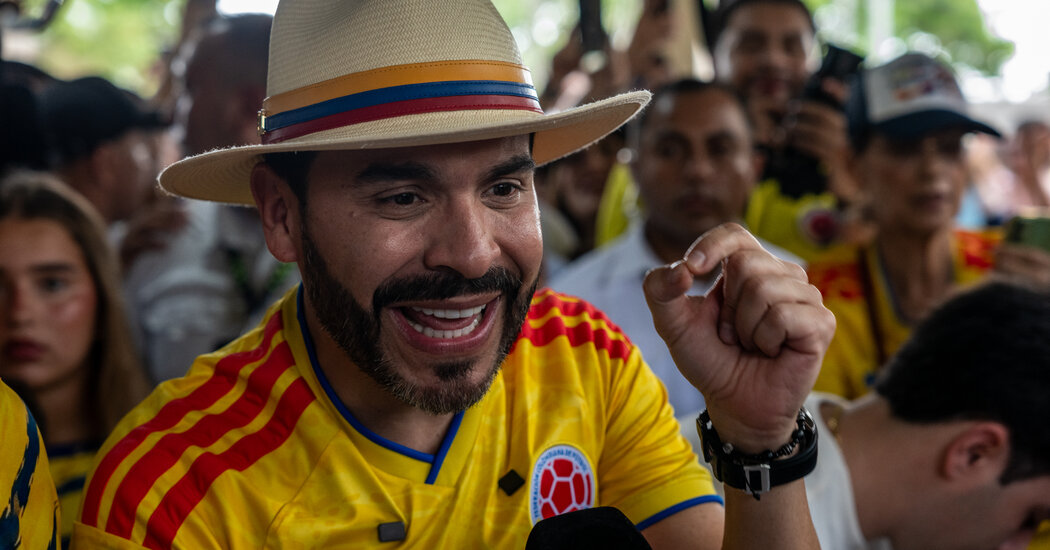
The meteoric ascent of the 47-year-old De La Espriella represents a masterclass in modern, hyper-visual political showmanship, showcasing a candidate who effortlessly traded the refined luxuries of his former life for the grit of populist campaigning. Before launching his bid for the Casa de Nariño, he was known to the public as a flamboyant, opera-singing bon vivant, an attorney who proudly represented high-profile figures embroiled in corruption, drug trafficking, and paramilitary scandals—taking only the cases that, in his own words, gave him “vertigo.” He once sang Italian classical hits on self-produced albums, dined on sushi aboard private jets in high-concept music videos, and established a commercial empire that spanned luxury watches, custom tailoring, and premium Caribbean rum. Yet, to connect with an angry, struggling electorate, De La Espriella executed a stunning aesthetic pivot, swapping his tailored double-breasted suits for the yellow jersey of Colombia’s national soccer team and a rustic straw hat. His campaign utilized advanced artificial intelligence, generating viral videos of predatory tigers—his chosen political mascot—alongside high-voltage rally production featuring literal, machine-generated flames. By circumventing traditional political elites and utilizing social media to broadcast everything from intense daily workouts to family prayers directly to voters’ cellphones, he transformed himself from a Miami-based legal insider into an anti-establishment force of nature.
The Iron-Fist Blueprint: Borrowing from Bukele and Milei
To address the deep-seated anxieties of a population weary of economic instability and rising crime, De La Espriella constructed an aggressive platform that drew heavily from the successful strategies of other regional heavyweights, notably El Salvador’s Nayib Bukele and Argentina’s Javier Milei. Campaigning under the fiercely nationalistic slogan “Firme por la patria!” (“Standing firm for the homeland!”), he focused his energy on urban centers where small business owners have been crippled by systemic extortion, tapping into terrifying memories of the country’s dark history of urban bombings and kidnappings. His promises were unapologetically severe: he vowed to dismantle progressive social policies, combat “gender ideology” in favor of traditional religious family values, and build sprawling megaprisons to isolate what he termed “narcoterrorists”—a highly charged phrase borrowed directly from the political vocabulary of Donald Trump. This radical rhetoric, coupled with his ominous promises to “disembowel” left-wing political structures in Colombia, drew intense criticism from human rights advocates who openly warned of a slide toward autocracy and military-style governance. Yet, for an electorate traumatized by a violent campaign cycle that claimed the lives of another conservative presidential contender and two of De La Espriella’s own campaign staff, his decision to deliver fiery speeches from behind thick, bulletproof glass while clad in tactical vests only added to his image as a fearless defender of a collapsing state.
The Washington Pipeline: Dual Citizenship and Geopolitical Alliances
Beneath the domestic, flag-waving patriotism of De La Espriella’s campaign layout lay a highly sophisticated networks of influence centered in the United States, where he lived for over a decade and obtained dual citizenship in 2023. While he carefully avoided displaying American symbols or MAGA hats at his local rallies to preserve his nationalist credentials, he regularly traveled to Florida to secure political support from influential Republican lawmakers, the powerful Colombian diaspora, and Donald Trump himself. His vision for Colombia’s future relies heavily on integrating the nation into a new, U.S.-led military coalition designed to aggressively target transnational drug cartels, a partnership he argues will revitalize foreign investment and mend the diplomatic divisions created during the Petro administration. However, this close alignment with Washington has also raised alarming questions about the weaponization of foreign power against his domestic opponents. The chilling reality of this geopolitical dynamic was brought into sharp focus just days before the election, when American authorities in Arizona detained Beto Coral, a prominent Colombian activist and outspoken critic of De La Espriella, on the very day U.S. Secretary of State Marco Rubio issued a memo arguing that Coral was deportable because his activism directly conflicted with American foreign policy priorities—a move that local critics point to as a harbinger of trans-border political suppression.
The Pragmatic Balancing Act: Reassuring the Establishment
Recognizing that his fire-breathing, anti-establishment rhetoric might alienate the crucial moderate voters needed to secure victory, De La Espriella made a calculated, brilliant decision by choosing José Manuel Restrepo as his vice-presidential running mate. Restrepo, a highly respected former commerce and finance minister, brought an invaluable aura of institutional stability, economic competence, and intellectual gravity to a campaign that many feared was too erratic. This strategic partnership created a compelling geographic and cultural synthesis: De La Espriella represented the raw, emotional, and unpredictable energy of Colombia’s sun-drenched Caribbean coast, while Restrepo embodied the serious, calculated, and elite technocratic traditions of the high-altitude capital, Bogotá. Many business owners, students, and middle-class professionals admitted that while they were deeply unnerved by De La Espriella’s threats to bury his political opponents “15 meters underground without light and water,” Restrepo’s presence on the ticket provided a reassuring guardrail. This balance convinced a critical segment of the electorate that the incoming administration would be capable of delivering necessary fiscal discipline and rolling back controversial state takeovers of the healthcare system without completely dismantling the nation’s democratic architecture.
A Fractured Nation Faces an Uncertain Horizon
As Colombia prepares for this monumental transition of power, De La Espriella faces a daunting mountain of systemic crises that will quickly test his populist appeal and aggressive governance model. He must immediately address a massive fiscal deficit left behind by his predecessor’s extensive social spending, while simultaneously confronting highly organized, armed criminal syndicates that now use advanced military technology, including surveillance and combat drones, to control profitable cocaine-trafficking routes and illicit gold mines. Furthermore, he inherits a deeply divided country where the public remains intensely polarized over his commitment to the rule of law and his threats of retribution against those who challenge his mandate. For his passionate supporters, who spent Sunday night celebrating in yellow jerseys and tiger costumes, he represents a bold, uncompromising savior capable of charting a prosperous, secure path forward. For his detractors, he remains a dangerous demagogue whose rise threatens to plunge Colombia back into a dark era of violence and state-sanctioned repression. Ultimately, as the country embarks on this volatile new chapter, a powerful mix of anxiety and hope defines the national mood, driven by a collective curiosity to see whether this singular, larger-than-life figure can truly transform his dramatic political promise into a stable, lasting reality.