





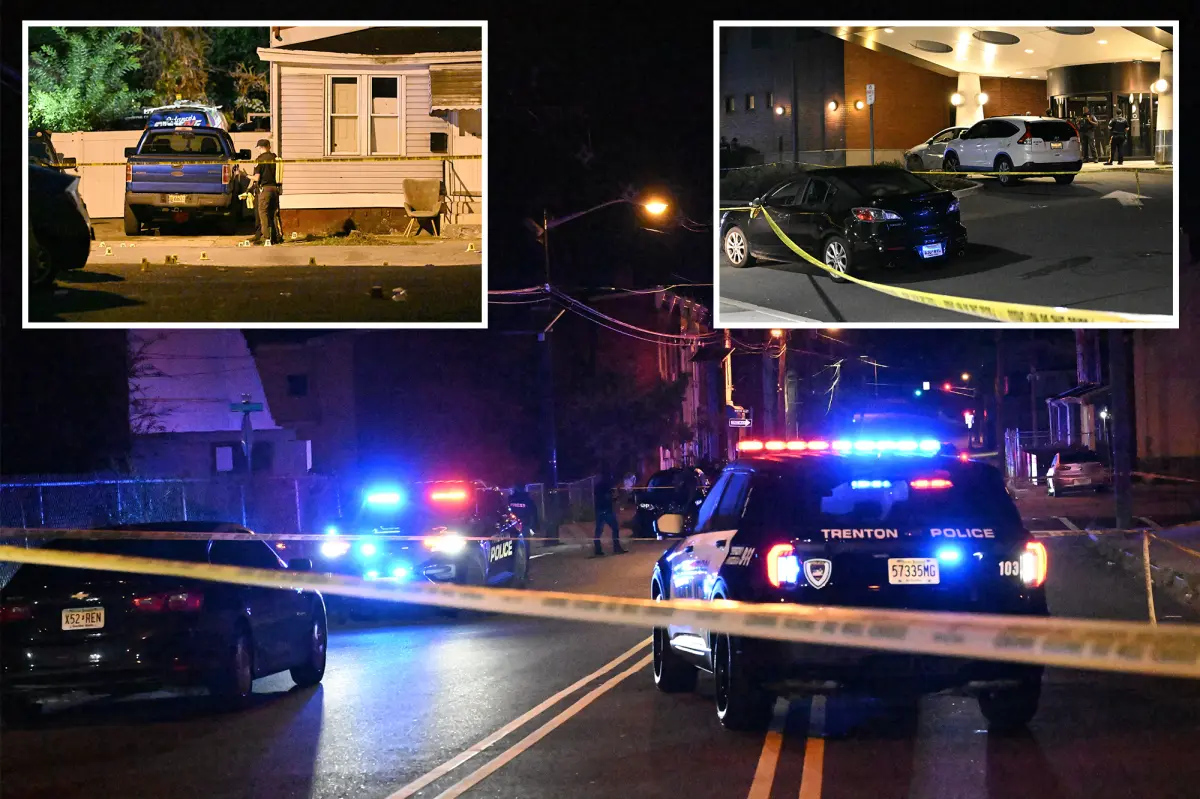
The quiet late-night stillness of a Trenton, New Jersey, neighborhood was shattered shortly after midnight on Sunday when gunfire erupted at a row house on Locust Street. Police arrived at 194 Locust Street around 12:25 a.m. after receiving multiple reports of shots fired, and what they found was a scene of devastating chaos. Two people had been killed, and eleven others were wounded. The sheer scale of the violence left first responders and neighbors struggling to process what had happened in a matter of moments. The row house, nestled among other homes in a residential area, was suddenly transformed into a crime scene, its walls and pavement stained with the evidence of tragedy. Sirens filled the night air as patrol cars and ambulances converged on the narrow street, their flashing red and blue lights casting an eerie glow over the shocked faces of residents who had been jolted from sleep. Some had heard the rapid bursts of gunfire and initially dismissed them as fireworks, only to realize the awful truth when screams followed. Others peered out of their windows to see people running, crying, and collapsing. The victims included men and women, though authorities did not immediately release their identities. The two who died were rushed to the hospital along with the others, but nothing could be done to save them. The eleven survivors were taken to Capital Health Regional Medical Center, where medical teams worked frantically through the night to treat wounds ranging from minor to critical. For the families who had not yet heard news, the hours that followed were an agonizing blur of fear, prayer, and desperate waiting. The shooting was not just a headline or a statistic. It was a rupture in the lives of dozens of people, and the beginning of a long and painful journey toward healing and justice.
In the aftermath, the human cost of the shooting became painfully visible. Outside the hospital, family members gathered, some still in their sleepwear, their faces etched with terror and confusion. They embraced one another, whispered reassurances, and waited for any word about their loved ones. Inside the emergency room, doctors and nurses worked with urgency, knowing that every second mattered. Some of the injured had been struck multiple times, and the trauma teams fought to stabilize them. The hospital waiting room filled with quiet sobs, muffled prayers, and the restless pacing of people who felt helpless. Meanwhile, back on Locust Street, investigators began the somber task of documenting the scene. Evidence markers were placed on the ground, each one representing a bullet casing, a pool of blood, or a personal belonging torn from its owner. Broken glass crunched underfoot, and the air still carried the faint smell of gunpowder. Neighbors stood behind the police tape, wrapped in blankets, staring at the row house that had always seemed so ordinary. They spoke in hushed tones about the victims, trying to piece together who had been inside and why someone would open fire. The wounded included people who may have been targeted and others who may simply have been in the wrong place at the wrong time. The exact circumstances remained unclear, and that uncertainty only deepened the community’s anxiety. Was this a personal dispute that escalated into violence? Was it a gang-related retaliation? Or was it a random act of terror that could have happened to anyone? These questions hung in the air as first responders, some of whom lived nearby, tried to separate their professional duties from their own grief and fear. The physical wounds would eventually heal, but the psychological scars would last far longer. Counselors and victim advocates began preparing to offer support, knowing that the trauma of that night would not fade quickly.
The investigation, led by the Mercer County Prosecutor’s Office Homicide Task Force, began almost immediately and promised to be complex and painstaking. Detectives arrived before dawn, moving methodically through the crime scene, searching for shell casings, DNA, fingerprints, and any other forensic evidence that could help reconstruct the events. They knocked on doors in the neighborhood, hoping to find witnesses who had seen something unusual in the hours before the shooting. Surveillance cameras from nearby homes and businesses were checked, and cellphone records were likely to be reviewed. The task force appealed to the public for tips, emphasizing that even the smallest piece of information could prove crucial in solving the case. But investigators knew that witnesses in such cases were often reluctant to come forward, fearing retaliation from those responsible. The code of silence, born of fear and distrust, is a formidable obstacle. Still, the investigators pressed on, determined to bring justice to the victims and their families. The row house at 194 Locust Street remained sealed off for hours, its windows dark and silent. In the early morning light, the neighborhood began to stir, and residents emerged to see the extent of the damage. Some stood in small groups, talking in low voices, while others simply stared, unable to find words. The investigation would likely take weeks, and there was no guarantee of a quick arrest. But the families of the dead and the survivors deserved answers, and the community deserved to feel safe again. The task force’s work was not merely about solving a crime; it was about restoring a sense of order to a neighborhood that had been violently upended.
This tragedy did not occur in isolation. Trenton, the capital of New Jersey, has long struggled with gun violence, poverty, and systemic inequality. While the city is home to vibrant communities, rich history, and resilient people, it has also borne the weight of repeated violence that has left deep scars. Shootings like the one on Locust Street have become all too common, and each incident adds another layer of trauma to a community already stretched thin. Residents speak of the constant hum of sirens, the fear of hearing gunshots at night, and the heartbreaking familiarity of seeing yellow police tape wrapped around a neighbor’s door. The root causes of this violence are complex: economic deprivation, lack of opportunity, easy access to illegal guns, and a legacy of disinvestment in marginalized neighborhoods. Addressing these issues requires more than momentary outrage; it requires sustained investment in mental health services, education, job training, and community-based violence prevention programs. Activists and community leaders have long called for these measures, but their pleas are often ignored until another tragedy forces the city to pay attention. The shooting on Locust Street is a stark reminder that gun violence is a public health crisis, not merely a criminal justice issue. It affects everyone, from the victims and their families to the first responders who treat them and the children who witness the aftermath. The trauma does not end when the news cycle moves on. It lingers in the memories of those who were present, in the nightmares of survivors, and in the grief of a community that has had to mourn too many times. Until meaningful action is taken, the cycle of violence is likely to continue, and more families will be forced to endure the unbearable pain of losing a loved one.
Behind the grim numbers of two dead and eleven injured are real people with names, faces, and stories that will never be the same. The two individuals who lost their lives were someone’s son, daughter, parent, partner, or friend. They had hopes and plans, favorite songs, and people who loved them unconditionally. Their sudden and violent deaths leave a void that can never be filled, and their families will forever be changed by the events of that night. The eleven survivors face their own battles, recovering from physical wounds that may leave permanent scars and emotional wounds that may never fully heal. Some will struggle with anxiety, depression, or post-traumatic stress, haunted by the sounds and images of the attack. The families who spent hours at the hospital endured a unique kind of torture, caught between hope and despair, not knowing whether the next update would bring good news or heartbreak. In the days ahead, there will be funerals, vigils, and memorials, moments of public grief where the community will come together to mourn. But there will also be quiet, private moments of devastation, when the reality of loss settles in and the pain feels unbearable. Yet even in the midst of such darkness, the human spirit has a remarkable capacity for resilience. Neighbors have already begun to organize, offering meals, flowers, and comfort to the victims’ families. Strangers have gathered to pray, and local organizations have pledged support. This is the way communities respond to tragedy: by reaching out, by holding each other close, and by refusing to let anyone grieve alone. The shooting brought out the worst in humanity, but it also revealed the best, as people set aside their differences to care for one another. Still, resilience should not be required so often. No one should have to become accustomed to this kind of violence, and no family should have to bury a loved one because of a gun.
As the sun rose over Trenton on Sunday morning, the crime scene tape still marked the spot where two lives were cut short and eleven others were forever altered. The investigation continued, and the city began the slow, painful process of healing. The Mercer County Prosecutor’s Office Homicide Task Force renewed its call for anyone with information to come forward, stressing that the community’s cooperation is essential to finding those responsible. Justice may not erase the pain, but it is a necessary step toward closure and accountability. The families of the victims, the survivors, and the entire Trenton community deserve more than thoughts and prayers. They deserve action, answers, and a commitment to preventing future tragedies. In the days and weeks ahead, there will be press conferences, community meetings, and political speeches. There will also be quiet acts of kindness, as neighbors check on one another and strangers offer comfort. The shooting on Locust Street is a tragedy, but it does not define Trenton. The city is more than the violence that plagues it; it is a place of cultural richness, historical significance, and unbreakable spirit. The road to recovery will be long, and some wounds may never fully heal. But by standing together, demanding justice, and addressing the root causes of violence, there is hope that future generations will not have to endure the same pain. For now, the city mourns. It holds its loved ones a little closer, remembers the two who were lost, and prays for the eleven who survived. And it waits, with a mixture of fear and hope, for the next chapter to unfold, hoping that this tragedy will finally be the one that sparks meaningful change.