





The Day the Deal Died: Trade Talks Collapse, Carney Digs In, and Washington Makes a Play for Lake Ontario
Ottawa, Ontario – In a stunning escalation that has fundamentally redrawn the geopolitical map of North America, the atmosphere between Washington and Ottawa has shifted from tense negotiation to open hostility. The collapse of high-stakes trade talks on Tuesday night did not merely signal a failure of diplomacy; it triggered a cascade of events that has left economists scrambling, citizens rallying, and the political establishment on both sides of the border reeling. Within hours of the breakdown, Prime Minister Mark Carney addressed the nation with a steely resolve, Canadian businesses defiantly fired back at their southern counterparts, and in a move that stunned cartographers and historians alike, former President Donald Trump issued an executive order attempting to rename Lake Ontario. What began as a dispute over tariffs has morphed into a full-blown constitutional crisis regarding sovereignty, identity, and the very definition of “Made in North America.”
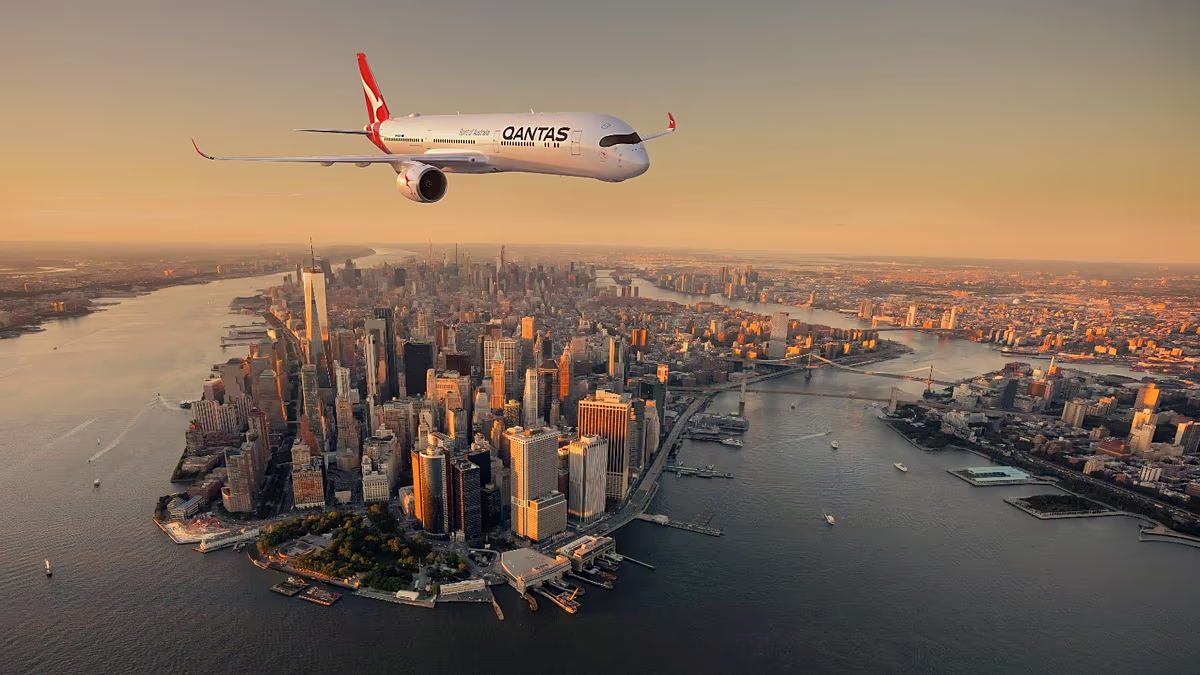
The rupture came after what officials described as “tense but productive” sessions held behind closed doors in a neutral venue in New York. Sources privy to the discussions claim the primary sticking point remained the United States’ insistence on a “reciprocity tax” that would level the playing field against Canadian agricultural subsidies and dairy tariffs—a demand Ottawa viewed as a trojan horse designed to dismantle its supply management system. However, the final nail in the coffin appeared to be a last-minute demand verbally floated for the ceding of navigation rights on the Great Lakes, a red line for the Canadian delegation. As the sun set over Manhattan, Canadian negotiators walked away from the table, leaving drafts of agreements unsigned and a void of uncertainty in their wake.
In the immediate aftermath, it was Mark Carney who seized the narrative. The former central banker, known for his calm demeanor in the face of financial crises, addressed the nation in what many are calling the most consequential speech of his political career. “We did not choose this fight, but we will not flee from it,” Carney declared from a podium in Ottawa. “The United States has decided to treat its closest ally as an adversary. We will treat them as a formidable one.” Carney did not mince words regarding the existential threat to the Canadian economy, but he pivoted quickly to a message of resilience. His speech outlined a two-pronged strategy: immediate retaliatory measures targeting key Republican voting districts, and a long-term plan to bolster domestic energy security and reduce reliance on the US market. His rhetoric signaled a shift away from the “quiet diplomacy” of previous administrations, embracing a more confrontational, leadership-on-the-front-foot approach that galvanized a nation often characterized by its politeness.
Yet, the most explosive development came not from the Prime Minister’s office, but from the floor of the stock exchange. As the trading day opened in Toronto, the “Buy Canadian” movement transformed from a social media hashtag into a wall of financial defiance. Corporate executives, usually reserved in their public statements, took to the airwaves to announce a sweeping review of all American supply chains. The Quebec-based grocery chain Metro announced it would delist U.S. goods in favor of local producers, while aerospace giant Bombardier pledged to fast-track domestic manufacturing contracts. This was not just about economic retaliation; it was psychological warfare. The business community, often seen as the bulwark of North American integration, appeared to signal that trust had been irrevocably broken. “We are facing a calculated attack on our sovereignty,” said a CEO of a major Canadian bank, speaking on the condition of anonymity. “We have to burn the haystack to find the needle; we have to rebuild our economic fortifications.”
However, it was the action taken by the outgoing president that transformed an economic dispute into a flashpoint of cultural rage. In a flurry of activity on social media, Donald Trump announced he would “correct a historical injustice” by renaming Lake Ontario—which is bordered by the province of Ontario and the state of New York—to “Lake Washington.” The directive, framed as a nod to “American greatness,” was immediately dismissed by constitutional lawyers as signifying nothing legally, given that the lake is a sovereign international waterway. Yet, the insult was clear, and it struck a nerve. For Canadians, the body of water is more than a geographic feature; it is a symbol of their identity, a gateway to the St. Lawrence Seaway, and a source of 20% of the world’s fresh water. The move was widely decried in Canadian media as an act of “bullying” and a “comedic distraction” from the serious implications of the tariff war, but it succeeded in unifying the country in outrage.
In the wake of this provocation, the strategic calculus has shifted dramatically. [Anchor] The immediate economic fallout is severe: the Canadian dollar has sunk to its lowest level in years, and projections suggest a potential GDP contraction of up to 2% if the tariffs are applied to autos and softwood lumber as threatened. However, the political consequences are likely to be more profound and longer-lasting. Carney has announced an emergency session of Parliament to pass expedited trade legislation and has instructed his ambassador to the UN to formally protest the “attempted redefinition of international borders.” Meanwhile, Ottawa has launched a massive public awareness campaign targeting American voters, reminding them that the Canadian market is the largest export destination for 34 US states. The strategy appears to be to bleed the Republicans electorally, using the “blue wall” of northern border states as a pressure point to force Congress to intervene against the former President’s unilateral actions.
Looking ahead, the path to restoration seems fraught with obstacles. The “special relationship” between the US and Canada, forged in the crucible of World War II and cemented by decades of mutual economic growth under NAFTA and the USMCA, appears to be on the verge of dissolution. Carney has called for a “New North American Framework” to be negotiated post-2024, but his tone suggests he expects a prolonged period of tension. For the average citizen, the changes are tangible: family reunions across the border are being delayed, cross-border shopping trips are dwindling, and the immediate consumer impact of tariffs is likely to drive up the price of groceries and gasoline on both sides of the line. As the pundits debate the legality of renaming a lake and the solvency of national pension funds, one fact remains firm: the era of unquestioned friendship has ended. The question now is whether a new equilibrium can be forged, or if the world’s longest undefended border is destined to become its most heavily policed economic fault line.