



China’s Maritime Militia: The Floating Armada Reshaping Power Dynamics in Asian Seas
China Deploys Vast Fishing Fleet Formations in Strategic Show of Maritime Strength
In an unprecedented demonstration of maritime coordination, China has quietly mobilized thousands of fishing vessels in recent weeks to form massive floating barriers stretching over 200 miles long in the East China Sea. These synchronized operations, largely undetected by the international community, reveal Beijing’s growing capability to rapidly deploy civilian vessels that could potentially be used to assert control in disputed waters or complicate military operations during a conflict.
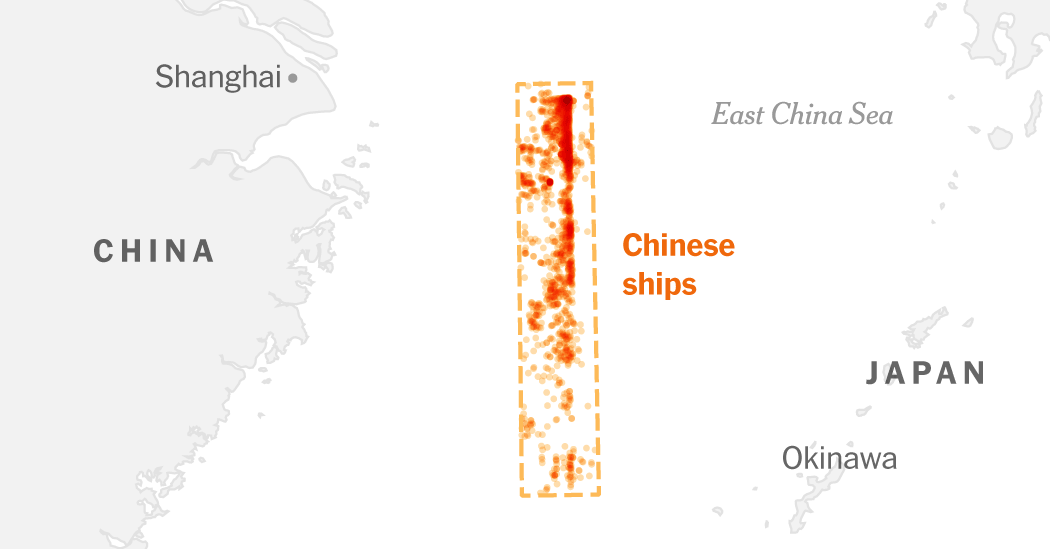
An extensive analysis of ship-tracking data by The New York Times has uncovered the scale and complexity of these maneuvers. The most recent operation unfolded last week when approximately 1,400 Chinese vessels abruptly abandoned their regular fishing activities or departed from their home ports to congregate in the East China Sea. By January 11, they had assembled into a rectangle formation extending more than 200 miles. The configuration was so dense that approaching cargo ships were forced to navigate around the formation or zigzag through it, according to ship-tracking data.
“I was thinking to myself, ‘This is not right,'” said Jason Wang, chief operating officer of ingeniSPACE, a data analytics company who first spotted an earlier formation of fishing boats on Christmas Day. “I mean I’ve seen like a couple hundred — let’s say high hundreds,” he added, referring to Chinese boats he has previously tracked, “but nothing of this scale or of this distinctive formation.”
A Pattern Emerges: Strategic Maritime Deployments in Key Shipping Lanes
The January operation followed a similar mobilization on Christmas Day when approximately 2,000 Chinese fishing boats gathered in two parallel formations in the East China Sea. Each line stretched an astonishing 290 miles — roughly the distance from New York City to Buffalo — forming a reverse L shape according to ship position data. The timing and location of these two large-scale maneuvers, occurring just weeks apart in the same waters, strongly suggest a coordinated effort by Chinese authorities.
Maritime and military experts believe these operations indicate China is strengthening its maritime militia — a force composed of civilian fishing boats trained to support military operations. The maritime militia has long been recognized as a key component of China’s “gray zone” strategy, allowing Beijing to assert territorial claims and project power without deploying naval warships that might escalate tensions.
“The level of coordination to get that many vessels into a formation like this is significant,” noted Mark Douglas, an analyst at Starboard Maritime Intelligence, which independently confirmed the ship movements. “We’ve never seen a formation of this size and discipline before.” The assembled boats maintained relatively steady positions rather than following typical fishing patterns such as looping or back-and-forth movements, further suggesting these were coordinated military exercises rather than commercial fishing activities.
Beyond Fishing: The Strategic Implications of China’s Maritime Militia
In a potential conflict scenario, particularly involving Taiwan, China could mobilize tens of thousands of civilian vessels to obstruct sea lanes and complicate military operations of opposing forces. While the fishing boats themselves would be too small to enforce an effective blockade independently, they could significantly impede the movement of American warships and other naval assets in the region.
“They could act as missile and torpedo decoys, overwhelming radars or drone sensors with too many targets,” explained Thomas Shugart, a former U.S. naval officer now with the Center for a New American Security. The sheer number of vessels could create confusion and force military commanders to divert resources to track and monitor civilian boats, potentially creating operational advantages for Chinese forces.
The recent maneuvers took place in the East China Sea near critical shipping lanes that branch out from Shanghai, one of the world’s busiest ports. These maritime arteries carry daily cargo shipments, including Chinese exports to the United States, and would be strategic control points in any military confrontation between China and the United States or its Asian allies.
Expanding China’s Maritime Toolkit for Regional Dominance
The fishing boat operations in January coincided with Beijing’s two-day military exercises around Taiwan, which included practicing naval maneuvers to blockade the island. This timing, coupled with rising tensions between China and Japan over Taiwan, suggests these maritime militia exercises may have multiple strategic objectives.
“My best guess is this was an exercise to see how the civilians would do if told to muster at scale in a future contingency, perhaps in support of quarantine, blockade, or other pressure tactics against Taiwan,” wrote Gregory Poling, director of the Asia Maritime Transparency Initiative at the Center for Strategic and International Studies, in emailed comments to The Times. “They are almost certainly not fishing, and I can’t think of any explanation that isn’t state-directed.”
The operations could also signal “opposition to Japan” or serve as practice for possible confrontations with Japan or Taiwan, according to Andrew S. Erickson, a professor at the U.S. Naval War College who studies China’s maritime activities. While Japan’s Ministry of Defense and coast guard declined to comment on the Chinese fishing boat formations, citing the need to protect intelligence-gathering capabilities, the implications for regional security are significant.
A New Phase in Maritime Militia Development
China has previously deployed maritime militia fishing boats in smaller groups — dozens or hundreds — to support its navy in territorial disputes, often by swarming, dangerous close maneuvering, and even physically bumping other vessels. However, the recent mass deployments represent a substantial evolution in capability and coordination.
A scan of Chinese state media reports revealed that some of the fishing boats involved had participated in previous maritime militia activities or belonged to fleets known to be engaged in militia operations. While China does not publish comprehensive lists of vessels in its maritime militia, making definitive identification challenging, the tight coordination displayed strongly suggests “an at-sea mobilization and exercise of maritime militia forces,” according to Professor Erickson.
“It does mark an improvement in their ability to marshal and control a large number of militia vessels,” noted Lonnie Henley, a former U.S. intelligence officer now with the Foreign Policy Research Institute. “That’s one of the main challenges to making the maritime militia a useful tool for either combat support or sovereignty protection.”
These recent deployments demonstrate that China’s maritime militia units are becoming more organized and better equipped with advanced navigation and communications technology. This enhanced capability provides Beijing with expanded options for asserting its territorial claims and projecting power throughout the region without resorting to conventional military assets.
As tensions persist over Taiwan and territorial disputes in the East and South China Seas, China’s ability to rapidly mobilize thousands of civilian vessels adds another dimension to regional security calculations. The floating armadas represent not just a display of organizational prowess but a strategic asset that complicates military planning for the United States and its allies, fundamentally altering the maritime security landscape in one of the world’s most contested waterways.