


The Madrid Convergence: Inside the Strategic Alliance Between Pope Leo and Pedro Sánchez
An Unlikely Geopolitical Alliance: Pope Leo and Pedro Sánchez Unite in Madrid
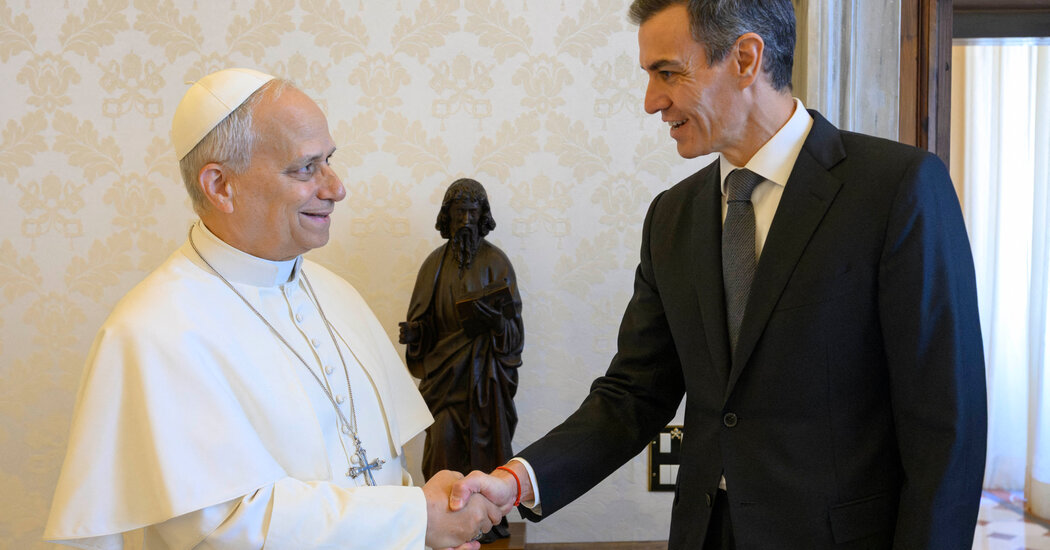
When Pope Leo met in Madrid with Spain’s left-wing prime minister, Pedro Sánchez, on Monday morning, they represented, at least to many liberals, a powerful duo joining forces to lead the opposition to President Trump. In an era increasingly defined by sharp populist divides and shifting transatlantic dynamics, this high-profile convocation at the Vatican’s diplomatic mission in the Spanish capital signaled a potent ideological realignment. “They have the same voice” when it comes to speaking out against Mr. Trump, observed Cardinal José Cobo of Madrid, summarizing a broader perception that the pontiff and the prime minister are forging a united front against the unilateralist, America-First policies of Washington. Indeed, Pope Leo has repeatedly drawn the American president’s sharpest fury, first for his outspoken denunciations of the intensifying conflict in Iran, and later for his bold, public declaration that he harbored “no fear” of the Trump administration’s geopolitical pressure. Simultaneously, Mr. Sánchez has consistently relished his role as a progressive counterweight to the American administration, clashing directly with Mr. Trump on issues ranging from NATO defense spending targets and strict global migration policies to his vociferous opposition to the devastating military campaigns in Gaza and Iran. Yet, beneath this public display of ideological orchestration lies a complex web of varying motivations, with the pope having been reluctantly dragged into the partisan arena by Mr. Trump’s direct provocations, while the Spanish prime minister has eagerly jumped into the fray to bolster his own international pedigree.
GEOPOLITICAL ALIGNMENT ON KEY GLOBAL ISSUES[ Pope Leo ] <=================================> [ Pedro Sánchez ]
(Holy See) Shared Policy Positions (Kingdom of Spain)
│ │
├───> Advocacy for Humane Migration Rights <────────┤
├───> Strict Regulation of Tech Giants <────────────┤
├───> Diplomatic Sanctions Over Rearmament <────────┤
└───> Opposition to Unilateral Foreign Wars <───────┘
The Art of Political Survival: Sánchez’s Global Gambit Amid Domestic Turmoil
For Mr. Sánchez, Europe’s most accomplished political escape artist, this monumental encounter with the supreme pontiff served as a masterclass in tactical diversion. Having spent the last eight years wriggling free from seemingly fatal parliamentary crises, fragile coalition collapses, and razor-thin confidence votes, the Spanish prime minister is no stranger to the high-wire act of contemporary statecraft. Facing a compounding series of domestic tribulations—most notably a succession of grueling corruption scandals and judicial inquiries now swirling around his former close political allies and his immediate family—Mr. Sánchez has increasingly looked beyond his borders to seek political salvation. Seizing on high-stakes international quarrels with Mr. Trump has allowed the prime minister to elevate his personal standing among European leaders while simultaneously deflecting domestic media attention away from the localized controversies threatening his administration. Joseba Louzao, a prominent professor at Cardinal Cisneros University and the author of A Brief History of the Catholic Church in Spain, noted that appearing alongside the highly respected pontiff “will help Sánchez with his external public image,” acting as a powerful legitimizing force on the global stage. During their meeting at the Vatican’s embassy on Monday, Mr. Sánchez went to great lengths to highlight this shared vision, presenting the pope with a carefully selected, Spanish-grown olive bonsai tree—a gift described by the Spanish government as “a universal symbol of peace, dialogue, and understanding, values shared by Spain and the Vatican.” While such optics may do little to sway votes in a hyper-polarized Spain where domestic public opinion regarding the charismatic prime minister is already deeply entrenched, the grand strategic hope of the administration remains that Mr. Trump will take the bait, launching an attack on the duo that would instantly elevate Mr. Sánchez’s international stature and re-energize his core progressive base.
The Secular Statesman and the Holy See: Navigating an Ideological Paradox
On the surface, the ideological alignment between the two leaders presents a striking paradox, given that they represent fundamentally incompatible worldviews on several of the most contentious social issues of modern times. Mr. Sánchez is a self-declared, uncompromising atheist, a fierce defender of progressive social reforms including abortion access and state-sanctioned euthanasia, and a historical opponent of Catholic involvement in Spain’s public education system. Yet, despite these profound philosophical discrepancies, the prime minister has engineered a narrative of spiritual and moral synchronicity, behaviorally singing from the very same hymn sheet as the Roman Catholic pontiff. “The Catholic Church and the Government of Spain are once again, I believe, very much in tune,” Mr. Sánchez remarked during a previous high-level trip to meet the pope at the Vatican, pointing to a “certain degree of harmony” regarding broad humanitarian issues such as the defense of vulnerable migrants, the ethical regulation of multinational technology conglomerates, and the pursuit of peaceful, multilateral resolutions to global conflicts. By casting Pope Leo as a vital “moral compass” navigating through “common sense against irrationality and the law of the jungle,” the prime minister has repeatedly attempted to shield his domestic decisions from conservative attacks. This was vividly demonstrated when Spain permitted a cruise ship carrying passengers exposed to a dangerous hantavirus outbreak to dock in the Canary Islands; challenged by local opposition leaders, Mr. Sánchez successfully disarmed his critics by citing “the explicit recognition expressed by none other than the pope for the solidarity and empathy shown by the people of the Canary Islands,” transforming a potential domestic health crisis into an internationally celebrated act of Christian charity.
THE DOMESTIC VS. INTERNATIONAL DYNAMICDomestic Friction International Harmony
┌────────────────────────┐ ┌────────────────────────┐
│ • Abortion Rights │ │ • Humane Migration │
│ • Secular Education │ [Pedro Sánchez] │ • Peace & Diplomacy │
│ • Euthanasia Laws │ [ Pope Leo ] │ • Tech Regulation │
│ • Corruption Inquiries │ │ • Climate Action │
└────────────────────────┘ └────────────────────────┘
The Church’s Double-Edged Sword: Spanish Prelates Defend Their Autonomy
Observing this strategic embrace from a cautious distance, Spain’s prominent Catholic prelates have worked tirelessly to prevent the ruling socialist party from entirely co-opting the figure of the pope. While acknowledging that there is indeed significant overlap between Catholic social teaching and the left-wing platform on specific global crises, church leaders have been exceptionally careful to draw clear boundaries. Joan Planellas, the archbishop of Tarragona, conceded that on certain topics traditionally categorized as left-wing—such as the welcoming of refugees, opposition to militarism, and the containment of corporate tech giants—”there is a certain harmony,” though he quickly clarified that this agreement abruptly ends when confronting “delicate topics” like abortion and the sanctification of life. Cardinal Cobo similarly warned that the prime minister’s opportunistic alignment with the pope should not be used as a convenient political shield, reminding the public that deep theological and ethical disagreements still divide the Spanish government and the Holy See. This sentiment was echoed by Bishop Eloy Alberto Santiago of Tenerife, who presided over the region where the pope and Mr. Sánchez met with newly arrived African migrants; although the local church was the driving force behind the government’s recent legislative push to grant legal status to hundreds of thousands of undocumented immigrants, the bishop insisted this humanitarian cooperation did not mean “we identify with a party or a government.” Even within the corridors of the Spanish state, senior officials remain quietly wary of drawing too close to the Catholic hierarchy, recognizing that an overly cozy relationship with the Vatican risks alienating the administration’s fiercely secular, hard-left coalition allies who remain deeply skeptical of ecclesiastical influence on public life, meaning both the prime minister and the pope share a strong mutual interest in maintaining a carefully calibrated diplomatic distance.
| Leader | Domestic Constituency | Key Geopolitical Stance | Primary Domestic Challenge |
|---|---|---|---|
| Pope Leo | Global Catholic Laity | Multi-lateral diplomacy, peaceful dialogue, protection of migrants | Navigating partisan co-optation by secular political parties |
| PM Pedro Sánchez | Secular, Progressive Coalition | Pro-European integration, active alignment with global moral authorities | Corruption scandals involving close allies and family members |
The Conservative Retort: Accusations of Hypocrisy and Spiritual Co-optation
Predictably, Spain’s conservative opposition has launched a ferocious counteroffensive, seeking to dismantle what they characterize as a cynical attempt by the prime minister to wrap himself in the moral authority of the papacy to distract from his own ethical vulnerabilities. Isabel Díaz Ayuso, the powerhouse conservative president of the Madrid region—who met with the pope in Rome earlier this month—openly accused Mr. Sánchez of trying to politically “appropriate” the pontiff’s visit for personal political gain. “In the last eight years, he has been incapable of having a single gesture toward Catholics, yet now he seeks to use the Vatican as his personal shield,” Ms. Ayuso told reporters, pointing to the government’s long history of secular legislation. The critique was delivered with even greater rhetorical venom by Alberto Núñez Feijóo, the leader of the mainstream conservative Popular Party, who took to the parliament floor to mock what he described as Mr. Sánchez’s desperate bid to cleanse his domestic image by standing in the shadow of the popular pope. “If he wants to get closer to the pope, he should remember the seventh commandment,” Mr. Feijóo declared triumphantly to the chamber, “‘Thou shalt not steal,’ and the eighth commandment, ‘Thou shalt not lie.'” This sharp line of attack highlights the acute frustration of Spain’s right-wing parties, including the populist party Vox, which has long attempted to position itself as the sole defender of Spain’s traditional Catholic inheritance, only to find itself frequently criticized by Catholic bishops for its hardline, anti-immigrant policies that run directly counter to the pope’s global humanitarian crusade.
CONSERVATIVE OPPOSITION RESPONSES TO THE MEETING┌────────────────────────────────────────────────────────────────┐
│ Isabel Díaz Ayuso (Madrid Regional President): │
│ “In the last eight years, he has been incapable of having a │
│ single gesture toward Catholics…” │
└────────────────────────────────────────────────────────────────┘
│
┌────────────────────────────────────────────────────────────────┐
│ Alberto Núñez Feijóo (Popular Party Leader): │
│ “If he wants to get closer to the pope, he should remember the │
│ seventh commandment: ‘Thou shalt not steal’…” │
└────────────────────────────────────────────────────────────────┘
A Calm and Firm Word: Pope Leo’s Balanced Mandate to a Polarized Nation
Ultimately, it fell to Pope Leo himself to navigate the minefield of Spanish politics, delivering a highly anticipated address to the Spanish Parliament that served as a masterclass in diplomatic neutrality and moral clarity. Speaking beneath the grand frescoed dome of the parliament building, with Mr. Sánchez and his fiercest political adversaries sitting in close proximity, the pope appeared to directly address the toxic polarization that has consumed the nation’s political discourse. “It falls to me today to speak a calm and firm word to those who bear the grave responsibility of legally ordering social coexistence,” Leo said, his voice echoing through the silent chamber. In a direct rebuke to the populist rancor that has come to define modern Spanish democracy, the pontiff warned that “political pluralism should not degenerate into the constant disparagement of one’s adversary,” adding with profound simplicity that “firmness does not require contempt; disagreement does not entail humiliation.” Throughout his address, the pope carefully kept a foot on both sides of the partisan divide, ensuring neither the left nor the right could claim absolute victory; he deliberately appealed to conservatives by reaffirming the Church’s defense of “the unborn child,” while simultaneously validating the progressive platform by describing the global migration crisis as a “tragic drama” that profoundly challenges the moral conscience of modern nations. While he echoed Mr. Sánchez’s anti-war rhetoric by calling for “diplomatic courage” over “rearmament” to resolve international disputes, the visit concluded with a sobering warning from Luis Argüello, the archbishop of Valladolid and president of the Spanish Bishops Conference, who cautioned the prime minister that true alignment with the Church’s teachings requires an ongoing commitment to transparency and ethical governance “inside our own nation,” most notably “on matters relating to corruption”—a clear sign that once the pope’s plane departs Madrid, the uneasy truce between the cross and the crown will quickly dissolve back into the familiar battles of Spanish politics.