







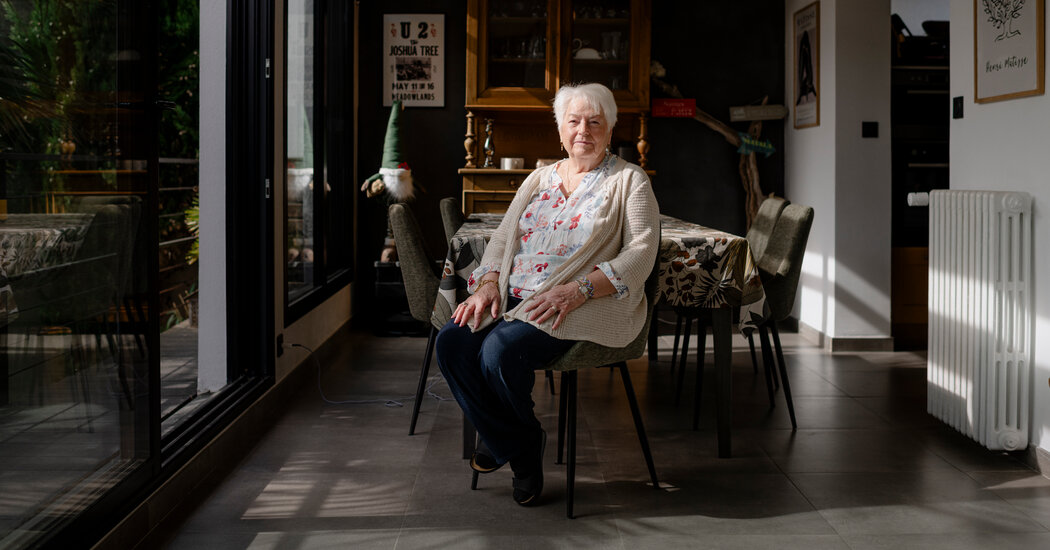
Marie-Thérèse Ross-Mahé had always imagined her twilight years filled with quiet contentment after a life of love, loss, and unexpected reunions. At 85, this French woman, with her soft accent and weathered hands etched by years of raising a family and traversing oceans, found solace in a cozy bungalow in Anniston, Alabama. Living alongside her beloved husband, Bill Ross—an American soldier she’d met decades ago—she thought her days were settled. Bill was her anchor, a man who had rekindled their flame after so many years apart. But on a quiet April morning, everything shattered when she was jolted awake by relentless banging at her door. Still groggy in her bathrobe, pajamas, and slippers, she opened it to find men who claimed they were immigration police. They surged in, handcuffed her fragile wrists, and whisked her away in an unmarked car to a cold jail cell. “I didn’t know what was happening to me really,” she later recounted softly, her voice trembling even across the distance. “It was very humiliating. My hair hadn’t even been combed. I was just getting out of bed.” This wasn’t the America she’d admired from afar, the place of opportunity she’d dreamed of adopting; it was a nightmarish blur of confusion and indignity that thrust her into the shadowy underbelly of the U.S. immigration system.
As Marie-Thérèse grappled with the surreal horror of her arrest, she was thrust into what felt like a dehumanizing abyss. Chained by wrists and ankles to other desperate detainees, she was shuttled like cargo—buses, planes, treated no better than sacks of potatoes. For 16 agonizing days, she bounced between facilities in Alabama and Louisiana, her elderly body aching from the constant movement and uncertainty. She pleaded for information, for a lawyer, for any semblance of humanity, but mostly encountered silence or barked orders. “It was humiliation all the time,” she shared, her eyes welling with tears in recall. “They never talked, they were always yelling.” Yet, amid the despair, small acts of kindness emerged from fellow inmates—women who helped her limp to the bathroom, soothed her with hot chocolate and cookies, and sang hymns on Easter eve that stirred her faith anew. “They were wonderful,” she whispered gratefully. “I found God in that jail through those women.” But the toll was immense; her sciatica flared, her back screamed, and hope dwindled until she resigned herself to death’s embrace. “I was waiting to die, really. I knew I was not going to make it.” The U.S. government, through Homeland Security, defended their practices, claiming detainees receive meals, water, blankets, and medical care—standards surpassing most prisons, they said—but for Marie-Thérèse, it was a world of forgotten souls, where human dignity was a distant myth.
Marie’s journey to this nightmare began long before that fateful dawn, rooted in a romance as enduring as the tides. In the 1950s, on a NATO base outside Nantes, France, she crossed paths with Bill Ross, a young American soldier. Their sparks flew briefly but fizzled when he wed her friend, Michèle Viaud, and returned to Alabama. Decades passed; Marie married Bernard Goix, bore three children, and built a life marked by duty and quiet joy. Bernard’s battle with lung cancer in 2022 left her bereft, but Bill, true friend, sent messages of comfort from afar. Four months later, he invited her to Alabama with a plane ticket, reigniting their old flame. “Everything came back,” she said with a wistful smile, recounting their years of cross-Atlantic flights, laughter under Southern skies. They wed in 2023—first before a notary in a parking lot, then in a church, surrounded by love’s gentle light. Bill pursued her permanent residency diligently, securing an employment authorization document and even a Department of Defense ID for veterans’ spouses, granting her base privileges. “For me, I was legal,” she insisted, clutching the remnants of her faith in the system. But Bill’s sudden death in January 2023 unraveled it all, leaving her in a foreign land with no will, just a modest estate: a bungalow, two vehicles, and a meager bank account.
Grief compounded into bitter conflict when Bill’s sons, Tony and Gary, emerged like storm clouds over the horizon. Both in their fifties, they descended on the bungalow the day after their father’s passing, seizing his truck and car, stripping her of his cellphone to sever her ties. Without it, her French phone couldn’t dial local numbers, isolating her further. They cut cable and internet, hoarded credit cards, and denied help with her blood pressure meds, leaving her shaking and frail. “I was scared to death,” she admitted, her voice small. Neighbors, angels in disguise, rallied—paying bills, driving her to the hospital, delivering meals through Wheels on Meals. But the probate court, where a hearing loomed, became a battlefield. Marie hired a lawyer, changed locks, and papered windows to bar entry. “I didn’t want to let them win,” she breathed defiantly. The probate judge, Shirley Millwood, later painted a damning picture in her ruling, alleging Tony— a courthouse security officer and former trooper—had orchestrated Marie’s arrest, tipped off by U.S. marshals hours before. Tony received a confirming text just an hour in. Efforts to contact him and Gary yielded silence, leaving the tale shrouded in family vendetta.
Eight days before that probate hearing on April 9, 2023, America’s immigration machinery seized Marie. An ICE officer cited an alleged “overstay”—her 90-day visa expired in September, but paperwork was submitted in December, creating a seven-month gap deemed illegal. Transferred to a filthy county jail, then chained to Louisiana’s ICE center, she endured hard benches, soiled beds, and endless waits. The endless transfers aggravated her pains, but fellow detainees’ compassion sustained her spirit. On April 16, at 2 a.m., a guard roused her, hinting at transfer; instead, she was flown to Dallas and onto a Paris-bound plane. The French consul in New Orleans had advocated fervently for her release, citing her age and ailments. “They treat them like dogs, not in a human way,” she reflected on the system she’d once championed, inspired by Trump’s policies. She added, “I thought that when we arrested them, we would treat them properly. It really shocked me.” Homeland Security countered that ICE standards exceed those for citizens, with audits reassuring quality care.
Now back in France, amidst sons who enfold her with love, Marie wrestles with an aftermath as profound as the loss of her husband. Diagnosed with PTSD, she walks in borrowed clothes from a mall dash, her Alabama belongings a distant echo. Bill’s gold wedding ring dangles near her heart, alongside a gem-studded cross—a talisman of faith. “I will never be able to go back to my husband’s grave. I won’t be able to see my friends there. That really hurts.” She learned of the judge’s suspicions—Tony’s alleged tip-off—only post-release. “I didn’t think they were capable of doing something like that. It has destroyed a part of me.” Yet, in this fragile recovery, Marie’s resilience shines; she’s a woman who ventured beyond borders for love, faced inhumane depths, and emerged with grace intact. Her story, while uniquely hers, mirrors countless others locked in immigration’s opaque grip, urging reflection on a system that can crush the unsuspecting. In humanizing terms, Marie’s ordeal isn’t just numbers and policies—it’s the palpable ache of dislocation, the warmth of strangers’ kindness in cages, and the enduring spark of hope in an 85-year-old soul. As she rebuilds, one prayerful step at a time, her voice reminds us of the human cost hidden in cold bureaucracy, a testament to love’s power over division.
Reflecting further on Marie’s saga, one can’t help but feel the raw vulnerability woven into her narrative—a widow in a double foreignness, American by marriage yet exiled by law’s cruel whims. From the 1950s’ fleeting romance to 2020s’ rebirth of passion, her life arc embodies the intricate dance of human destiny, impervious to age or oceans. Bill’s death cleaved her bonds anew, plunging her into a predatory familial tug-of-war over meager assets, where sons’ actions, as alleged by a shrewd judge, morphed into sabotage via immigration’s blunt instrument. That dawn raid, handcuffed and slipper-clad, wasn’t mere procedure; it was a robbery of dignity, herelderly form shunted like chattel amid clinical indifference. Yet, the detainees’ hymns and comforts illuminate humanity’s quiet heroism, transforming dread into fleeting joy. Homeland Security’s assurances of audits and comforts ring hollow against such visceral accounts, highlighting systemic flaws where the elderly languish unseen. Marie’s political awakening—from Trump admirer to disillusioned critic—underscores how ideals fracture against lived reality, her shock echoing like a wake-up call. Returned to French soil, clad in new garments, she mourns not just lost ties but the trust in American promise. Her PTSD diagnosis is no abstract woe; it’s the persistent tremor of trauma, felt in sleepless nights and phantom chains. Fellow deportees’ parallels amplify her plight, revealing a labyrinth where rights evaporate, lawyers vanish, and release hangs on arbitrary mercy. In humanizing her pain, we see the cost: an 85-year-old’s spirit tested, yet unbroken, standing as a poignant emblem of resilience amid unjust tides.
Moreover, Marie’s tale invites empathy for the unseen figures in immigration’s shadows—elderly, vulnerable souls like her, whose stories rarely breach headlines. Her family’s legacy, tangled in shared histories across continents, underscores the irony: love’s rekindling led to belonging’s snatch. The probate dispute, fueled by greed or grief, escalated into a weaponized detention, per the judge’s damning verdict, exposing how family feuds can exploit bureaucratic levers. Transfer after transfer eroded her health, yet inmate solidarity fostered bonds stronger than steel bars, a testament to empathy’s endurance. Her release, brokered by diplomatic plea, felt serendipitous amid despair’s grip. Now, adorned with Bill’s ring and cross, Marie fosters healing, her sons’ embrace a balm for exile’s wounds. The inability to visit his grave etches permanent loss, a heartache universal in migration’s wake. Upon reflection, her experience dismantles myths of benevolent immigration measures, revealing a system that, in her words, treats people “like dogs.” For Marie, this has been a crucible of suffering, forging wisdom from ashes— a lesson in humanity’s fragility and fortitude.
To encapsulate Marie-Thérèse’s journey is to honor a life richly lived, bitterly tested, and enduringly hopeful. From NATO’s youthful sparks to Alabama’s golden sunset weddings, her path was one of transnational devotion, derailed by untimely death and ruthless familial strife. Arrested in slumber’s innocence, detained in detention’s dehumanizing sprawl, she emerged scarred yet compassionate, her faith revived by captives’ hymns. The probate judge’s incriminations of Tony unveil betrayals within kin, weaponizing the law’s power. Marie’s shock at the system’s brutality—once championed for France’s sake—speaks to disenchantment’s depth, as she equates it to animalistic neglect. PTSD’s shadow now looms, but borrowed clothes and familial support signal renewal. Her story, laced with quotes of quiet agony, humanizes the abstract: immigration isn’t cold policy; it’s bodies shackled, souls singed, heads uncombed in dawn’s harsh light. May it spur change, ensuring no other elder endures such indignity.