



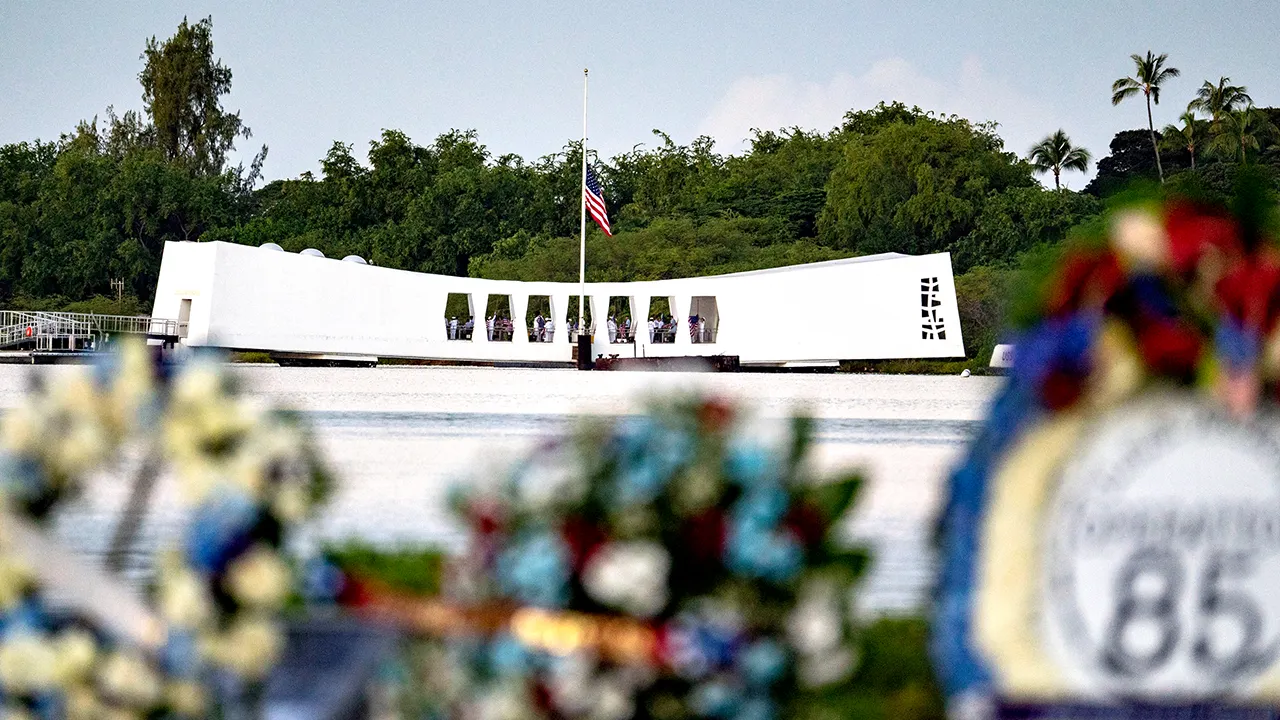
Before the world knew the name Pearl Harbor as a tragic catalyst for global warfare, it was merely an exotic, sun-drenched horizon to an adventurous seventeen-year-old boy from the quiet, pine-scented hills of Plainview, Arkansas. Royle Bradford Luker was just a teenager, a handsome boy still carrying the soft features of youth and the hopeful optimism of a life just beginning, when he stepped away from his parents and the clean, familiar dirt roads of his rural hometown to answer a calling larger than himself by enlisting in the United States Navy. Behind him, he left the comforting embrace of his tight-knit southern community, carrying his dreams and a trunk of modest belongings across the American continent to be stationed aboard the colossal, grey battleship USS West Virginia. To a young man raised in landlocked Arkansas, the vast, shimmering blue stretches of the Pacific Ocean and the tropical warmth of Oahu must have felt like an enchanting dream, a world of unimaginable scale and endless possibility. However, this beautiful illusion, filled with the easy peace of peacetime naval service, was violently shattered on the quiet, sunlit Sunday morning of December 7, 1941, when the skies over Hawaii suddenly darkened with the terrifying drone of Japanese warplanes. In an instant, the tranquil waters around Ford Island turned into a chaotic crucible of fire, screaming steel, and suffocating black smoke as multiple torpedoes ripped through the side of the West Virginia, sending the majestic ship sinking rapidly to the shallow harbor floor. Amid the deafening roar of explosions, the hiss of steam, and the heroic, desperate struggles of sailors fighting for their lives in the flooded, dark passages, young Royle Luker was killed in the line of duty alongside 105 of his shipmates. At just seventeen years old, a boy who had barely tasted the dawn of his own maturity made the ultimate sacrifice, lost in the fiery opening salvo of a global conflict that would demand the very soul of his generation.
For the family back home in Plainview, the catastrophic news of the Pearl Harbor attack arrived not with the clarity of closure, but with the paralyzing fog of uncertainty and profound grief. Royle’s father, George F. Luker, was a veteran of the First World War who knew all too well the brutal, lingering realities of combat, yet nothing could have prepared him or his wife, Nettie David Luker, for the agonizing reality of losing their teenage son to a war that had only just begun. For decades, Royle was officially listed simply as killed in action, a painful classification that offered no physical remains to bury and no grave to weep over, as his body remained unidentified amid the chaotic aftermath of the salvage operations. Instead, his bones were recovered and interred as an “Unknown” beneath a simple, nameless marker at the National Memorial Cemetery of the Pacific, located within the solemn, volcanic bowl of the Punchbowl crater in Honolulu. As the years turned into decades, the world moved forward with dizzying speed; the Allied forces triumphed, the post-war boom reshaped America, and the generation that fought World War II slowly began to fade into history. Throughout all this time, George and Nettie grew old, their hearts bearing an unhealed wound as they eventually passed away without ever knowing where their beloved boy’s final resting place lay, leaving only his name inscribed on the bronze tablets of the Courts of the Missing. Yet, even as his parents went to their graves, the memory of the brave seventeen-year-old sailor did not vanish; it was tenderly preserved like a sacred relic by subsequent generations of the Luker family, who refused to let the passage of eight decades erase the legacy of the boy who never came home.
The agonizing silence of over eight decades was finally broken by a remarkable convergence of modern forensic science, unwavering military devotion, and the enduring love of an Arkansas family that refused to let his memory fade. Under the dedicated direction of the Defense POW/MIA Accounting Agency, an organization driven by the sacred, solemn promise to never permanently abandon a fallen American service member to the shadows of history, researchers began the meticulous process of exhuming unidentified Pearl Harbor casualties from Hawaii’s National Memorial Cemetery of the Pacific. These nameless sailors, once interred in collective obscurity as unknowns, were carefully exhumed and transported to advanced military laboratories, where forensic anthropologists, odontologists, and DNA specialists used state-of-the-art technology to examine skeletal remains and extract viable mitochondrial and nuclear DNA. To bridge this vast, formidable chasm of time, scientists reached out to Royle’s surviving bloodlines, requesting genetic samples from his living relatives who had spent holidays and quiet family gatherings hearing tales of the legendary young naval hero they had never been able to meet. His nephews, Donald Bradford Henderson and John Luker, along with his niece, Becky Downen Lensing, eagerly stepped forward to provide their DNA, offering the crucial, living molecular threads needed to sew back together a tapestry of family history that had been brutally torn apart on a bloody Hawaiian morning. On May 29, 2024, the decades-long scientific puzzle was officially and triumphantly resolved when laboratory analysis confirmed a definitive match, instantly transforming an anonymous casualty of war back into Fireman Third Class Royle Bradford Luker. This monumental breakthrough represented far more than a triumph of genetic science; it was a profound emotional victory that spanned generations, validating a family’s willingness to share their heritage and finally bridging the long, painful gap between devastating loss and the sudden, beautiful light of knowing.
To truly grasp the profound gravity of Royle Luker’s sacrifice, one must look deep beneath the surface of cold military records and into the grueling, terrifying reality of his daily duties as a Fireman Third Class. Within the massive steel belly of a battleship like the USS West Virginia, a fireman’s role was physically punishing and inherently perilous even under peaceful conditions, demanding intense labor in the hot, cramped, and deafeningly loud boiler and engine rooms situated far below the vessel’s waterline. When the torpedoes struck and the ship began to buckle, these deep compartments became immediate, dark traps of rushing seawater, toxic smoke, and burning oil, yet the young men stationed there fought desperately to maintain power and save their shipmates, demonstrating courage of the highest order. For his extraordinary bravery and devotion to duty during those final, chaotic moments, Royle was posthumously awarded some of the nation’s most revered military decorations, most notably the Purple Heart, awarded to those wounded or killed in the line of combat, and the Navy Presidential Unit Citation, which recognizes exceptional heroism performed by units under direct enemy fire. His legacy of valor is further immortalized by a stunning array of accolades, including the Gold Star Veteran designation, the Combat Action Ribbon, the Navy Expeditionary Medal, the Navy Good Conduct Medal, the Asiatic-Pacific Campaign Medal, the American Campaign Medal, and the World War II Victory Medal. Each of these honors tells a story of a boy who had not yet reached the age to vote, yet possessed the iron resolve of a seasoned warrior, leaving behind a legacy of decorated service that commands the deepest respect and gratitude of a grateful nation.
On May 30, more than eighty-four years after his life was violently cut short in the warm waters of the Pacific, Royle Bradford Luker will finally make his long-awaited, deeply emotional journey back to the peaceful, rolling hills of Plainview, Arkansas, to receive the proper, dignified burial he has so long deserved. Organized with exquisite care and deep-seated reverence by Cornwell Funeral Homes, his homecoming will be marked not by the quiet anonymity of his past eighty-four years, but by the grand, solemn dignity of full military honors, a pristine presentation of the flag, and the warm, respectful embrace of an Arkansas community that has preserved his memory as a sacred local legend. In a deeply moving ceremony, he will finally be laid to rest in a family plot situated right alongside his beloved parents—his father, George, a proud World War I veteran who understood the heavy toll of combat, and his mother, Nettie, whose maternal heart had carried the heavy burden of a missing child into her own grave. This burial serves as a profound, long-delayed family reunion, bringing a sense of ultimate completeness and peaceful closure to a quiet country cemetery where a blank space had waited for a teenage sailor for nearly a century. As a pristine honor guard of active-duty sailors gently drapes the American flag over his casket, the mournful, clear notes of Taps will echo through the soft Arkansas breeze, providing a beautiful and heartbreaking lullaby for a hero who has finally returned from the sea. For the nieces and nephews standing by the graveside, the physical presence of his casket represents a miraculous closing of a circle, proving that time and distance are ultimately powerless against the enduring bonds of family and homeland.
The extraordinary and deeply moving saga of Royle Bradford Luker’s return is far more than a comforting conclusion to a single family’s historical tragedy; it stands as a towering, living testament to the sacred, unbroken covenant that the United States of America maintains with every single individual who steps forward to wear its uniform. It sends a powerful, unambiguous message across the generations: no matter how many decades slip away, no matter how deep the ocean depths, and no matter how complex the scientific hurdles may seem, our country will never stop searching for those who laid down their lives on the altar of freedom. In a modern world that cycles rapidly through new crises, where the firsthand veterans of the Greatest Generation are swiftly leaving us and the monumental events of the Second World War risk fading into the abstract pages of history textbooks, the physical homecoming of this seventeen-year-old sailor serves as a visceral, deeply human reminder of the raw cost of our liberty. It forces a fast-paced nation to pause, to look back, and to remember that behind every stark military statistic of Pearl Harbor, there was a flesh-and-blood boy with a distinct voice, a family who loved him, and a home that spent eighty-four years waiting for his return. As Royle Bradford Luker is finally laid to rest beneath the protective, whispering pines of the Arkansas soil, reunited with the parents who first gave him life and the country that honored his ultimate sacrifice, his long journey serves as an eternal beacon of hope, closure, and historical reverence. His winding, eighty-four-year path from the burning decks of a sinking battleship in Hawaii to the peaceful silence of a cemetery in Plainview reminds us all that true heroes are never truly lost to time, so long as we possess the scientific resolve to seek them out, the familial devotion to claim them, and the national honor to bring them home.