

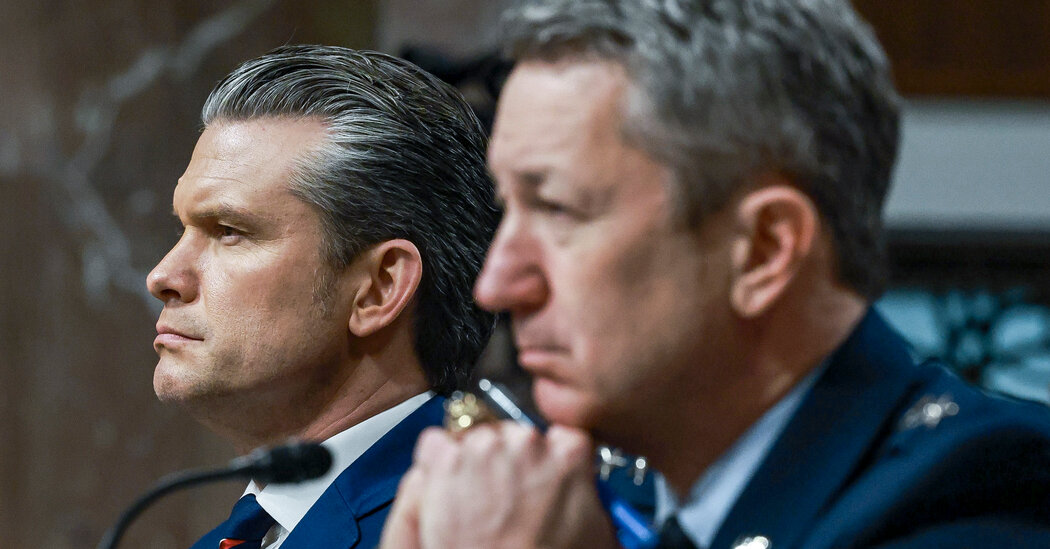
Imagine stepping into the cavernous halls of the U.S. Senate Armed Services Committee on a crisp Thursday morning, where the air buzzes with anticipation over the Defense Department’s jaw-dropping $1.45 trillion budget request—the biggest ever for the Pentagon. You might think the session would dive into spreadsheets and strategic breakdowns of how all that money flows into troop salaries, advanced weaponry, or global security initiatives. But if you were hoping for those nitty-gritty details, you’d walk away hungry. Instead, for three full hours, senators peppered Defense Secretary Pete Hegseth, Joint Chiefs Chairman Gen. Dan Caine, and Pentagon Comptroller Jay Hurst with pointed questions that zigzagged more around the ongoing U.S. confrontation with Iran and Hegseth’s own tenure in office. It felt less like a fiscal deep dive and more like a charged political standoff, where budget lines blurred into debates on war tactics, personal ideologies, and the human cost of conflict. As an observer, you couldn’t help but sense the underlying tension; this hearing wasn’t just about dollars and cents—it was a window into how American leaders grapple with a volatile world, where every detail from drone strikes to diplomatic blunders could tip the scales. And as the session unfolded, it became clear that the budget was a mere backdrop for deeper clashes on ethics, strategy, and the very soul of military leadership. You’d walk out not with a clear picture of fund allocations, but with a knot in your stomach about the trust—or lack thereof—between Congress and the Pentagon.
At the heart of the drama was Hegseth himself, a figure who wasted no time in playing the role of the defiant straight-shooter, railing against what he saw as the real enemy: not Iran, but fellow lawmakers. Picture this: right off the bat, he condemned congressional Democrats (and some Republicans) for their “reckless naysayers and defeatist words,” accusing them of undermining the fight against Iran. It was a stark echo of the fiery speech he’d delivered just a day earlier in the House. As someone watching, you might feel a mix of admiration and unease—was this plainspoken honesty, or divisive rhetoric designed to deflect scrutiny? Hegseth stood firm, insisting that these “adversaries” posed a greater threat to national security than any external foe. You could see Democrats in the room shifting uncomfortably, knowing this wasn’t just talk; it was a direct jab at their patriotism and support for troops. It reminded you of those heated family dinners where politics turns personal, where questioning the war isn’t just dissent but betrayal. In this charged atmosphere, Hegseth’s words didn’t just float; they lingered, reshaping the narrative around the hearing. If this was about allocating the nation’s largest-ever defense budget, why did it feel like a blame game, with Hegseth painting critics as saboteurs rather than collaborators in securing America’s future?
Diving deeper, the conversation shifted to the grim realities of civilian casualties in the Iran conflict, and it quickly turned into a sobering examination of humanity amid the chaos of war. Democratic senators like Kirsten Gillibrand and Richard Blumenthal zeroed in on Hegseth’s decision to slash the Civilian Harm Mitigation and Response office—a pivotal Pentagon unit established in 2022 after damning reports on indiscriminate deaths in past wars like Iraq and Afghanistan. “Why gut this office by 90 percent?” Gillibrand pressed, her voice steady but pointed. Hegseth brushed it off dismissively, dodging specifics and leaving questions unanswered. Then came haunting details about a Tomahawk missile strike that obliterated a girl’s elementary school on the war’s first day, claiming 168 lives. Blumenthal demanded answers on the Pentagon’s ongoing investigation, but Hegseth offered only vague reassurances that it remained “under review.” It was gut-wrenching to hear—imagining those innocent lives, children slaughtered in a supposed precision operation. Even Republican senators Mike Rounds and Dan Sullivan chimed in, asking point-blank if U.S. forces ever deliberately targeted civilians. Both Hegseth and Caine swore no, categorically. Yet, the evasion hung heavy, like a veil over the true toll of war. As a listener, you empathized with the senators’ frustration; these weren’t abstract policy debates but stories of real people devastated by our defense strategies. It made you wonder: if we’re pouring trillions into firepower, how much are we investing in preventing the preventable heartbreak that comes with it?
Things got even more personal when the topic turned to women in combat roles, unveiling layers of unspoken biases in the military’s upper echelons. Senator Mazie Hirono, unafraid of confrontation, grilled Gen. Caine three times on whether integrating women into combat units compromised standards, assuming they met the same rigorous physical benchmarks as men. Time and again, Caine sidestepped, mumbling non-committal responses about women “performing well” across specialties without endorsing their frontline roles outright. He deferred to “civilian leaders” for setting those, evading the core question. Hegseth chimed in with his own stance, insisting that the “highest male standard” should apply to all combat positions. It felt disingenuous, like a dance around equality in an institution built on meritocracy. Think about the countless female soldiers who put their lives on the line daily, fighting shoulder-to-shoulder with men—why the reluctance to celebrate their contributions? As someone reflecting on this, you might root for leaders like Hirono, who pushed for inclusivity, while feeling conflicted about Hegseth and Caine’s hedging. It wasn’t just about policy; it was about honor and fairness. In a time when the military desperately needs every capable body, these exchanges highlighted how old-school mindsets could limit our strength. You’d leave questioning if this reluctance stemmed from genuine concerns or deeper prejudices, wishing for voices that embraced diversity as a force multiplier.
The hearing simmered further with accusations of Christian nationalism and racial insensitivity, turning the room into a veritable powder keg. Senator Jack Reed, probing Hegseth’s record, highlighted the secretary’s pattern of sidelining women and Black men from top leadership spots, tying it to an overemphasis on Christianity and nationalism at the expense of diverse talents. “That’s the wrong direction,” Reed declared, his words sharp as a sermon. Hegseth erupted, visibly outraged, defending his faith in Jesus Christ and branding Reed’s critique a “smear” on his character. The exchange escalated as Reed pressed on Hegseth’s Pentagon prayer services and wartime justifications laced with religious rhetoric, cautioning that stressing Christianity didn’t foster a “neutral position” accepting all beliefs. It painted a picture of Hegseth as a leader who wore his religion like a badge, blurring personal creed with official duty. Then Senator Jacky Rosen escalated the tension, labeling Hegseth’s comparison of critics to biblical “Pharisees” as antisemitic, a term historically used to villainize Jewish groups as hypocritical. Rosen urged caution: “Words matter.” Hegseth doubled down, justifying it as a “pretty accurate” descriptor for those ignoring their own flaws while nitpicking successes in preventing Iranian nukes. The clash felt raw and revealing—here were leaders debating tolerance in a nation founded on pluralism. As an onlooker, you might feel the sting of divided ideologies, wondering how faith-driven leadership shapes our armed forces. It highlighted a fear: when personal beliefs dominate policy, could it erode the secular fabric of our democracy, alienating those of different backgrounds and prioritizing exclusion over unity?
Finally, the discussion circled back to the tangible, everyday impact of the Iran war on ordinary Americans, with Democrats spotlighting the economic fallout that hits pockets and gas tanks nationwide. They hammered home the chokehold on the Strait of Hormuz, a critical artery carrying 20 percent of global oil, leading to soaring prices and supply snarls. “We can’t claim victory until that’s open,” Senator Elissa Slotkin argued passionately, cutting through the polished rhetoric of “tactical successes.” It was a rare moment of bipartisan harmony when Senator Gary Peters echoed this, questioning when the war might end and stressing that no negotiations could flourish without securing the strait. Republican heavyweight Roger Wicker, the committee chair, surprisingly applauded Peters’ input, seeing it as constructive advice for bolstering U.S. efforts. This fleeting unity cut through the partisanship like a ray of light, proving that amid the shouting, shared goals could emerge. Yet, it underscored the hearing’s broader message: while Pentagon budgets balloon, war’s ripple effects cripple families struggling with inflation and uncertainty. As someone processing this, you could empathize with Peters and Slotkin—the war feels distant for many elites, but devastating for middle-class workers facing higher fuel costs or disrupted trade. It made you ponder: if trillions protect national interests, why does victory still feel so elusive, leaving Americans to foot the bill for prolonged conflict?
In wrapping up the hearing, it became evident that this budget discussion transcended mere finances, evolving into a searing critique of leadership, morality, and long-term strategy in an era of endless wars. Hegseth’s unapologetic defiance, the probing on civilian harms and inclusivity issues, the religious undertones, and the economic wake-up call all converged to expose fractures in how we wage and fund defense. You couldn’t help but feel disheartened by the evasion—questions unanswered, standards undefended, faith weaponized. Yet, the flicker of agreement between Peters and Wicker hinted at hope: perhaps in bipartisanship lay the path to wiser wars. As the session adjourned, leaving a record $1.45 trillion on the table, it prompted deeper reflection: Is this budget investing in a stronger America, or merely prolonging cycles of division and destruction? For everyday folks tuned in, it wasn’t just about military might; it was a reminder that true security starts with accountability, empathy, and unity, ensuring that the next generation inherits a nation healed, not scarred, by its conflicts. In humanizing these exchanges, we see not just politicians, but flawed individuals grappling with immense power—much like ourselves wrestling with big questions in a small world. And therein lies the challenge: transforming tense hearings into actions that honor the lives and livelihoods at stake.