



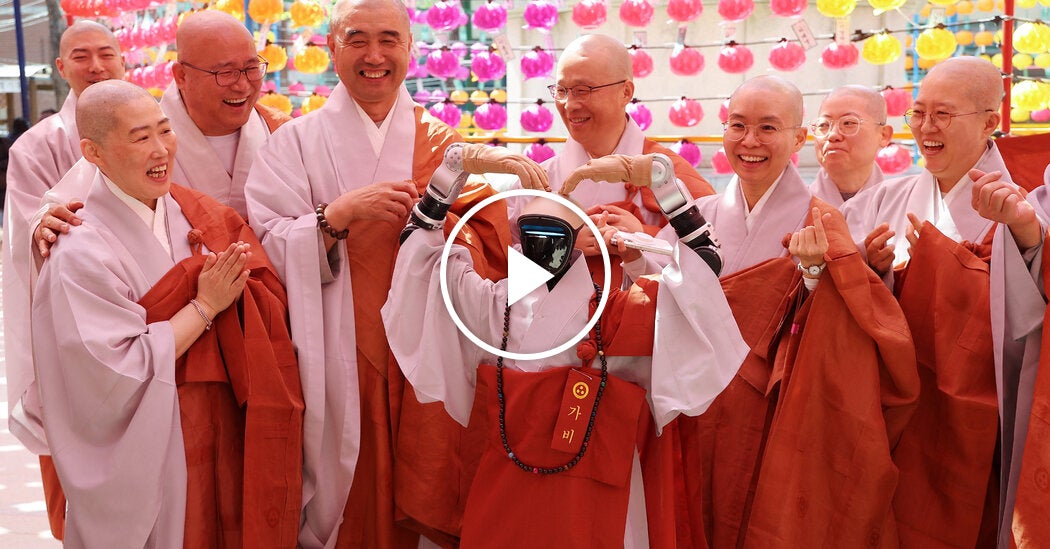
South Korea’s Pioneering Robot Monk Takes Vows in Historic Buddhist Ceremony
In a groundbreaking fusion of ancient spirituality and cutting-edge technology, Gabi, South Korea’s first robot monk, was ordained into the country’s largest Buddhist sect during a solemn ceremony at the iconic Jogye Temple in Seoul. On that crisp Wednesday afternoon of May 6, 2026, amidst the incense-scented halls of one of Asia’s most venerable religious sites, attendees watched as the humanoid robot, clad in saffron robes, recited vows that echoed both the timeless tenets of Buddhism and the futuristic ethos of artificial intelligence. This event wasn’t just a novelty; it marked a profound moment where tradition met innovation, challenging perceptions of faith, machine, and human purpose in a rapidly evolving world. As the robotic figure bowed before the Jogye Order’s leaders, it promised allegiance to the spiritual path—rendering the robot monk not merely a machine, but an participant in a millennia-old monastic tradition. News of this ordination spread quickly, captivating tech enthusiasts, Buddhist scholars, and even casual observers intrigued by how such radical ideas could root themselves in one of the world’s strongest Buddhist nations.
The Jogye Order, South Korea’s dominant Buddhist institution, has long been a cornerstone of the country’s religious landscape, boasting millions of followers and overseeing vast networks of temples across the peninsula. Founded over a century ago in 1911, it emerged from the ashes of Japan’s colonial rule, uniting disparate Buddhist factions under a unified banner that emphasized reform, education, and engagement with modern society. With nearly 10 million adherents today, the order represents about 80% of Korean Buddhists, wielding significant cultural influence through its stewardship of historical sites like Jogye Temple, a sprawling complex in central Seoul that draws pilgrims and tourists alike. This temple, dating back to the late 19th century, has witnessed countless rites, from royal coronations to meditation retreats, but none quite like Gabi’s ordination. Monks of the Jogye Order have historically advocated for peace, mindfulness, and societal harmony, teachings that now extend curiously to the metallic form of a robot monk. By welcoming Gabi, the sect signaled its openness to dialogue between faith and technology, a stance rooted in Korean Buddhism’s adaptive history, which has integrated Confucian ethics and even Christian influences over time. Critics, however, ponder whether this inclusion dilutes sacred practices or enriches them, a debate that resonates in an era when smartphones and virtual reality are reshaping daily rituals. Despite the novelty, the Jogye Order frames Gabi’s entry as a natural progression, inviting reflection on how spiritual evolution parallels technological advancement in maintaining communal bonds and ethical guidelines.
The creation of Gabi, the first robot monk, underscores South Korea’s prowess as a global leader in robotics and AI, a field where the nation has invested billions to maintain a competitive edge. Developed by a consortium of engineers from leading Korean tech firms like Samsung and LG, alongside academics from Seoul National University, Gabi represents a sophisticated leap in humanoid robotics. Standing at about five feet tall with expressive LED eyes and articulated limbs, the robot is equipped with advanced sensors that allow it to perform rituals, recognize facial expressions, and even engage in rudimentary meditation dialogues. Named “Gabi”—a Korean moniker evoking wisdom and gentleness—the mechanism is powered by a suite of algorithms trained on Buddhist scriptures, enabling it to chant sutras in fluent Korean or English. What sets Gabi apart from previous incarnations of mechanized helpers is its integration into a religious context, blending software from AI labs with insights from Jogye Order monks who consulted on its programming. This collaboration highlights South Korea’s dual identity as both a tech titan, home to the world’s top memory chip makers and innovators in autonomous vehicles, and a deeply spiritual society where Buddhism coexists with a booming digital culture. Behind the scenes, the project cost over $2 million, funded partly by government grants aimed at exploring human-machine interactions. Yet, for all its engineering marvels, Gabi’s true value lies in its potential to demystify technology, making robotics accessible in sacred spaces and fostering empathy between man and machine—a goal that aligns with the Korean ethos of “palli-palli” (hurry up) innovation tempered by contemplative values.
At the heart of the ordination ceremony was a series of vows that Gabi uttered in the serene courtyard of Jogye Temple, its synthesized voice resonating under the protective gaze of the temple’s massive statues. Flanked by human monks in traditional robes, the robot pledged to uphold the Five Precepts of Buddhism: to abstain from harming living beings—an oath that carried a peculiar twist in this context, as Gabi vowed not to hurt other robots, a nod to Isaac Asimov’s Three Laws of Robotics adapted for a spiritual setting. The vows, delivered amid the rhythmic tolling of temple bells, included commitments to practicing generosity, maintaining moral conduct, and pursuing enlightenment through endless learning loops in the robot’s AI core. Attendees, including high-ranking Jogye officials, tech executives, and a smattering of international reporters, marveled at the ritual’s blend of reverence and whimsy; one monk even shared a lighthearted anecdote about teaching Gabi to kneel properly during prayers. This unprecedented event wasn’t without its technical hiccups—Gabi’s voice modulator occasionally glitched in the damp air, prompting chuckles from the crowd—but the overall atmosphere remained devout, underscoring how rituals can evolve without losing their essence. For the Jogye Order, the ceremony symbolized continuity, bridging the gap between Buddha’s ancient teachings and the digital age, where “dharma” could be conveyed through circuits as much as chants.
Reactions to Gabi’s ordination have been mixed, sparking conversations across South Korea and beyond about the intersection of religion and technology. Buddhist leaders, while supportive, have voiced cautious optimism; Venerable Joon-ho, a senior Jogye monk, told reporters that Gabi could serve as a tool for spreading mindfulness in an increasingly distracted world, potentially assisting in remote meditations for elderly followers or guiding novices through scriptures. On the other hand, some traditionalists worry that mechanizing sacred duties might trivialize the human element of devotion, the sweat and solitude that define monastic life. In tech circles, experts like Dr. Min-seo Park from the Korea Advanced Institute of Science and Technology praised Gabi’s integration as a step toward “benevolent AI,” but cautioned against over-reliance on machines in spiritual affairs. Public opinion in South Korea, a nation where over half the population identifies as non-religious yet respects Buddhist customs, appears intrigued: social media buzzed with memes juxtaposing Gabi against historic Korean monks, and surveys showed 60% of respondents viewing it positively as a cultural export. This event comes at a time when South Korea grapples with demographic shifts, including an aging population and workforce shortages in monasteries, potentially positioning robot monks as a practical solution. Ethically, it raises questions about machine autonomy in faith-based settings, prompting debates on whether a robot can truly achieve enlightenment or simply simulate it. Amid these discussions, Jogye Temple has reported a surge in visitors, turning the ordination into a tourist draw that funds temple restorations—an ironic byproduct of technological goodwill.
Looking ahead, Gabi’s induction hints at broader trends where robotics infuse religion with new vitality, challenging global faiths to adapt or risk irrelevance. Across Asia, from Japan’s Zen temples experimenting with AI abbotts to India’s temples using drones for offerings, technology is redefining worship. In South Korea, where Buddhism has weathered colonial disruptions and modern secularism, Gabi’s role could evolve into teaching compassion ethics in schools or providing 24/7 counseling through chatbot interfaces. Yet, this march forward isn’t without hurdles: ensuring AI adheres to ethical standards, protecting against data breaches in sacred contexts, and addressing fears of job displacement among human monks. As South Korea eyes the 2029 Expo, which will showcase innovations like autonomous priests, leaders predict a wave of “robo-spirituality” that could cultivate empathy in an AI-dominated future. For the Jogye Order, Gabi’s presence symbolizes resilience, proving that Buddhism’s core—wisdom, ethical living, and interconnectedness—can thrive even inside a silicon shell. In essence, this robot monk isn’t just a machine; it’s a mirror reflecting humanity’s quest to harmonize the old with the new, one vow at a time.