


Maduro’s Capture: From Venezuelan Presidency to a U.S. Federal Detention Center
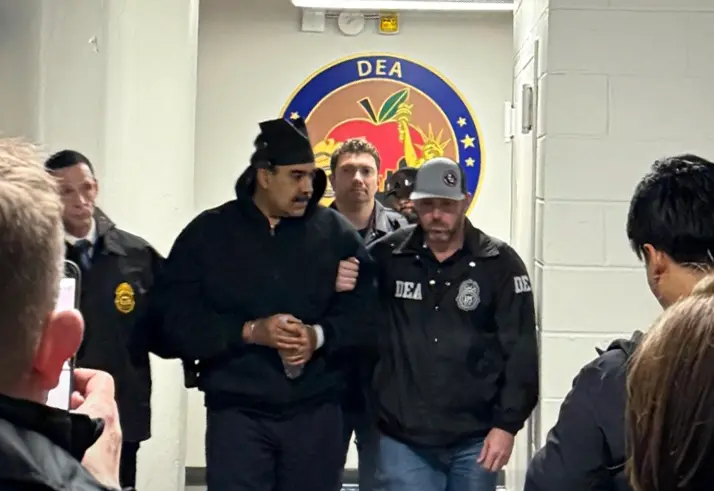
In a stunning turn of events that has captivated international attention, former Venezuelan President Nicolás Maduro has been captured by U.S. forces and brought to American soil to face serious criminal charges. The first images of Maduro since his apprehension show a dramatically different figure from the powerful leader who ruled Venezuela with an iron grip for years. Dressed in simple black sweatpants and a hastily placed black hat, Maduro was photographed at the Drug Enforcement Administration headquarters in Manhattan’s Chelsea neighborhood, clutching a water bottle while under the watchful eyes of federal agents. This jarring visual represents a dramatic fall from power for the man who once commanded one of South America’s most resource-rich nations and stood as one of the region’s most controversial political figures.
The White House released a video of Maduro at the DEA office with the pointed caption “Perp walked,” highlighting the U.S. government’s framing of the operation as a law enforcement action rather than a political intervention. In the footage, Maduro can be heard seemingly making the incongruous statement, “Good Night, Happy New Year,” a bizarre greeting that underscores the surreal nature of his situation. The casual pleasantry stands in stark contrast to the gravity of his circumstances and the charges he now faces. This brief glimpse into Maduro’s demeanor following his capture suggests either a disconnect from reality or perhaps a calculated attempt to project normalcy in an extraordinarily abnormal situation. The overnight operation that resulted in his capture represents one of the most significant U.S. actions against a foreign leader in recent years, reminiscent of operations against figures like Panama’s Manuel Noriega in 1989.
Following their initial processing at DEA headquarters, Maduro and his wife, Cilia Flores, were transferred to the Metropolitan Detention Center in Brooklyn, a facility that has housed numerous high-profile defendants over the years. The couple’s journey from presidential palace to American prison cell marks an unprecedented diplomatic and legal situation, as they now await their first court appearance before the Southern District of New York. The charges they face are substantial – narco-terrorism allegations that accuse Maduro of turning Venezuela into a narco-state and using drug trafficking profits to cement his political power. These charges carry potential life sentences, representing a complete reversal of fortune for a couple who once enjoyed the privileges and protections of executive power in their homeland.
This capture operation comes after years of escalating tensions between the United States and Maduro’s regime. The U.S. government had previously placed a $15 million bounty on Maduro’s head, designating him as a narco-trafficker rather than recognizing him as Venezuela’s legitimate president. The Biden administration, continuing policies initiated under former President Trump, had recognized opposition leader Juan Guaidó and later other opposition figures as Venezuela’s rightful leadership. The timing of the capture raises questions about its potential impact on U.S. domestic politics, occurring as it does during a heated presidential election season where immigration and border security – issues often linked to Venezuela in political discourse – remain contentious topics. The operation demonstrates the continued willingness of the United States to use its military and law enforcement capabilities to pursue those it considers threats to regional security and American interests.
For Venezuelans both in their homeland and among the diaspora that has fled the country’s economic collapse, Maduro’s capture represents a momentous development with uncertain implications. Under Maduro’s leadership, Venezuela experienced one of the most severe economic collapses in modern history, with hyperinflation, widespread hunger, medicine shortages, and a refugee crisis that has seen millions flee the country. His critics have long accused him of dismantling democratic institutions, persecuting political opponents, and rigging elections to maintain power. However, Maduro has maintained support among some segments of Venezuelan society, particularly those who benefited from the social programs established under his predecessor, Hugo Chávez, or who view American intervention with deep suspicion rooted in the region’s complex history with U.S. foreign policy.
As Maduro and his wife prepare for their expected Monday court appearance, the international community watches with rapt attention. The case presents complex questions of international law, sovereignty, and the limits of American power projection. For the justice system, it represents a challenging test case of how to handle a former head of state accused of transforming his nation into a criminal enterprise. For Venezuela itself, Maduro’s capture creates a power vacuum with unpredictable consequences. Will his allies maintain control, or will opposition forces gain momentum? Will this accelerate Venezuela’s potential return to democracy, or trigger new rounds of instability? As these questions linger, the image of Maduro – once one of Latin America’s most powerful leaders – now shuffling through a DEA facility in prisoner’s garb serves as a stark reminder of how dramatically fortunes can change in the volatile world of international politics and power struggles.