


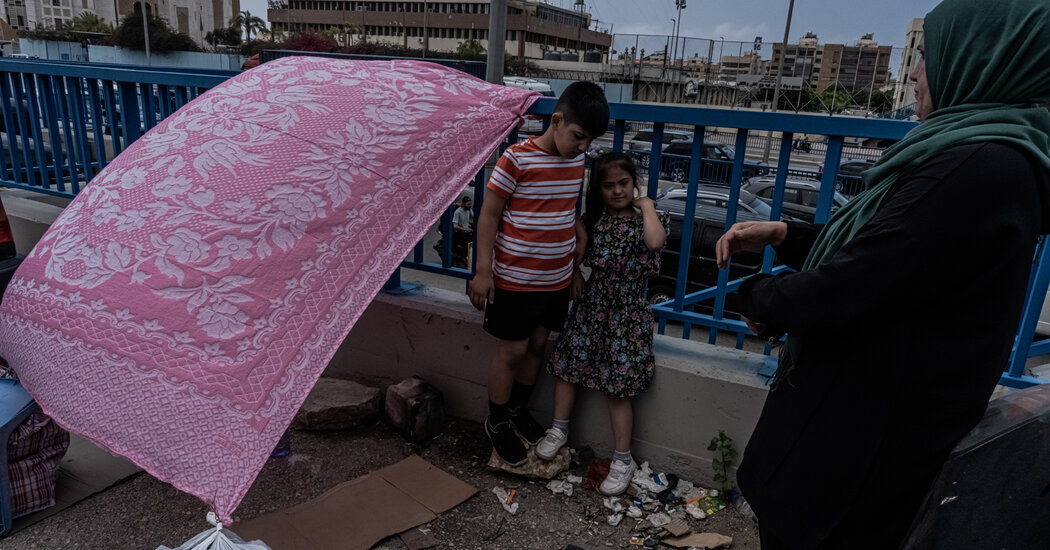
The highways of southern Lebanon on Monday transformed into a chaotic, sun-baked landscape of desperation, choked with thousands of vehicles carrying families who had packed their entire lives into suitcases and strapped mattresses to the roofs of their cars. This mass exodus, fueled by sheer panic, was triggered by Israel’s ominous warnings of imminent, crushing airstrikes targeting the southern suburbs of Beirut—a densely populated urban heartland already reeling from the psychological terror of encroaching warfare. For many of the elderly fleeing their homes, the unfolding nightmare carried a devastating sense of déjà vu. The sight of the Israeli military advancing deeper into southern territory and hoisting the blue-and-white state flag over the historic stone ramparts of Beaufort Castle—a medieval Crusader fortress that served as the grim nerve center of Israel’s nearly two-decade-long southern occupation from 1982 to 2000—reopened deep, generational wounds. In Beirut and across the villages of the south, the raising of that flag was not just a military maneuver; it was felt as a direct assault on Lebanese dignity and a terrifying signal that history was repeating itself. As local public shelters quickly overflowed, leaving women, children, and the elderly to sleep in crowded school corridors and public parks, the fear of a permanent, expanding foreign military occupation settled over the nation like a heavy shroud. This human suffering soon echoed all the way to New York, where Martha Ama Akyaa Pobee, a senior United Nations official, pointedly reminded the world that Israel’s military presence north of the internationally recognized Blue Line constituted a flagrant violation of Lebanon’s sovereignty and territorial integrity, sending shockwaves of instability throughout an already fragile Middle East.
Away from the dusty, terror-filled roads of the Levant, the crisis reached a boiling point within the sterile, green-marble chamber of the United Nations Security Council in New York, where an emergency meeting requested by France highlighted a stark and deepening global divide. While the translation headsets buzzed with urgent diplomacy, a striking near-unanimity emerged among the council’s members, who collectively demanded that Israel immediately halt its northern offensive, withdraw its forces from Lebanese soil, and refrain from launching any further escalatory attacks. This collective front, however, was fractured by a glaring exception: the United States. Having initiated a highly controversial war with Israel against Iran back in February, Washington stood virtually alone in its refusal to condemn the Israeli incursion, choosing instead to focus its rhetorical energy entirely on blaming Iran and its heavily armed proxy, Hezbollah. The atmosphere in the chamber was thick with frustration as diplomats representing the world’s major powers argued that a massive regional war was unfolding in real-time while the council remained historically paralyzed. The contrast between the cold, procedural decorum of the United Nations headquarters and the raw, frantic terror of families hiding from airstrikes in Beirut could not have been more pronounced, underscoring the profound difficulty of translating international law into actual protection for human lives on the ground.
As the threat of a catastrophic regional inferno loomed, the geopolitical puppet strings were being pulled across multiple capitals, revealing a delicate global chess game where a single miscalculation could prove fatal. At the center of this diplomatic storm was a highly fragile, behind-the-scenes peace negotiation between the United States and Iran, a deal aimed at defusing a broader conflict that Tehran now threatened to abandon completely if Israel carried through with its promised devastation of Beirut. The stakes became even more precarious when President Donald Trump intervened directly, claiming through backchannel diplomacy that he had personally pressured Israel to halt its impending strikes on Lebanon, while simultaneously securing a promise from Hezbollah to refrain from launching retaliatory rocket barrages deep into Israeli territory. Despite this temporary and highly unstable pause, the underlying hostility remained incredibly volatile; Hezbollah had initially entered the fray in early March, launching rockets into northern Israel under the banner of defending its primary patron, Iran, shortly after the wider war erupted. In response, Iran’s armed forces escalated the psychological warfare by issuing sweeping evacuation warnings for northern Israel, advising civilian residents to flee their homes immediately if Beirut were to be attacked. This hyper-escalation left ordinary citizens on both sides of the border trapped in a terrifying state of limbo, their daily survival entirely subject to the whims of military commanders and foreign leaders.
Within the council chamber, the debate quickly devolved into sharp, public recriminations, exposing the deep rifts between traditional allies and highlighting the tragic helplessness of the Lebanese state. Jérôme Bonnafont, the French ambassador to the U.N., did not mince words, declaring that Israel was committing a “major strategic mistake” in Lebanon, arguing that while Israel maintains an inherent right to self-defense against Hezbollah’s relentless March rocket attacks, absolutely nothing could justify the devastating scale and disproportionate nature of its current military operations. Britain’s deputy ambassador, James Kariuki, echoed these concerns in equally damning terms, labeling the Israeli military actions a “reckless and disproportionate escalation” that systematically dismantled civilian infrastructure and placed the fragile, cash-strapped government of Lebanon under an unbearable strain. The central tragedy of the conflict was embodied by the Lebanese government itself, represented at the U.N. by Ambassador Ahmad Arafa; though Beirut has tried to engage in direct, desperate negotiations with Israel to bring an end to the hostilities, the official government yields virtually no power or security consensus over Hezbollah, leaving the sovereign state of Lebanon to suffer the devastating consequences of a war it did not start and cannot control. Conversely, Israel’s ambassador, Danny Danon, adamantly rejected allegations of territorial ambition, shifting all blame to Hezbollah for transforming peaceful northern Israeli communities into ghost towns through intensified rocket fire, claiming that Israel’s actions were merely a necessary defense against a non-state army bent on its destruction.
This cycle of violence and subsequent diplomatic hand-wringing drew sharp criticism from a diverse coalition of non-permanent council members—including Colombia, which held the rotating presidency for the month of June, alongside Denmark, Liberia, the Democratic Republic of Congo, Pakistan, and Bahrain. These nations jointly warned that a continued barrage of airstrikes, coupled with the mass displacement of Lebanese civilians and the systematic destruction of their towns, would permanently erase any lingering hopes for a durable, lasting peace in the region. Ambassador Arafa of Lebanon delivered a scathing, emotional critique of the Security Council’s historical failures, pleading with the body to finally find its collective voice and soundly condemn Israel’s actions rather than remaining a passive observer to tragedy. He argued passionately that the international community’s repeated failure to hold Israel accountable for previous incursions had created a dangerous culture of absolute impunity, a systemic double standard that continually emboldens the perpetrator to commit the exact same campaigns of violence time and time again without fear of consequence. For these smaller nations, the crisis in Lebanon was not just a localized conflict, but a defining test of the post-World War II international order, proving once again that when major global powers clash, the rules of sovereignty and human rights are easily discarded.
Ultimately, as the emergency session drew to a close without a concrete resolution, the immediate fate of millions of people hung by a thread, precariously balanced on the temporary, rhetorical ceasefire claimed by President Trump. For the tens of thousands of displaced families huddled in crowded schools, unfinished buildings, and public parks across Lebanon, the grand speeches delivered in New York offered cold comfort against the chilling reality of their ruined livelihoods and uncertain futures. The haunting presence of the Israeli flag fluttering atop Beaufort Castle remained a stark, physical reminder of how quickly past horrors can reclaim the present, leaving an entire generation of Lebanese children to inherit the same trauma of dispossession and fear that their parents endured decades prior. In northern Israel, families similarly remained on high alert, their lives disrupted by sirens and the constant threat of retaliatory fire, proving that violence yields no security for either side of the border. As the world watches to see if the delicate diplomatic maneuvering will prevent a total collapse into war or simply delay the inevitable, the human heart of this tragedy remains unchanged: a desperate, universal yearning for a life free from the terror of falling bombs, a simple peace that continues to be denied to ordinary people caught in the crossfire of geopolitical giants.