On a brisk Thursday morning, the majestic steel span of the Queensboro Bridge—a vital, historic artery connecting the bustling landscapes of Manhattan and Queens—served as the backdrop for an unimaginable tragedy that shattered the morning routine of thousands of New York City commuters. For thousands of New Yorkers, the daily journey across this bridge is a beloved ritual of transition—a physical and mental space between home and livelihood, quiet reflection and the roar of the working day. Yet, at approximately 8:21 a.m., when the bridge was alive with the rhythmic hum of rush-hour traffic, this vital connector was suddenly transformed into a site of devastating horror. In the dedicated bike lane, a path specifically designed to keep non-motorized travelers safe from the roaring flow of automobiles below, two lives intersected with catastrophic force. A 39-year-old man riding a westbound stand-up electric scooter collided head-on with a 35-year-old cyclist heading eastbound on a white bicycle. These two individuals, representing different lives, responsibilities, and dreams, were simply trying to navigate their morning routines, trusting the city’s shared lanes to carry them safely to their destinations. In a fraction of a second, the quiet whir of wheels transformed into an impact of extreme violent force. This tragic incident highlights the painful fragility of human existence in a fast-paced metropolis where the aggressive pursuit of speed and momentum often obscures our shared physical vulnerability. It leaves two families suddenly broken, friends paralyzed by unexpected grief, and an entire community of city commuters questioning the safety of the very paths they rely on to return home each night. We must look beyond the sterile numbers of the police report to see the human faces of these two men, who woke up that morning expecting nothing more than a normal workday, only to have their futures erased on a bridge suspended high above the East River. Their sudden deaths cast a somber shadow over the bustling city, forcing us to reckon with the heavy price we pay for unregulated speed on our communal pathways.
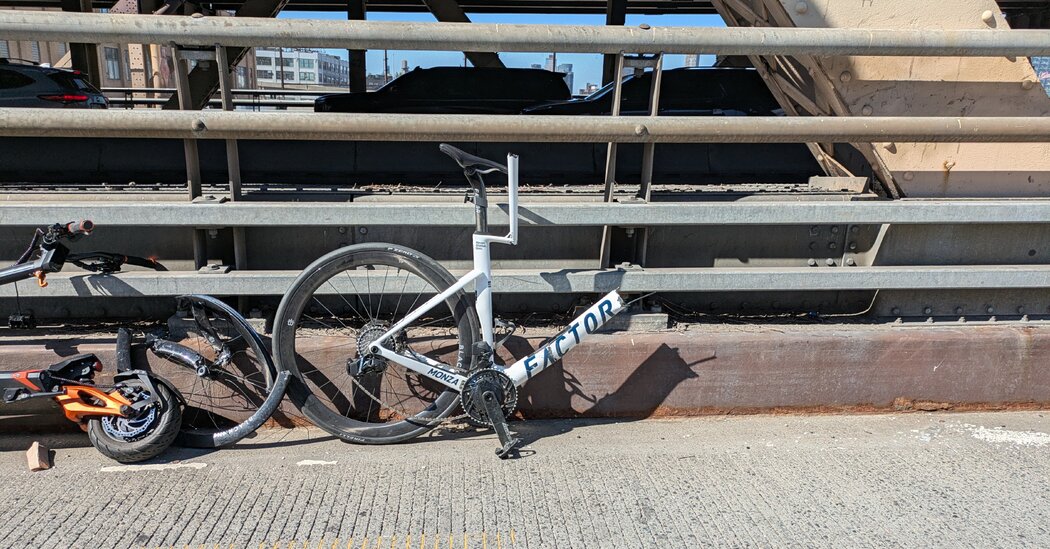
The physical aftermath of the collision, frozen in photographs taken shortly after the impact, presented a graphic, heart-wrenching reality of the violence that had taken place. A white commuter bicycle, an elegant symbol of active transit and low-impact travel, sat crumpled against the steel framework of the bridge, its frame violently snapped completely in half by the raw energy of the collision. Next to the shattered remnants of the bicycle lay an orange electric standing scooter, heavy and mechanically intact, its metallic frame standing as a grim testament to the motorized power that has increasingly populated our urban pathways. The front tire of the bicycle was utterly crushed, bent at an impossible, unnatural angle against the concrete barrier of the bridge, illustrating the absolute lack of physical protection afforded to traditional cyclists in high-impact scenarios. Emergency medical workers arrived swiftly, navigating the congested morning roadways to administer urgent care to the two severely injured men lying on the cold concrete. They were carefully loaded into ambulances and rushed across the river to NewYork-Presbyterian Hospital in Queens, where medical staff stood ready to perform emergency trauma care in a desperate bid to save them. However, the force of the head-on collision had inflicted injuries far too severe for medical science to overcome; both men were tragically pronounced dead shortly after their arrival. The cold, clinical reality of the hospital room became the tragic final chapter of their morning, sending shockwaves of grief through their families and leaving the wider cycling community deeply shaken. They were sons, friends, and neighbors whose sudden departure leaves an echo of grief that will linger long after the physical debris has been cleared from the bridge. The image of that shattered white bicycle, resting broken in the middle of a lane meant for safety, stands as a haunting monument to the vulnerability of the human body against motorized momentum, reminding every commuter of the invisible dangers that walk hand-in-hand with our modern technological advancements.
As investigators worked to piece together the exact mechanics of the crash, the spotlight quickly shifted to the specific vehicle that had introduced such lethal velocity into a pedestrian-adjacent space. Vincent Barone, speaking on behalf of the New York City Department of Transportation, confirmed that the orange stand-up electric scooter involved in the collision was entirely illegal for public street use under current city laws. The vehicle was engineered to achieve speeds far beyond the legal limits established by the city to protect vulnerable road users in designated bike lanes. Under municipal ordinances, the maximum speed for bicycles and electric bikes in these lanes is strictly capped at 15 miles per hour, and any standing electric scooter without a seat is completely outlawed if it is mechanically capable of exceeding 20 miles per hour. By operating a vehicle of this caliber on a narrow bridge path, the rider had introduced highway-level kinetic danger into a zone designed for gentle, human-powered movement. Danny Pearlstein of the Riders Alliance, an advocacy group focused on equitable transit policy, voiced the widespread community anger by comparing the deployment of these ultra-fast, unregulated machines on city streets to “throwing a grenade” into a public space. Pearlstein pointedly blamed the manufacturers and distributors who produce and market these heavy, high-speed devices, accusing them of bypassing local safety laws, misleading consumers, and prioritizing profit over the preservation of human life. This is a critical distinction that moves the blame away from individual choices and forces us to look at the systemic corporate greed that allows dangerous, high-speed motorized vehicles to flood our public markets without consequence. When a company sells a device capable of highway speeds to someone navigating a crowded bike path without a license or training, they are directly contributing to the violence that unfolded on that bridge, creating an environment where a simple trip to work becomes a high-stakes gamble with death.
The tragedy on the Queensboro Bridge exposes a profound and systemic paradox in how modern cities attempt to design safe infrastructure for their citizens. Just last year, the Department of Transportation celebrated a massive redesign of the bridge’s outer roadways, a long-sought triumph for safe-streets organizers that successfully separated bicycle traffic from pedestrians and doubled the available space for micromobility. The expansion was envisioned as a sanctuary, a progressive leap forward to encourage eco-friendly travel and foster a peaceful, community-oriented path across the river. However, this fatal accident reveals that physical space is only one component of a safe transit ecosystem; infrastructure cannot protect users if the vehicles allowed inside it are fundamentally mismatched in mass and speed. The traditional, human-powered bicycle is now forced to share narrow, bi-directional lanes with heavy, fast-moving motorized vehicles that behave more like light motorcycles than active transit devices. This vast discrepancy in kinetics turns protected lanes into high-hazard zones, proving that without active enforcement and severe restrictions on vehicle weights and speeds, even the most well-designed urban pathways will remain dangerous arenas where vulnerable commuters pay the ultimate price. We cannot simply build wider lanes and declare the job finished; we must actively govern what is permitted to enter those lanes, ensuring that the peaceful, low-speed environment of pedestrian and cycling paths is not compromised by the relentless intrusion of heavy, high-speed motorized transit. The Queensboro Bridge redesign was meant to be a crowning achievement of urban planning, a testament to what is possible when we design cities for people rather than cars. Yet, this tragedy shows us that physical infrastructure is only as safe as the regulations that govern its use. When we allow heavy, motorized vehicles to share tight spaces with human-powered bicycles without strict speed controls, we are creating a recipe for disaster that undermines the very purpose of our progressive street designs.
In the devastating wake of this preventable double tragedy, advocacy groups are turning their grief into political pressure, demanding that city officials take immediate, decisive action to prevent future loss of life. Ben Furnas, the executive director of the prominent advocacy organization Transportation Alternatives, released a somber and urgent statement emphasizing that this horrific crash was entirely avoidable. He used the occasion to renew a passionate plea for the passage of a pending City Council bill that would outlaw the retail sale of any e-bikes or electric scooters capable of traveling faster than 20 miles per hour. Furnas emphasized a simple, life-saving philosophy that advocates have championed for years: “Twenty is plenty—no matter who you are or how you’re traveling,” delivering the stark reminder that, at its core, “speed kills.” This legislative push represents a vital shift towards proactive safety, moving away from reactive emergency responses and focusing instead on regulating the supply chains that flood city streets with dangerous, overpowered machinery. It frames the issue of micromobility safety not as a matter of personal commuter choice, but as a critical public health crisis that demands strict oversight, corporate accountability, and a collective commitment to protecting human bodies from deadly kinetic violence. We must move beyond the rhetoric of personal responsibility and realize that without systemic legislative intervention, our streets will continue to be battlegrounds where lives are cut short by speed. The bill currently before the City Council represents a crucial opportunity to draw a line in the sand, establishing that our communities will no longer tolerate the unchecked sale of lethal, high-speed motorized vehicles. By placing strict limits on what can be sold to the public, we can cut off the supply of these dangerous devices at the source, preventing them from ever entering our shared pathways and ensuring that we do not have to witness another heartbreaking scene of destruction on our city’s bridges.
Ultimately, the painful loss of these two lives on the Queensboro Bridge must serve as a turning point for the soul and safety of New York City’s public streets. The 39-year-old and 35-year-old men who died on Thursday morning were not merely statistics or obstacles in an urban transit grid; they were beloved family members, friends, and valuable community members whose sudden absences leave a permanent, aching void. Looking at the heartbreaking images of the snapped white bicycle frame and the heavy orange scooter, we are forced to recognize that a city’s greatness is measured by how safely and humanely it protects its most vulnerable travelers. Moving forward, New York must transcend simple lane-painting and adopt a comprehensive safety strategy that includes strict crackdowns on illegal high-speed vehicle manufacturing, meaningful speed enforcement, and a cultural shift toward shared responsibility and mutual care. We must reject the harmful notion that our streets are merely competitive conduits for high-speed travel and instead reclaim them as safe, shared spaces where every person can travel with dignity and the absolute assurance of arriving home safely. Only by honoring the memory of these two lost commuters with bold, systemic changes can we build a city where our iconic bridges serve as pathways of connection and life, rather than sites of preventable tragedy. Let us dedicate ourselves to this urgent work, ensuring that no more families have to experience the devastating phone call that changed the lives of two local families forever on that fateful Thursday morning. We must cultivate a city where the simple act of choosing a green, active commute is not met with the threat of death, but with the support of a protective community and robust, safe infrastructure. It is time to reclaim our public spaces as warm, human-centered arteries where neighbors look out for neighbors, and where the preservation of life is always prioritized over the convenience of speed. By transforming our collective grief into action, we can build a safer, more compassionate New York for everyone.