

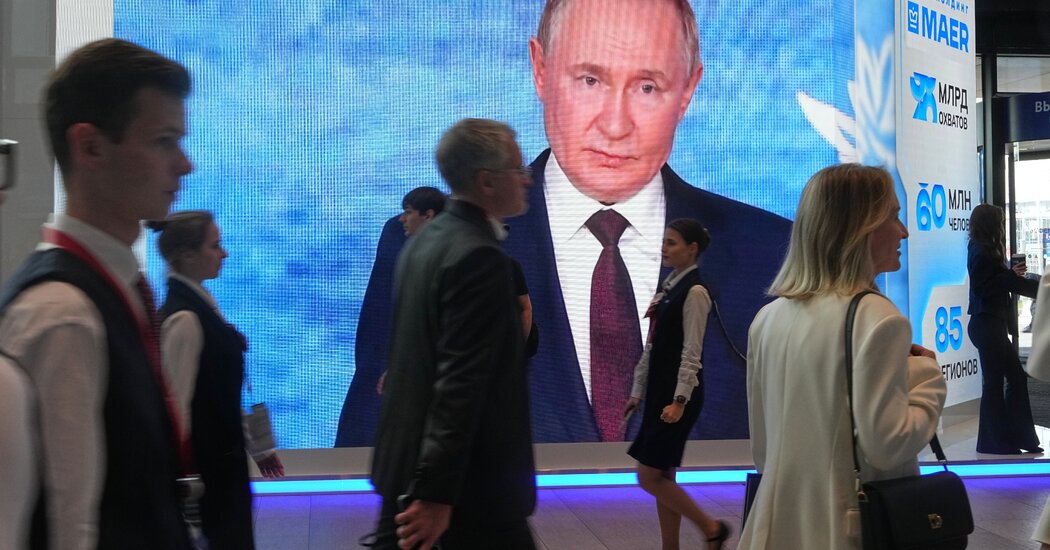
In the hopeful autumn of President Donald Trump’s Second Term, the corridors of power in Moscow hummed with a quiet, desperate optimism. Members of the Russian elite allowed themselves to dream of a grand masterstroke of diplomacy—one where a sympathetic American administration would effortlessly sweep the messy conflict in Ukraine under the rug, lift paralyzing sanctions, and reopen the floodgates of lucrative transcontinental business deals. Yet, more than sixteen months into this hypothetical future, those lofty dreams of a total geopolitical reset have shriveled into something far more modest, almost surreal. Today, the singular tangible agreement between the two historical adversaries is not a landmark peace treaty or a massive trade accord, but a simple game of hockey. Scheduled to take place in Moscow, the match features an unspecified roster of Russian and American players who will lace up their skates to face off on the ice. This lone concession to diplomacy was proudly unveiled during Vladimir V. Putin’s flagship St. Petersburg International Economic Forum, an event once teeming with Wall Street titans that has now transformed into a theater of forced resilience, showcasing Russia’s determination to survive Western isolation by pivoting toward new allies in Asia and the Middle East, even as its heart still beats with a longing for Western validation.
This striking contrast reveals a country caught in a profound psychological schism, split down the middle between hawkish security forces who preach an uncompromising, fire-and-brimstone hostility toward the West, and a quieter, technocratic elite who yearn for a rational thaw in relations. This year, the forum’s organizers went to extraordinary lengths to welcome a highly unusual flock of Americans, demonstrating that despite the frost, Russia refuses to fully slam the door on Washington. The crown jewel of this charm offensive was a dedicated session on Russian-American cultural ties, headlined by a minor yet fascinating American official: Rodney Mims Cook Jr., the chairman of the U.S. Commission of Fine Arts. Cook, who advises the White House on projects ranging from a grand ballroom expansion to a proposed triumphal arch in Washington, became the first U.S. official to grace the forum since 2018. Sharing the spotlight with him in St. Petersburg was Candace Owens, the fiery, right-wing American podcaster and cultural commentator. Together, this bizarrely mismatched pair of American voices became the focal point of intense state-media fascination, treated by the Russian establishment with a level of fanfare usually reserved for visiting heads of state.
For Candace Owens, the trip was a triumph of mutual flattery, eagerly broadcasted by the state’s propaganda apparatus to a domestic audience hungry for Western approval. Having arrived in Moscow mapping out a personal voyage of discovery, Owens publicly marveled at the city, declaring it a spotless, orderly metropolis that shattered every negative stereotype she had been fed back home. Beyond her tourist observations, Owens stepped onto a forum panel dedicated to balancing parenthood with a high-flying career, where she was greeted with an almost maternal warmth by Russian television anchor Maria Sittel. In a moment of pure theatrical kinship, Sittel leaned toward Owens and asked, “Where do you get so much Russianness from, Candace? You are just so, so one of us!” For her part, Owens leaned heavily into the embrace, asserting that ordinary citizens in both the East and the West are fighting the exact same cultural battles against a manipulative media establishment that manufactures division where none actually exists. She confidently told her audience that the American public is growing increasingly tired of funding the war in Ukraine, offering her hosts exactly what they wanted to hear: a confirmation that their enemies abroad are weary, divided, and secretly admiring of the Russian way of life.
Meanwhile, in another corner of the forum, Rodney Mims Cook Jr. steered his panel toward the romantic notion that art and beauty can construct bridges where political diplomacy has collapsed. Cook charmed the room with tales of his deep personal affinity for Russia, describing his Atlanta home which he lovingly designed in a “Russian wooden vernacular” style, and recalling the time he rode horses alongside Leo Tolstoy’s great-grandson. Sitting before a prestigious audience of Russian cultural royalty—including Valery Gergiev, the controversial director of the Bolshoi and Mariinsky theaters, and Mikhail Piotrovsky, the director of the Hermitage Museum—Cook’s session buzzed with a shared, desperate belief in the power of cultural diplomacy. The panelists collectively fantasized about a near future where the “massive block of ice” between their nations could be melted by the warmth of a spotlit stage. They even proposed that Gergiev himself could inaugurate a new era of friendship by conducting a performance inside Trump’s newly completed White House ballroom or beneath the proposed Washington triumphal arch. It was a poignant display of escapism, showing how Russia’s cultural elite, frozen out of Western concert halls, still cling to the belief that the shared language of classical music and ballet can wash away the blood and division of the geopolitical present.
However, the warm, nostalgic glow of the St. Petersburg panels crashed headfirst into the cold, unyielding reality of official Washington. When questioned about the American presence at the forum, U.S. Secretary of State Marco Rubio seemed completely oblivious to the cultural overtures, stating flatly that he was unaware of any American delegation and dismissively noting that any U.S. citizen present certainly did not represent a high-level official capacity. Rubio went on to confirm that the United States is actively drafting a fresh slate of punitive economic sanctions, reminding the world that the geopolitical machinery of Washington remains entirely unmoved by the soft-power theater in St. Petersburg. This stark disconnect highlights what Robert Agee, the president of the American Chamber of Commerce in Russia, described as an absolute lock on normal relations. Agee argued that because official channels are utterly paralyzed, humanity must look to sports and culture as the only remaining conduits for basic human connection. His simplistic, heartfelt plea—to just “play hockey together” and “have a ballet in New York”—captures the exhaustion of business leaders and cultural figures who find themselves trapped inside a geopolitical freezer, hoping that a sliding hockey puck can somehow crack the ice.
The ultimate irony of Russia’s quest for Western validation played out in Moscow with the surreal arrival of Andrew and Tristan Tate, the highly controversial British-American internet personalities currently facing serious criminal charges of human trafficking and organized crime. The Tate brothers, notorious figures of the internet’s toxic “manosphere,” were greeted on the tarmac by a traditional choir of Russian folk singers and dancers, a welcoming comedy that perfectly illustrated Moscow’s willingness to embrace any Western dissident, no matter how compromised. Yet, this spectacle did not sit well with everyone in Russia, exposing a deep rift of hypocrisy that irritated domestic nationalists. Roman Antonovsky, a prominent Russian right-wing blogger, voiced his disgust online, pointing out the absurdity of the state’s behavior. “We are supposedly ridding ourselves of worshiping the West,” Antonovsky wrote bitterly, “yet we continue to grovel before some Western clowns.” Ultimately, this grand dance of cultural overtures, hockey games, and internet celebrities reveals a nation locked in a profound identity crisis: a Russia that loudly proclaims its independence from a decaying Western world, yet remains deeply, tragically hungry for the applause, the presence, and the validation of anyone carrying an American passport.