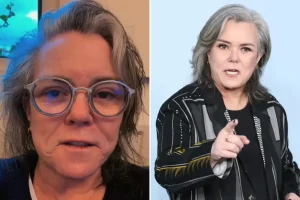


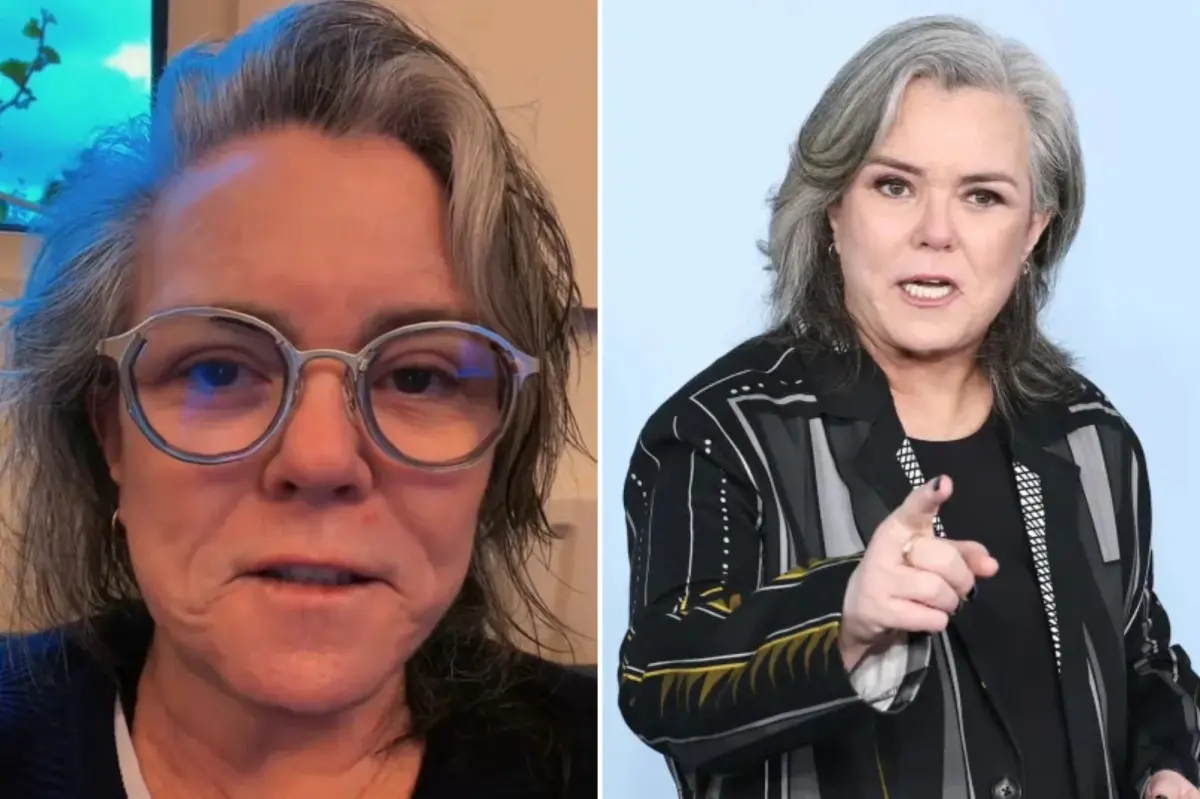
For Rosie O’Donnell, Ireland has been a beautiful exile—a green, quiet refuge from the political storm she left behind when Donald Trump returned to the White House in 2024. She packed up her life, crossed the Atlantic, and settled into Dublin, where she could breathe without the constant noise of American politics. And in many ways, she loved it. She has described the city as lovely, the people as warm, and the slower rhythm of life as a balm. But no matter how charming the cobblestone streets or how comforting the Irish rain, something essential has been missing. Her family. Her children. Her grandson. In a candid interview with The Washington Post, O’Donnell admitted that the beauty of Dublin can’t replace the ache in her heart. “Dublin is beautiful — we love it here, but my family’s not here,” she said. The words are simple, but they carry the weight of a woman who has spent years in the spotlight, only to find that the spotlight means nothing when you’re far from the people you love. She has four children with her ex-wife Kelli Carpenter, and one child with her late ex-wife Michelle Rounds, and they are scattered in a way that makes Dublin feel less like home and more like a waiting room. But the deepest pull is her grandson, born just six months ago. “I miss my grown kids. I miss my grandson that was born six months ago,” she said, her voice thick with emotion. “And I feel like I’ve missed half his life already and don’t want to miss any more.” That sentence is the heart of her homesickness—a grandmother doing the math of lost time, counting the months, the milestones, the tiny smiles she’s only seen through a screen. Ireland gave her peace, but it couldn’t give her a rocking chair next to a crib. And so, as the midterm election results began to roll in, O’Donnell found herself thinking not just about politics, but about going home.
On election night, the distance between Dublin and Washington felt unbearable. O’Donnell had been watching the returns with the anxious hope of someone who had invested not just her vote, but her entire emotional well-being, in the outcome. She wanted to stay up, to watch every state light up, to witness the moment the country turned a corner. But the anxiety was too much. “I didn’t think I could stay up; I was so anxious,” she later recalled. So she did what many of us do when we’re terrified to look at the news: she went to bed early, pulled the covers over her head, and tried to sleep through the uncertainty. It didn’t last. At three in the morning, her phone exploded. Ding, ding, ding, ding—text after text, notification after notification, a cascade of joy and relief from friends and family back in the States. She woke up to the news that Democrats had won control of the House and captured the Senate majority, a blue wave that felt like a tidal shift. She started to cry. Not a single tear, but the kind of overwhelming, body-shaking emotion that comes when hope you were afraid to feel suddenly becomes real. “I was so overwhelmed with emotion – overwhelmed,” she said. When she got up that morning, she didn’t reach for something dark or neutral. She put on a blue jumper, a small but meaningful act of solidarity. “I’m wearing blue today,” she said, and it sounded less like a fashion choice and more like a declaration. For O’Donnell, the color blue wasn’t just about party affiliation. It was about the sky clearing, the ocean of relief, the feeling that maybe, just maybe, the country she loved was finding its way back to itself. She was proud—deeply, tearfully proud—of the people who showed up, who voted, who refused to look away. “It’s a beautiful morning in the world,” she said, and for the first time in a long time, she meant it.
When she finally spoke, her voice carried the weight of years of frustration, anger, and hope. O’Donnell has never been shy about her politics, and she didn’t soften her words now. She called the moment a loud, clear message to Trump and his allies, and she didn’t hold back. “The Trump regime is over, thank you America. I knew we would do it; I knew it in my heart,” she said on TikTok, her eyes bright with emotion. She thanked the voters who turned out, who believed, who pushed through the exhaustion and the fear. “You gotta believe people, and you did, and you showed up,” she said. Then she turned her attention to the administration she had spent years criticizing, calling out what she saw as cruelty and criminality. “And we gave a very loud and clear message to Trump … and his partners in cruelty. His criminal friends – Enough, we’ve had enough.” It was catharsis, pure and simple—a release of the pent-up fear and anger that had been building since she fled the country. She spoke of the “unconstitutional, un-American things” that she believes the administration has done, to the people of the United States and to the world, and she made it clear that she wants accountability. “Let the investigations begin, really,” she said. “This is a glorious day.” For O’Donnell, this wasn’t just a political victory. It was personal. It was validation. It was proof that the country she had left was still capable of change. But not everyone was celebrating with her. The White House responded with a statement that was as harsh as it was dismissive, calling O’Donnell “a nasty woman and a total slob whose brain has been completely destroyed by Trump Derangement Syndrome.” The insult was ugly, but O’Donnell has been through worse. She has spent decades trading barbs with Trump, and she knows that his attacks are often a sign that she’s getting under his skin.
Comedy has been part of her healing, a way to fight back with laughter when the world feels heavy. Earlier this year, O’Donnell stepped in as a guest host for Jimmy Kimmel’s late-night show, and she used the platform to do what she does best: make people laugh while making a point. She called Trump “orange Voldemort,” a nickname that delighted her fans and infuriated his. During her final opening monologue, she thanked Kimmel for the opportunity and reminded everyone of something that feels increasingly precious: the right to free speech. “I’ve really enjoyed my time here thanks to everyone who’s been watching this week, especially the hungry, hungry hypocrite in the White House,” she said, her delivery sharp and playful. Then she added, “Most of all, I’d like to thank Jimmy Kimmel for inviting me to do this and for reminding everyone that we have the right to free speech in this country, whether orange Voldemort likes it or not.” It was a classic O’Donnell moment—equal parts comedy and conviction, a reminder that even in dark times, humor can be a form of resistance. But the feud between O’Donnell and Trump is not new, and it’s not just about politics. It goes back decades, to 2006, when O’Donnell was a host on “The View” and criticized Trump for his decision to be lenient toward a Miss USA winner who had been accused of drug use and other bad behavior. Trump, never one to let a slight go unanswered, fired back, and the two have been locked in a battle of words ever since. Over the years, the fight has escalated, with Trump threatening to revoke O’Donnell’s citizenship after she fled to Ireland in 2025. It’s a feud that has followed her across the ocean, a reminder that some battles don’t end just because you leave the battlefield.
For O’Donnell, the decision to move to Ireland was never just about politics. It was about survival, about finding a place where she could breathe. But now, with the political landscape shifting and the blue wave washing over the country, she is beginning to imagine a different future—one that includes her children, her grandson, and the familiar streets of New York. She loves Dublin, and she will always be grateful for the refuge it gave her. But gratitude and love are not the same as belonging. “I miss my grown kids,” she said, and that simple confession says everything. There is something deeply human about wanting to be near the people who made you a mother, and about wanting to watch your grandchild grow up in person rather than through photographs. O’Donnell is a woman who has spent her life in the public eye, but at her core, she is just a mother and grandmother who wants to be home. The midterm results have given her hope, and hope, for her, is a reason to return. She is not naive about the challenges ahead. The investigations she called for will take time, and the wounds of the past few years will not heal overnight. But she believes that the country has turned a corner, and she wants to be part of that turning. She wants to be back in New York, where she can hug her kids, hold her grandson, and watch the world change from a place that feels like home. Dublin will always hold a piece of her heart, but her heart, she knows, is in America. And so, as she packs her bags and says goodbye to the Irish coast, she carries with her the hope that the best chapters are still ahead—not just for her, but for the country she never stopped loving.