





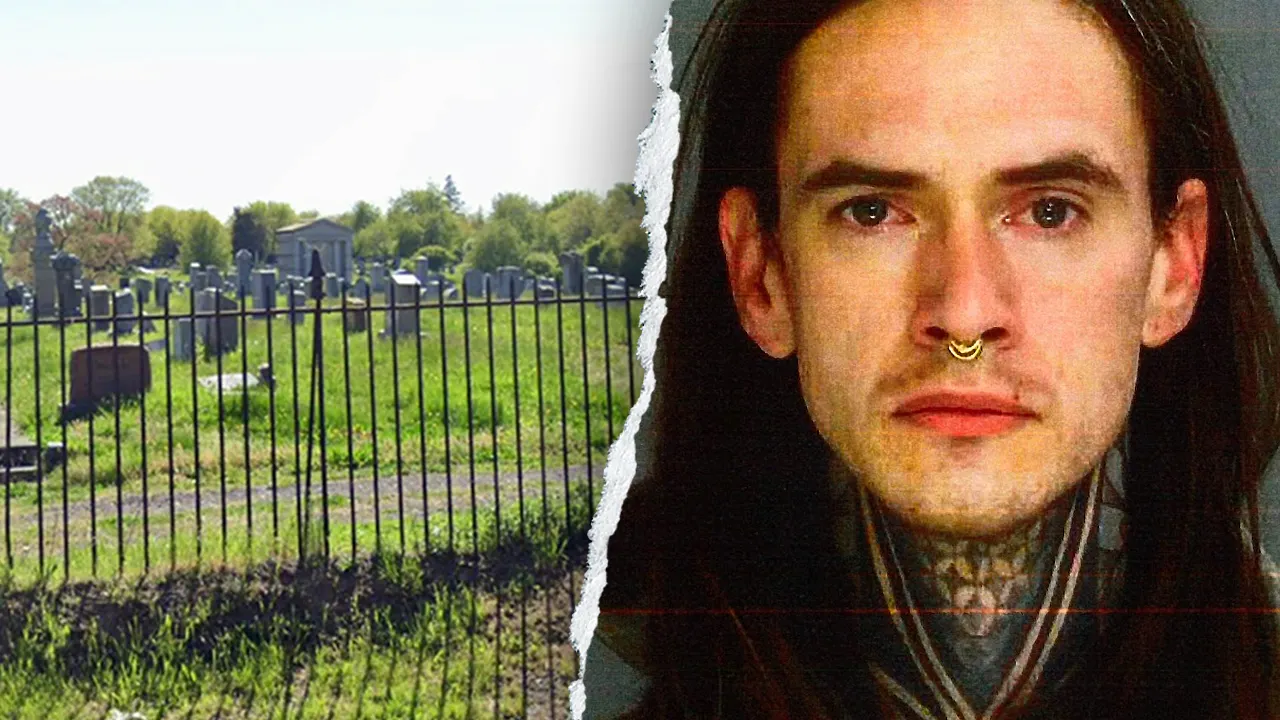
In the heart of suburban America, where quiet cemeteries hold the lingering echoes of history, a chilling story unfolds that blurs the lines between the mundane and the macabre. Imagine a man in his thirties, Jonathan Gerlach, who once seemed unremarkable, but whose actions have now thrust him into a nightmare of grave-robbing accusations. It started innocently enough—or so the narrative goes—until investigators uncovered a hoard of over 100 sets of human remains hidden in his home and storage unit. These weren’t just old bones; some dated back centuries, relics of the past; others belonged to vulnerable infants, stolen from sacred ground. Picture the shock rippling through communities, as families grappling with grief over the loss of loved ones found themselves confronted by this unthinkable violation. Gerlach’s transformation from a seemingly ordinary individual to a figure straight out of a horror film was stark that day in court. Dressed in a lime green prison jumpsuit, his appearance markedly different from his initial booking photo—clean-shaven, hair tied back in a bun—he stood before a Delaware County judge, speaking only briefly during the proceeding. The charges against him were staggering: nearly 500 counts, including burglary, abuse of a corpse, and desecration of monuments, all stemming from break-ins at historic sites like Mount Moriah Cemetery near Philadelphia. As prosecutors channeled some of the burglary accusations into additional counts from Lancaster and Luzerne counties, the court room air thickened with unspoken dread. This wasn’t just a crime; it was an affront to decency, shattering the peace of the final resting places where ancestors lay undisturbed for generations. Families, like Judy Prichard McCleary, whose own forebears were affected, voiced their heartbreak: “I believe their souls are in heaven. I still think it’s disruptive,” she shared with emotion, capturing the profound sense of loss that words can barely convey. In a world where trust in the sacred is paramount, Gerlach’s alleged deeds felt like an invasion of the most personal sanctuaries, leaving investigators and the public alike reeling from the “horror movie come to life” as described by District Attorney Tanner Rouse. Yet, amid the outrage, details emerged of Gerlach’s methodical operations—how police first spotted suspicious activity at Mount Moriah, bones visible in his vehicle, followed by sightings of him exiting laden with a burlap bag, crowbar, and tools in hand. He reportedly confessed to pilfering about 30 sets of remains, a fraction of the total unearthed. This wasn’t random; it was calculated, drawing parallels to other disturbing cases across the nation, like a Florida man who stuffed remains in suitcases or a Washington State discovery of skeletal fragments from a missing woman. But in Pennsylvania, the scale was unprecedented, turning a simple surveillance operation into an exposé of disrespect that transcended legal repercussions. As Gerlach sits behind bars, bail set at $1 million, the story serves as a stark reminder of how one person’s compulsions can disrupt entire communities. The public’s fascination, fueled by media like Fox News, which now offers audio versions of articles for those on the go, underscores a collective disbelief. Why would anyone do this? Motives remain murky, shrouded in Gerlach’s silence, but the ripples extend far. His actions challenge societal norms, forcing us to reckon with themes of death, reverence, and the fragility of human dignity. Extended investigations could reveal patterns—perhaps a disturbed mind driven by obsession, collection, or something far darker. Law enforcement, still piecing together the timeline from January’s arrest, must navigate a web of evidence while protecting the dignity of the affected. For families, the emotional toll is immeasurable, compounded by the knowledge that their loved ones’ remains were treated as mere objects. Psychologists might point to paraphilic disorders or a twisted fascination with mortality, but simplistic explanations fail to capture the full horror. Gerlach’s life, pieced from court records, paints a picture of isolation; no family statements have emerged, no friends rallying in defense. His clean-shaven visage in court juxtaposes the wild, unkempt image from arrest, hinting at a potential for reformation or, conversely, deep-seated deceit. This duality humanizes the perpetrator in unsettling ways—making him relatable on the surface, yet utterly alien in his choices. Broader societal commentary arises: how do we safeguard our dead when trust in institutions wanes? Cemeteries, once bastions of peace, now require heightened security, a sad evolution. Discussions on mental health, criminal justice, and cultural taboos flood online forums, with people sharing anecdotes of eerie encounters at graveyards. Yet, beneath the sensationalism lies a call for empathy—for the victims, both living and deceased. Gerlach’s court appearance, brief as it was, ended without a plea entered, leaving attorneys unidentified and prosecutors unreachable for immediate comment. The legal saga promises unfolding, but for now, the man remains detained, a emblem of consequences for those who cross sacred boundaries.
Delving deeper into the man’s psyche and the events that led to this point, one can’t help but ponder what drives someone to such extremes. Jonathan Gerlach, now 34, lived what appeared to be a solitary existence in Ephrata, Pennsylvania, far from the prying eyes of history until his arrest earlier this year. Neighbors and acquaintances paint a vague portrait: he was private, perhaps eccentric, with no known criminal history to foreshadow this descent. The question lingers like a fog over the case—was this a sudden spiral, sparked by personal turmoil, or the culmination of long-suppressed urges? Reports suggest he was first flagged during routine surveillance at Mount Moriah Cemetery, a site steeped in 19th-century significance, where officers noticed something amiss: bones protruding from his vehicle. It was an innocuous observation that escalated into a full-blown investigation, revealing a pattern of nocturnal intrusions. He’d allegedly return with tools—a crowbar for prying open crypts, bags to haul away the macabre loot—treating sacred ground as a personal treasure trove. This wasn’t mere theft; it was a systematic desecration, spanning at least three counties and accumulating nearly 500 charges. Each burglary count represents not just a forcible entry but a theft of identity, stripping away the final dignity afforded to the deceased. For instance, the partial and full sets of remains included infant bodies, evoking unimaginable grief for parents long gone, and centuries-old skeletons from eras when cemeteries were less regulated. Prosecutors, in their filings, emphasize the breadth: some items dated back to the Colonial period, others from the Victorian age, collected not for scholarly purpose but seemingly for personal gratification. This collector’s mentality, if proven, blurs ethical lines, raising debates on whether antiquities laws apply retroactively to human remains. Gerlach’s reported admission to around 30 thefts provides a glimpse into his mindset—a mix of compulsion and cunning, admitting only to what was witnessed, perhaps withholding fuller confessions. Psychiatrists consulted in similar cases often cite conditions like necrophilia or a fetish for the morbid, but without his input, speculations abound. His transformation in appearance—from prison photos to the court appearance—fuels narratives of a man reinventing himself, maybe projecting an image of remorse or normalcy. Yet, the horror embedded in this tale extends beyond the acts to the aftermath: forensic teams painstakingly cataloging remains, identifying owners where possible, and returning them to rightful sites. This process, akin to solving a massive puzzle, highlights the investigative strain—years of work for law enforcement, blending archaeology with criminology. Public outcry, amplified by outlets like Fox News, demands accountability, yet also illuminates vulnerabilities in cemetery security. Drones, cameras, and patrols are being proposed in policy discussions, a modern shield against such intrusions. For families like McCleary’s, the disruption is visceral; imagining ancestors’ peace shattered evokes a primal fear. Broadly, this case taps into cultural fascinations with the undead, from Gothic literature to true-crime podcasts, but reality’s impact is sobering. Gerlach’s solitude in jail underscores the isolation of guilt, a stark contrast to the communal outrage outside. As hearings continue, details dribble out: no violent confrontations reported, but a trail of tools suggesting premeditation. Societally, it prompts reflections on death rituals—why do we bury loved ones, only to lose trust in their sanctity? Mental health advocates argue for early interventions, noting how untreated disorders can manifest destructively. Gerlach, unidentified by legal counsel yet, embodies a cautionary tale, reminding us that monsters often lurk in the unassuming. His $1 million bail reflects the severity, a financial barrier likely to keep him confined while prosecutors build their case. In the meantime, the public grapples with voyeuristic curiosity balanced against genuine empathy for the aggrieved. This isn’t just news; it’s a mirror to humanity’s darker impulses, urging us to protect the vulnerable, even in death. Extended media coverage, including digital innovations like listenable articles, ensures the story resonates, fostering dialogue on ethics and enforcement. Ultimately, Gerlach’s actions challenge us to reclaim reverence for the past, ensuring that no life, or ending, is ever reduced to mere objects in the night.
As the legal drama unfolds, the human stories behind the statistics emerge, painting a poignant picture of loss and resilience. Families affected by Jonathan Gerlach’s alleged crimes share deeply personal accounts, transforming cold facts into heartfelt testimonies. Take Judy Prichard McCleary, whose words have become synonymous with the public’s dismay: her ancestors, interred at Mount Moriah, now part of this unsettling narrative, their eternal rest rudely interrupted. “I believe their souls are in heaven,” she poignantly remarked, a statement imbued with faith amid turmoil, “I still think it’s disruptive.” Such sentiments echo through community vigils and online forums, where descendants lament not just the theft but the invasion of a sacred bond. These aren’t abstract grievances; they’re intimate wounds, recalling family histories tied to the cemetery’s plot markers and weathered headstones. Psychologically, experts note, this desecration mimics a form of secondary trauma, reviving old griefs and igniting fears about one’s own mortality. Compounding the hurt are the unidentified remains, some belonging to infants whose stories vanish into anonymity—tears for mothers long passed, speculations about lives cut short. Prosecutors detail how these thefts spanned eras: brittle bones from the 1700s, commingled with Victorian relics, each item a chapter in American history now tainted. Gerlach’s storage unit became a macabre gallery, a testament to obsession, where ordinary spaces housed the extraordinary in horror. Initial police involvement stemmed from eagle-eyed surveillance, officers noticing skeletal protrusions in his car, a jarring sight that prompted deeper scrutiny. Follow-up observations of him toting bags and tools cemented suspicions, leading to his January arrest. His purported confession of 30 incidents hints at a cataloguer’s mind, perhaps driven by a distorted fascination, akin to collectors obsessed with rare artifacts. Yet, this humanizes the absurdity—imagining a person, alone in the dark, engaging in acts that defy reason. Court proceedings, like the Friday hearing, add procedural drama: waivers, dropped charges, added counts, all while Gerlach presents a composed, altered facade. Bail at $1 million signals non-negotiability, a punitive measure reflecting the scope’s enormity. Without a plea recorded, speculations swirl—will he fight the charges, citing mental incapacity, or remain silent under counsel? Families, meanwhile, seek closure through memorials and advocacy, pushing for laws strengthening grave protections. Broader implications ripple outward: educators discuss respecting cultural heritages, while ethicists debate the commodification of remains. Media outlets, enabling audio access for articles, democratize information, allowing busy listeners to absorb the tale on commutes. But beneath the accessibility lies a call to empathy—understanding the perpetrator’s isolation, not excusing it. Gerlach’s backstory, sparse as it is, invites questions: what life events shaped this? Childhood traumas? Unaddressed mental health? Analysts draw parallels to other grave-robbing cases, like historical body snatchers for medical schools, evolving into modern psychopathology. Public discourse balances condemnation with curiosity, fueling debates on criminal sentencing and rehabilitation. For the loved ones, rebuilding trust in memorial sites requires community action, from installing fences to conducting blessings. This case, in its extremity, underscores humanity’s capacity for both upheaval and unity, reminding us that even in death’s shadow, the living seek meaning and justice. As investigations persist, involving forensic anthropologists to reassemble identities, the narrative evolves from shock to reflection, a testament to societies’ resilience against the profane.
Peering into the investigative labyrinth, the Jonathan Gerlach case reveals a tapestry of methodical detection and forensic marvels that feel almost like a thriller unfolding in real life. From the initial tip-off at Mount Moriah Cemetery, where vigilant officers spotted unusual cargo in Gerlach’s vehicle—bones glinting under lamplight—to the subsequent stakeouts capturing him exiting with a burlap bag slung over his shoulder, tools clinking ominously, the operation exuded precision. This wasn’t blind luck; it was the culmination of community vigilance and law enforcement tenacity, transforming routine patrols into a gateway to horror. Police reports delineate the discoveries: at Gerlach’s Ephrata home, an ordinary residence masked a trove of over 100 sets of remains—full skeletons, partial fragments, some centuries-old relics evoking colonial Philadelphia, others poignant infant bones whispering untold tragedies. Storage units added layers, turning mundane spaces into clandestine vaults. Prosecutors’ filings hyped the scale, leading to nearly 500 charges, each one a thread in a web of desecration. Abuse of a corpse, burglary, monument desecration—these aren’t mere labels; they’re acknowledgments of profound disrespect, where graves became hunting grounds. Gerlach’s reputed admission to stealing around 30 sets adds a confessional twist, humanizing his role by admitting partial guilt, yet leaving gaps for motive. Was it morbidity, profit, or compulsion? Psychological profiles suggest possible necrofiliac tendencies or obsessive hoarding, but without interviews, fiction fills the void. Court dynamics amplify the intrigue: his Friday appearance, silent yet poised, contrasted with his disheveled booking photo, suggesting a chameleon-like adaptability. Dropped burglary counts and new piled-on charges from neighboring counties illustrate prosecutorial strategy, building an ironclad case on evidence trails. Bail at $1 million underscores severity, a barrier ensuring containment while trials loom. Fox News and affiliates, now offering audio versions, expand reach, allowing commuters to digest the drama aurally. Forensic advancements shine—DNA analysis identifying owners, historical context piecing eras—offering closure amid chaos. Families, like those impacted at Mount Moriah, find solace in procedural justice, their voices amplified through press. Yet, the case sparks policy reforms: enhanced cemetery monitoring, perhaps AI surveillance or community patrols, to preempt future atrocities. Ethically, debates rage on repatriating remains, respecting indigenous ties or historical significances. Gerlach, undefended publicly, embodies the enigmatic antagonist, his silence breeding speculation. Societally, this tale intertwines with true-crime lore, influencing books and documentaries, but real stakes involve healing communities. Investigative timelines stretch from January’s bust to ongoing probes, promising revelations. In the end, the case transcends crime; it’s a lesson in humanity’s fragility, urging vigilance against the erosion of sacred trusts. As digital media evolves, stories like this remain timeless, bridging eras through shared outrage and pursuit of truth.
Reflections on justice and its imperfections permeate this unfolding saga, as Jonathan Gerlach’s alleged crimes prompt reevaluation of how society confronts the unfathomable. Beyond the charges—nearing 500, spanning burglary, corpse abuse, and monument desecration—lies a deeper inquiry into accountability and rehabilitation. Courts, bastions of fairness, saw Gerlach waive his evidentiary hearing rights during Friday’s proceedings, a decision underscoring his quiet resignation or strategic silence. His attire, a lime green jumpsuit against a clean-shaven face and bun-tied hair, painted a picture of mitigated defiance, starkly contrasting the unkempt figure from his booking image. Prosecutors adjusted charges, dropping some burglaries while adding others from Lancaster and Luzerne counties, a tactical refinement amid the evidentiary avalanche. Mount Moriah Cemetery, historically rich and now marred, becomes a focal point, its break-ins symbolizing breaches of collective memory. Authorities describe it as “a horror movie come to life,” a phrase capturing the surreal dread—a man in daylight hours, spiriting away remains for what? Motives remain elusive, fueling psychological analyses: perhaps a degenerative compulsion, mental illness unmedicated, or a deviant fascination with death’s artifacts. His home and storage unit yields offered grim evidence: over 100 remains, blending eras—infant vulnerabilities with ancient sands. Public discourse, enabled by accessible media like Fox News’ audio articles, dissects these angles, blending empathy for potential broken minds with righteous indignation. Family testimonies, poignant as McCleary’s, propel calls for justice marred by grief. Legal hurdles abound: unidentified counsel, unreached prosecutors for comment, and no plea entered, prolonging suspense. Bail’s million-dollar heft ensures detainment, allowing investigations to mature. Broader ramifications include advocacy for stricter cemetery laws, drawing from similar scandals nationwide, and mental health paradigms urging intervention. This isn’t isolated; it mirrors global anxieties over bodily sanctity, inspiring educational campaigns. Gerlach’s narrative, solitary and opaque, invites exploration of pathologys—could therapy redeem him? Society contends with balance, weighing punishment against understanding. As trials approach, the case evolves into a landmark, shaping policies on forensic handling and ethical repatriation. Ultimately, it pleads for humanity in justice, recognizing victims’ pain while probing perpetrators’ depths, fostering a society that heals rather than merely condemns.
In embracing the aftermath, the Jonathan Gerlach story transcends headlines, weaving threads of community healing and systemic change that resonate long after the courts adjourn. As he languishes in Delaware County custody under $1 million bail, the public and policymakers grapple with ripples of desecration affecting Mount Moriah and beyond—nearly 500 charges a testament to endurance in response to horror. Families like Judy Prichard McCleary’s exemplify resilience, their faith-based resilience amidst disruption urging communal support. McCleary’s words—”I believe their souls are in heaven. I still think it’s disruptive”—embody a quiet strength, inspiring vigils and dialogues on mourning. Investigations, led by District Attorney Tanner Rouse, unveil horrors: centuries-old bones and infant remains tangled in Gerlach’s mundane life, his Ephrata home a unlikely vault. Surveillance origins, spotting bones in his vehicle, evolve into confessions of 30 thefts, hinting at broader depths. Court waivers and charge adjustments reflect procedural momentum, with potential pleas forthcoming under as-yet unidentified counsel. Fox News’ innovation, audio articles, democratizes access, fostering widespread engagement and empathy. Ethical debates flourish: repatriating unidentified remains, enhancing cemetery safeguards against future intrusions, and addressing mental health to prevent such falls. Gerlach’s altered appearance in court suggests introspection, yet motives linger—compulsion, deviance, or something prophetic? Societally, this sparks cultural reexaminations of death rites, valuing ancestral peace. Media amplification humanizes victims, urging reforms in forensic protocols and legal frameworks. For Gerlach, if repentant, rehabilitation paths exist, though skepticism prevails. Overall, the case catalyzes unity, transforming tragedy into advocacy for dignity in life and afterlife. As hearings continue, societies emergent stronger, fortified by lessons in respect and redress, ensuring the dead and living find enduring solace.