





Passengers Subdue Cockpit Clash on Dubai–Tel Aviv Flight, Emergency Landing in Saudi Arabia
Incident aboard a crowded passenger jet forces swift diversion and raises questions about inflight safety.
A Routine Flight Turns Chaotic in the Sky
It began as a routine journey across the Arabian Peninsula, the kind of flight that shuttles between two of the Middle East’s most vibrant cities every single day. A passenger aircraft travelling from Dubai to Tel Aviv was cruising at altitude, with men and women settling into their seats, when suddenly, without warning, the routine shattered. According to accounts from those on board, a clash broke out in the cockpit of the aircraft, a violent confrontation that was loud enough to be heard over the steady hum of the engines. What followed was a frantic few minutes in which passengers intervened, unsure whether they were facing a hijacking, a medical emergency, or something far more sinister. The plane, which had departed from Dubai International Airport and was bound for Ben Gurion Airport near Tel Aviv, was forced to make an emergency landing in Saudi Arabia. The decision to land came after the situation in the forward section of the plane escalated to the point that the crew determined they could no longer continue safely. On the ground, emergency vehicles were deployed, and the aircraft touched down without incident, but the memory of those chaotic moments would stay with the passengers for a long time.
The flight itself was part of a growing web of air links between the Gulf and Israel, routes that have expanded dramatically in recent years following the diplomatic agreements that reshaped the region. For most passengers, it was a short hop across the Arabian Peninsula, no more than three hours in the air. But the disruption turned what should have been a straightforward journey into an ordeal. Witnesses described hearing raised voices, then the unmistakable sound of a struggle. Some passengers initially thought the noise was coming from the galley, perhaps a trolley falling over or a member of the cabin crew stumbling. It soon became clear, however, that this was something far more serious. The clash was not a minor argument. It was a violent confrontation, and it was happening in one of the most sensitive parts of any aircraft: the cockpit. Exactly how the conflict began remained unclear in the immediate aftermath, but the fact that passengers felt compelled to step in spoke volumes about the severity of the situation.
Passengers Describe the Moment Chaos Erupted
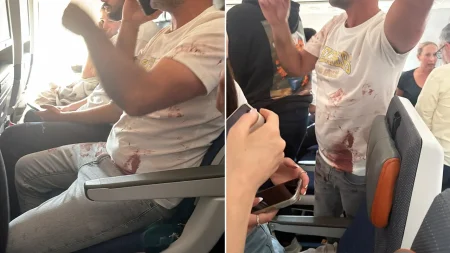
According to several people on board, the atmosphere changed within a matter of seconds. One moment, the cabin was quiet, with passengers scrolling through their phones or gazing out at the endless stretch of desert below. The next, a commotion erupted near the front of the plane, and the tension spread through the cabin like a wave. Passengers who were seated near the scene described seeing members of the cabin crew shouting at the cockpit door, trying to get the attention of the pilots. Others reported hearing banging and muffled shouts coming from the flight deck area. It was then that a group of passengers, acting on instinct, unbuckled their seatbelts and rushed toward the front of the aircraft. They were not professional security guards. They were not trained law enforcement officers. They were ordinary travellers — a teacher, a business executive, a young man returning from a holiday — who realised that the situation required immediate action. Together, they forced their way into the melee and managed to pull the individuals apart, restraining those involved until the crew could regain control.
The exact sequence of events remained murky in the hours after the landing, but the testimony of those on board painted a picture of coordinated bravery. Some passengers were told to sit down and fasten their seatbelts, while others formed a protective barrier around the scene. One passenger, speaking to those around him after the plane had landed, said that the decisive moment came when a woman stood in the aisle and urged the others to act, reminding them that the worst thing they could do was hesitate. It was a reminder that, in the confined and unforgiving environment of an aircraft, every second counts. The clash in the cockpit might have involved nothing more than a personal dispute that got out of hand, or it could have been something far more calculated. At that point, no one on board had the luxury of waiting for a clearer picture. They only knew that the flight crew was in danger, and that the safety of everyone on board depended on their ability to intervene.
Cabin Crew and Passengers Work Together to Restore Order
Once the immediate threat was contained, the flight crew took charge of the aircraft and assessed the situation. The cockpit had to be secured, and the pilots needed to determine whether the aircraft had sustained any damage during the struggle. The captain made a brief announcement over the intercom, confirming that there had been an incident and that the plane would be making an unscheduled landing. The captain’s voice, according to passengers, was calm but firm, the voice of someone who had been trained to handle exactly this kind of emergency. The decision to divert to Saudi Arabia was not made lightly. It meant flying into the airspace of a country that, until recently, had no formal ties with Israel, and it involved coordinating with air traffic controllers and local authorities under highly stressful conditions. But the crew had little choice. The plane needed to land as quickly as possible, and the nearest suitable airport was in Saudi Arabia.
In the cabin, the crew moved methodically through their emergency procedures. They checked on passengers who had been jostled during the confusion and made sure that no one was seriously injured. A few people were crying, others were visibly shaken, and at least one passenger was treated for a panic attack. The individuals who had been involved in the clash were held in the rear of the aircraft, watched closely by a combination of crew members and volunteers from among the passengers. It was not a formal arrest, but it was a necessary measure to ensure that the situation did not spiral out of control again. The pilots, meanwhile, communicated with the airline’s operations centre and with air traffic control, providing updates on the situation and preparing for the emergency landing. The aircraft descended through the clouds, and the passengers braced themselves, following the safety instructions they had heard a hundred times before. The landing itself was smooth, a testament to the skill of the pilots, and the plane came to a stop on a remote section of the tarmac, well away from the main terminal buildings.
Emergency Landing and a New Kind of Security Test
Within moments of the aircraft coming to a standstill, the scene on the ground came alive. Emergency lights flashed as fire trucks, ambulances and security vehicles surrounded the plane. Armed personnel boarded the aircraft and took custody of the individuals involved in the clash, while investigators began the painstaking work of gathering evidence. Passengers were asked to remain in their seats until the authorities had completed their initial assessment. For many, the weight of what had happened only truly began to sink in at that point. They had been part of a potentially dangerous incident, and they had responded with a courage that surprised even themselves. The emergency landing in Saudi Arabia was also significant from a diplomatic perspective. It demonstrated that, even in times of political tension, practical cooperation in the name of aviation safety is possible. Saudi Arabia has long been a vital hub in the region’s air travel network, and the decision to allow the diverted flight to land was a reminder that no country wants to be seen as turning its back on a stricken aircraft.
The incident has inevitably raised questions about airport security, cockpit access and the psychological screening of passengers. In recent years, much of the focus has been on preventing explosives and weapons from getting onto aircraft, but this episode highlights a different threat: the danger posed by a person who may be experiencing a mental health crisis or who simply snaps under the pressures of modern travel. Airlines around the world have invested heavily in reinforced cockpit doors, sophisticated surveillance systems and crew training, but there is no failsafe solution when the conflict involves individuals who are determined to cause harm. The fact that the passengers were able to intervene in the cockpit at all will lead some to ask how the confrontation was able to escalate so far in the first place. Others will point to the passengers as heroes, ordinary people who were unwilling to stand by while the safety of their fellow travellers hung in the balance.
What the Investigation Will Look For
As the aircraft remained on the ground in Saudi Arabia, the investigation into the incident began in earnest. Aviation authorities on both sides of the Gulf, along with Israeli officials, were expected to examine every detail, from the flight data and cockpit voice recorders to the backgrounds of the individuals involved. The central question was a simple one: what caused the clash? Investigators would need to determine whether the incident was a spontaneous explosion of anger, a premeditated act of violence, or something in between. They would also need to assess the response of the crew and passengers, and whether the protocols in place had been followed correctly. Every incident of this kind becomes a case study in how to improve aviation safety, and this one was no different.
For the passengers, the aftermath of the emergency landing was a mixture of exhaustion and relief. They were eventually taken to a secure facility, where they were interviewed by police and security officials. Some were searched and had their personal belongings examined. Others were asked to provide written statements describing what they had seen. The process was slow and painstaking, but most passengers understood the importance of getting the details right. There were also practical concerns to deal with. The flight had been scheduled to continue to Tel Aviv, but that journey had now been disrupted. Passengers were offered accommodation and rebooking options, though few were in the mood to think about the next leg of their journey. For many, the memory of the landing, the sight of armed officers moving down the aisle, and the sound of the captain’s voice on the intercom would take a long time to fade.
Safety Lessons and the Road Ahead
The incident on the Dubai–Tel Aviv flight is a powerful reminder that aviation safety is not only about what happens on the ground. It is also about what happens in the air, in the cramped spaces and high-stress environments where decisions are made in a split second. It is about the flight attendants who are trained to read the warning signs, the pilots who are prepared to land at a moment’s notice, and the passengers who refuse to be passive witnesses to their own fate. In this case, the system worked, but it worked because ordinary people made an extraordinary choice to act. They did not wait for someone else to solve the problem. They saw a situation spiralling out of control, and they did what they could to stop it.
Looking ahead, the aviation industry will likely study this incident closely, drawing lessons that could shape training and security procedures for years to come. Questions will be asked about how passengers can be better prepared to respond to such situations, and whether more can be done to support the mental health and wellbeing of those who step onto an aircraft carrying the weight of their own personal struggles. The passengers who intervened may never know the full impact of their actions, but they can take pride in knowing that they helped bring a difficult situation to a peaceful end. The plane landed safely. No lives were lost. And a group of strangers, bound together by circumstance, proved that courage can be found in the most unexpected places. For the passengers and crew of that flight, the journey may have been delayed, but it was not defined by the fear and confusion of a single chaotic moment. It was defined by their response to it — and by the resilience they showed when it mattered most.