



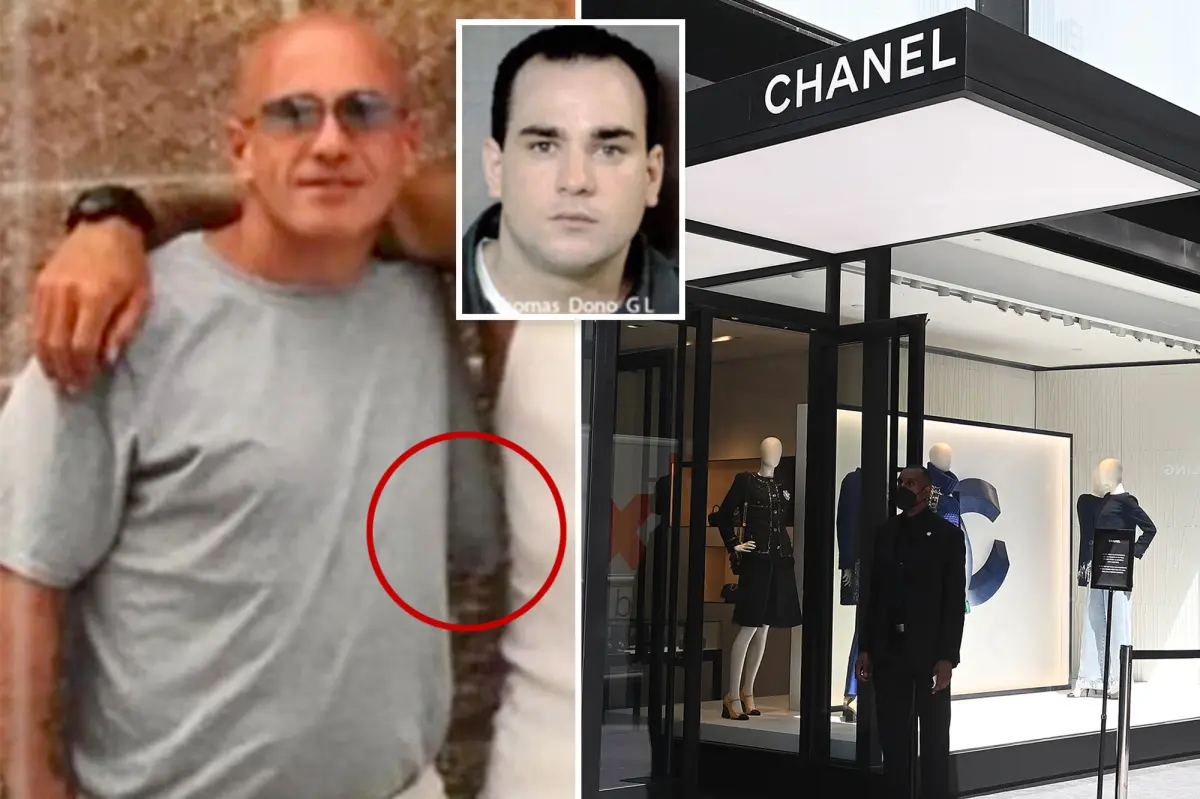
On the humid summer evening of Saturday, July 13, 2024, Manhattan’s East 57th Street was wrapped in its usual post-sunset tranquility. This prestigious corridor, lined with towering glass monoliths, historic brownstones, and the world’s most elite luxury boutiques, is typically considered one of the most secure commercial districts on the planet. Yet, as the clock struck 10:14 p.m., a quiet, meticulously planned operation began to unfold at the flagship boutique of Chanel at 15 East 57th Street—a high-fashion fortress housing millions of dollars in designer inventory. This was not the chaotic, impulsive smash-and-grab style of robbery that has plagued modern retail centers, but rather a throwback to a classic era of professional, disciplined burglary. For exactly three hours and eleven minutes, a highly coordinated team of eleven individuals breached the store’s physical defenses with surgical precision, bypassing advanced security systems to pull off an astonishingly quiet, high-stakes caper. By the time they departed into the early morning darkness at 1:25 a.m. on Sunday, July 14, they had made off with the single largest and most economically devastating haul in Chanel’s entire history in the United States. In total, three hundred meticulously selected luxury items—ranging from high-end leather goods and exquisite jewelry to exclusive fashion pieces—were carried out, representing an astronomical loss of $1,776,700. Each item taken was a symbol of pure, undisturbed high-society wealth, now shoved unceremoniously into bags like common street waste. As the city slept, a mastermind parked in an unassuming white minivan sat at the curb, acting as the eyes and ears of a crew that was executing a cinematic heist destined to enter the annals of New York’s deep criminal folklore, blending the grit of 20th-century street crews with the high-stakes targets of 21st-century luxury markets.
The man watching the empty, yellow-lit street from that minivan was fifty-two-year-old Thomas “Tommy” Dono, a figure who represents a living bridge between the traditional organized crime of the twentieth century and the highly scrutinized modern world. Unlike the flashier contemporary criminals who broadcast their lifestyles on social media, Dono is an old-school professional who cut his teeth in the 1990s as a skilled bank burglar, a dangerous trade requiring absolute silence, meticulous planning, and an intimate understanding of structural engineering. He belonged to an era of whispers and shadows, where respect was earned through years of reliable criminal service rather than the theatrical online postures of contemporary crime culture. His life, however, was fundamentally altered when a devastating car accident forced the complete amputation of his left arm at the shoulder, a severe physical loss that would have ended the career of almost any other street operator. Instead of retreating into obscurity, Dono adjusted, his missing limb becoming a badge of resilience and a stark visual marker within Brooklyn’s tightly knit underworld, earning him the respect of hardened peers who valued mental grit over physical perfection. Yet, in a modern, hyper-surveilled New York City defined by high-definition cameras, complex algorithms, and inescapable facial tracking, this very physical uniqueness would ultimately prove to be his undoing. Detectives from the NYPD’s elite squads, task forces, and the Manhattan District Attorney’s office quickly identified the distinct, asymmetric silhouette of a one-armed man operating at the heart of the million-dollar crime. The physical vulnerability that Dono had spent years overcoming was transformed in an instant into a neon arrow, pointing investigators directly toward a seasoned Gambino family soldier who had refused to let a physical handicap diminish his hunger for the traditional, high-reward mob score.
To appreciate the complexity of the burglary, one must look at the sheer physical labor and structural engineering utilized by the crew during their three-hour occupation of the high-end boutique. Recognizing that the building next door on East 58th Street was actively undergoing construction and covered in dense protective scaffolding, the conspirators recognized a golden opportunity to hide in plain sight. Several members of the ten-man field team dressed as construction workers, donning fluorescent vests and heavy-duty hard hats to blend effortlessly into the late-night physical landscape of Manhattan. Under the cover of darkness, they easily penetrated the construction site, scaled the heavy scaffolding, and navigated their way to a rear fire escape exit that led directly into a quiet alleyway running behind the Chanel store. Working with heavy tools and absolute coordination, they smashed through a stockroom ceiling hatch, creating a physical passage directly into the heart of the luxury brand’s secure inventory room. The physical mechanics of the theft required not only deep structural knowledge but also absolute trust, as ten men worked blindly within the dark, unfamiliar corridors of a corporate temple. For hours, while working in near-total silence to avoid triggering acoustic sensors, they systematically stripped the shelves of their most valuable designer items, stuffing the high-priced loot into ten massive laundry bags and heavy-duty trash bags. As sweat poured and muscles strained, the bags were carefully carried back down the fire escape, through the construction site, and directly onto East 58th Street, where they were loaded into a waiting white Sprinter van. All of this unfolded under the watchful, protective eye of Dono, who monitored the surrounding streets from his white minivan until the entire convoy melted away into the early morning traffic, leaving behind a baffled corporate empire.
To truly understand how this fifty-two-year-old burglar managed to coordinate such an intricate, multi-million-dollar operation, one must trace his dark history and deep family ties to the Gambino crime family. Dono is the nephew of the late Thomas “Huck” Carbonaro, a notorious and deeply feared Gambino soldier who was eventually convicted of racketeering and plotting the assassination of the legendary turncoat underboss Salvatore “Sammy the Bull” Gravano. Dono’s own underworld pedigree is stained with blood; in 1998, he was deeply involved in the brutal, daylight execution of Frank Hydell, a suspected FBI informant who was gunned down outside a Staten Island gentlemen’s club in a desperate bid to protect the family’s lucrative secrets. According to federal prosecutors, Dono’s steadfast silence and participation in this violent crime earned him a formal proposal for membership in the crime family as early as 2001, a highly coveted reward in the traditional Mafia underworld. This historical continuity connects the present-day heist directly back to the golden era of the five families, proving that the old lines of authority and criminality remain fully operational. Dono ultimately accepted a plea deal that resulted in a fifteen-year federal prison sentence, serving his time with his lips sealed and his loyalty intact, a testament to the old-school code of omertà that has largely vanished in the modern era. Following his release from federal custody in 2021, he was formally welcomed back and inducted as a soldier in good standing, operating under the aging but highly influential capo Louis “Big Lou” Vallario, who had inherited Gravano’s fierce Brooklyn crew, proving that Dono was operating with the institutional backing of one of America’s most storied criminal enterprises.
The investigative breakthrough that shattered Dono’s freedom highlights the incredible power of modern digital surveillance when combined with traditional, boots-on-the-ground police work. Following the discovery of the massive theft on the morning of July 14, detectives from the NYPD and investigators from the District Attorney’s office immediately began analyzing thousands of hours of high-definition video footage recovered from public and private cameras across Midtown. It did not take long for investigators to notice the synchronized movements of the white minivan and the white Sprinter van, but the true breakthrough occurred when cameras captured the distinctive physical profile of the minivan’s driver. The unmistakable image of a driver with only his right arm steering the vehicle through the narrow Manhattan streets immediately pointed investigators toward Dono, whose unique physical characteristics and extensive mob record had long been documented in federal and municipal databases. Using advanced license plate readers and city highway cameras, law enforcement traced the path of the two white vehicles out of Manhattan and into the quiet, residential neighborhood of Bath Beach, Brooklyn. There, detectives observed the vehicles parked outside a modest, three-family home on Bay 10th Street, with additional neighborhood footage showing Dono interacting with the vehicles on the very days of the heist. This intersection of old-world human traits and new-world technological observation created a digital trap that no traditional mob protocol could anticipate or bypass, showing the vulnerability of old-school methods. The profound irony of the case is that the physical loss Dono suffered in his tragic car accident, which had made him a legendary figure, also bound him to the crime in a way that no digital mask or alibi could ever hope to erase, sealing his fate in the eyes of law enforcement.
The current courtroom scene in Manhattan represents a quiet, dignified clash between the unyielding silence of the old-school Mafia and the overwhelming mechanical power of the modern American judicial system. On May 19, Thomas Dono stood before Judge Felicia Mennin, maintaining the stoic, unreadable expression of a sworn Gambino soldier as he entered a firm plea of not guilty to charges of first-degree grand larceny. Despite the prosecution’s intense arguments that Dono was a dangerous flight risk with deep organized crime connections and should be held on high bail, Judge Mennin chose to release him on a $300,000 bond, allowing him to return to his Brooklyn home while his legal team prepares for a lengthy trial. Meanwhile, a dense cloud of mystery continues to hang over the entire case, as the NYPD acknowledges that not a single piece of the spectacular $1.77 million Chanel haul has been recovered, and the other ten members of the highly professional crew remain completely unidentified and at large. As the legal machinery grinds forward, the empty shelves of Chanel and the silent streets of Brooklyn tell a story of an enduring criminal subculture that continues to defy modern progress. This intriguing case serves as a powerful reminder of the enduring, adaptable nature of organized crime in New York, demonstrating that even as the city is transformed into a high-tech digital fortress, there are still old-school wiseguys operating in the shadows, willing to risk everything for one more spectacular, million-dollar score under the neon lights of Manhattan, showing that the age-old game of cops and robbers has not yet concluded.