



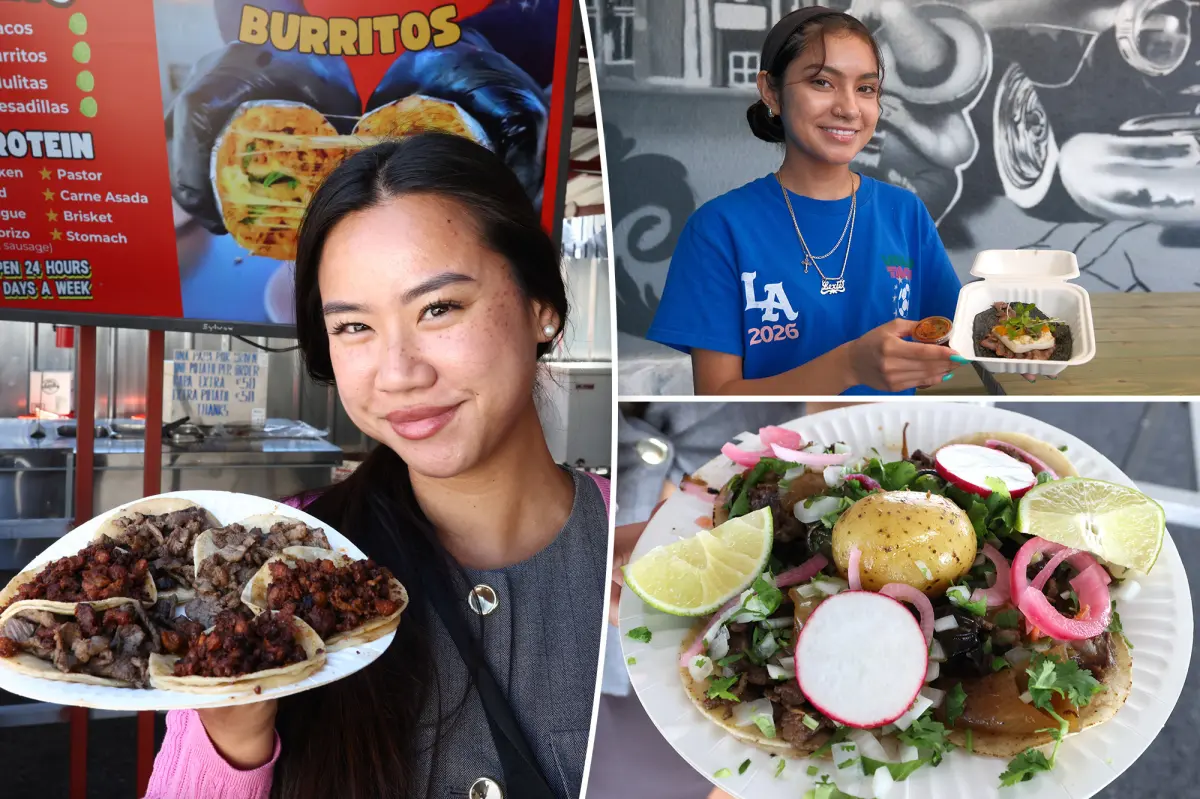
On National Taco Day, the streets of Los Angeles tell a delicious story of contrast, one that celebrates the humble tortilla in all its glorious forms. There is no single definition of a taco in this city; instead, there is a spectrum as wide and diverse as the people who make and eat them. On one end, you have the kind of taco that fuels everyday life—a warm, satisfying, no-frills hand-held meal that costs just a couple of dollars and can be enjoyed several times a week without guilt. On the other end, you have a taco that borders on art—an extravagant creation with rare, luxurious ingredients that transforms a street-food staple into a fine-dining experience. It is a five-fold price difference that could easily feel divisive, yet in Los Angeles, both versions are not only accepted but cherished. The taco, in all its forms, serves as a universal language, connecting people across neighborhoods and income brackets. On this particular day, as Angelenos lined up at taquerias from South Central to the Eastside to the Westside, they proved that whether you have two dollars or twelve, the taco is still the heart of the city’s culinary soul.
At Tacos LA 26, the philosophy is simple and rooted in community. Here, tacos are just $2.25, and diners can choose from eight different meat options, ranging from classic carne asada and al pastor to chicken and birria. The price is not an accident; it is a deliberate promise. Marketing specialist Jennifer Huynh explains that keeping prices low is part of the restaurant’s commitment to the people it serves. “Our goal is for the community to be able to afford something sustainable, something they can come to like three times a week, four times a week,” she said. “Something that doesn’t hurt their pocket.” This is a place where food is about more than profit—it is about providing a consistent, comforting meal for families, workers, and students who may be on a tight budget. The restaurant’s carne asada is delivered fresh every morning and cooked to order, a small but crucial detail that makes each taco taste vibrant rather than reheated. Huynh believes a great taco comes down to meat that is “juicy, tender” and gives customers a good bang for their buck. There is pride in offering something affordable without sacrificing freshness or flavor, and that pride is visible in the faces of the cooks and the satisfied customers who keep coming back. In a city often criticized for its high cost of living, Tacos LA 26 stands as a reminder that good food can still be accessible to everyone.
On the other end of the spectrum is Villa’s Tacos, a name that has become synonymous with pushing the boundaries of what a taco can be. With three locations across Los Angeles, Villa’s takes a far more extravagant approach, offering a $12 creation that sounds less like street food and more like a chef’s tasting menu. This signature taco features Japanese A5 Wagyu beef and Chilean sea bass, both nestled together on a fresh blue corn tortilla. It is then finished with carrot purée, microgreens, and a decadent bone marrow butter that melts into the meat as you take your first bite. Every element is intentional, from the quality of the beef to the delicate fish to the handmade tortilla. The team at Villa’s says the premium ingredients are part of an effort to “elevate the taco experience.” They are not trying to make a taco that competes on price; they are trying to make a taco that competes on emotion, memory, and sheer indulgence. Danny Peñate, the kitchen manager, explains that there is real thought behind the price tag. “What makes this a $12 taco is the intention behind it,” he says. “Everything is made with a reason.” It is a bold statement, but one that becomes believable when you see the care that goes into each plate.
For Villa’s, the extravagant taco is also a statement about where fine dining belongs. Peñate believes that the idea of a fancy restaurant being confined to “four white walls with white linen tables” is outdated. “It could be anywhere,” he says. “It could be out here in the street.” This is the heart of their philosophy: you do not need a stuffy dining room to experience something elevated. You can stand on a sidewalk, feel the evening air on your skin, and still enjoy a taco made with Japanese Wagyu and bone marrow butter. The juxtaposition is beautiful—it democratizes luxury in a way that feels very Los Angeles. The city itself becomes the dining room, and the taco becomes the vehicle for a culinary adventure. Villa’s is not mocking the $2.25 taco; rather, it is expanding the definition of what a taco can mean. It is a celebration of creativity and craftsmanship, borne out of respect for the traditional taco, but unafraid to take it somewhere new. The result is a food item that is both familiar and wildly inventive, a symbol of how culture evolves while still honoring its roots.
Despite the roughly 5.3-times difference in price, representatives from both Tacos LA 26 and Villa’s Tacos agree on the fundamentals of what makes a taco great. It starts with the tortilla—fresh, warm, and made from corn—because without a solid foundation, no amount of fancy meat or garnish can save the dish. Next comes the meat, ideally grilled over mesquite or prepared in a way that highlights its natural juices and tenderness. And finally, there must be a well-balanced salsa, one that brings heat, acidity, and freshness to tie everything together. Peñate describes the ideal taco as a “harmony” of ingredients, where nothing overpowers the other, and every bite feels complete. Interestingly, Jennifer Huynh would likely say the same thing, even if her version costs a fraction of the price. Neither side sees the other as a competition. Instead, they both respect the craft that goes into making a taco that satisfies the soul. Whether you are spending $2.25 or $12, the goal is the same: to create something that brings people joy, comfort, and a moment of pure flavor. That shared understanding is a powerful reminder that quality is not always measured in dollars.
In the end, National Taco Day is not about arguing over which taco is better or which price is more justified. It is about celebrating the incredible range of this dish and the people who dedicate their lives to perfecting it. A $2.25 taco from Tacos LA 26 is a gift to a community that needs affordable sustenance. A $12 taco from Villa’s is a gift to those seeking an unforgettable flavor experience. Both are made with care, both honor the traditions of Mexican cuisine, and both are worthy of respect. The beauty of Los Angeles is that you do not have to choose—you can grab a cheap, delicious taco on a Tuesday and splurge on a luxurious one on a special occasion. The taco is flexible enough to fit every moment, every mood, and every budget. It can be a quick lunch, a late-night craving, a celebration meal, or a comfort food that reminds you of home. On this day, as we celebrate the taco, we also celebrate the city that embraces it so fully. Los Angeles is a place where community and creativity can coexist, where the humble and the extravagant stand side by side, and where a simple folded tortilla filled with meat can tell the story of a people. That is the true beauty of the taco: it is not just food—it is identity, belonging, and love, available to anyone willing to take a bite.