


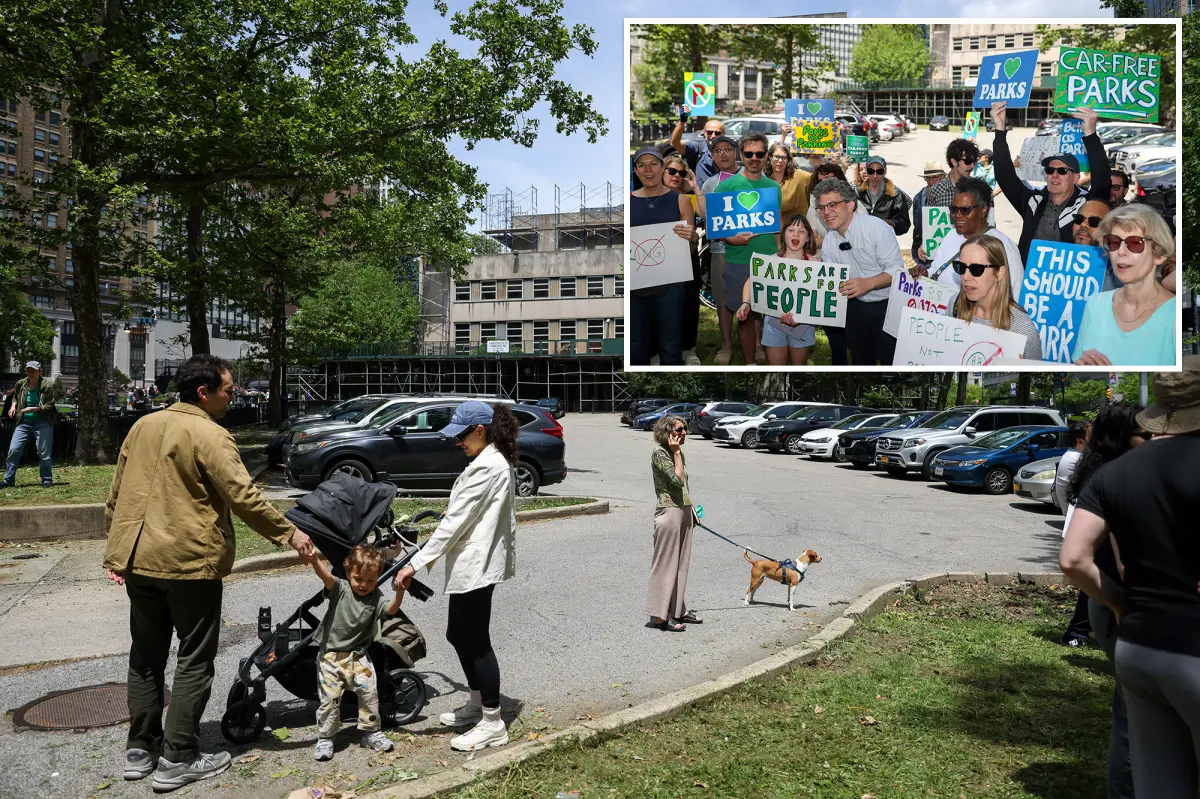
On a crisp, sunny Sunday afternoon in Downtown Brooklyn, a vibrant and diverse coalition of neighborhood residents, young parents pushing strollers, eager community advocates, and passionate environmental activists gathered not to admire a scenic landmark, but to protest a bleak, flat expanse of grey asphalt. For several decades, this highly contested plot of land—officially and historically designated as Columbus Park—has been stripped of its natural potential and paved over with thick, unyielding concrete, acting as an exclusive, three-dozen-space parking lot for local judges and court staff. This concrete barrier stands as a stark, daily physical manifestation of institutional privilege, where the personal convenience of a select group of the city’s most powerful legal minds is prioritized directly over the recreational, physical, and mental well-being of thousands of neighborhood residents. As young children ran along the harsh edges of the pavement and protesters held hand-painted signs demanding the restoration of their long-promised green sanctuary, the atmosphere in the air was charged with a mixture of deep frustration and defiant hope. Local Councilman Lincoln Restler captured the crowd’s boiling sentiment perfectly, pointing out that generations of jurists have selfishly prioritized their personal commutes at the direct expense of the public good. The ongoing battle over this parking lot is more than just a minor dispute over street parking; it is a fundamental struggle over who actually owns the city’s public spaces and who gets to decide how our shared urban environment is utilized. The surrounding buildings, towering glass behemoths of recent residential developments, cast long shadows over the protest, serving as a silent reminder of how quickly the neighborhood is changing without adequate space for its human inhabitants to breathe. For the people of Brooklyn, the message delivered to the judiciary on Sunday was unmistakable: it is time to return the park to the public, recognizing that a small patch of grass and a few shaded trees can do infinitely more to heal, unite, and elevate a community than thirty-six parked cars ever could.
The pressing urgency of this reclamation project is underscored by the truly dizzying transformation of Downtown Brooklyn over the past decade. Once primarily a commercial and civic hub that emptied out into a quiet ghost town after business hours, the area has undergone an unprecedented residential boom, with more than twenty-five thousand new housing units constructed in recent years. This massive, rapid influx of families, young professionals, and long-term residents has occurred without any corresponding expansion of the essential public infrastructure needed to sustain a healthy, livable urban life—most notably, parks, playground areas, and open green spaces. According to alarming data shared by Kathy Park-Price of the advocacy group New Yorkers for Parks, Downtown Brooklyn and its immediate surrounding neighborhoods suffer from a severe parkland deficit, with green spaces accounting for a mere six percent of the total land area, compared to a twenty-three percent average citywide. This stark geographical disparity has real-world, painful consequences for the physical and mental health of the locals, particularly during the grueling, increasingly intense heat of New York summers. Residents like Cobble Hill’s Kate Blumm describe the suffocating experience of walking through the baking concrete corridors of the neighborhood, wishing desperately for the cooling relief of a tree canopy, a patch of grass, or a simple public bench in the shade. As concrete absorbs and radiates solar heat, the surrounding apartments become hotter, energy bills rise, and children are left with nowhere safe to play outdoors during peak summer days, illustrating how the loss of this designated parkland directly impacts the quality of life for every single neighbor in the vicinity. Converting Columbus Park from a heat-retaining asphalt lot into a vibrant, living ecosystem would offer thousands of people a place to breathe, cool down, and connect with nature, turning a localized crisis of urban density into a shared, beautiful community victory.
To the average New Yorker who relies on the subway, walks miles every day, or struggles daily to find a single legal parking space, the judges’ absolute refusal to relinquish their designated parking spots feels like an egregious, outdated abuse of institutional privilege. Councilman Restler has pointed out that the judicial system in Downtown Brooklyn is already incredibly well-accommodated when it comes to vehicle parking, possessing access to approximately two hundred and fifty free parking spots in the immediate vicinity. This generous allocation includes one hundred and seventy reserved on-street spaces and an additional eighty spots inside a secure, city-built parking garage situated just two blocks away from the courthouse steps. In a dense city with one of the most robust, expansive, and heavily utilized public transit networks in the entire world, the expectation that public servants must be guaranteed front-row, open-air parking is increasingly out of step with modern civic planning and environmental values. Restler and local community planners have gone to great lengths to propose viable, highly secure, and convenient alternative parking solutions for the judges, exploring partnerships with nearby entities such as Brooklyn Law School, a local Marriott hotel, and a nearby residential co-op garage that could easily absorb the displaced vehicles. The prevailing sentiment among the protesters is that these alternative options are more than adequate for high-earning professionals who possess the financial means to pay for parking or, better yet, the civic responsibility to use the subway system like the millions of constituents they serve. In a borough where public space is premium, dedicating valuable land to idle metal boxes instead of children’s play areas represents a colossal failure of urban imagination and social equity. The insistence on maintaining a private, surface-level parking lot in the dense heart of a booming urban center, despite these highly accessible and secure alternatives, reveals an archaic commuter mindset that the community is no longer willing to tolerate in an era of environmental crisis.
Predictably, the legal world’s elite have chosen to fight this grassroots community effort not with compromise or dialogue, but with aggressive litigation. In a move that many locals view as deeply ironic and disappointing, the judges took legal action against the city administration and former Mayor Eric Adams, claiming that the city’s plans to reclaim the parking space violated a 2008 written agreement. This agreement, forged in a bygone era when Downtown Brooklyn’s residential footprint was a mere fraction of what it is today, allegedly mandated that the city secure the explicit approval of the judiciary before making any structural changes to the parking lot. This legal maneuvering highlights a larger, more systemic issue of political intimidation; Councilman Restler openly noted that many elected officials in past administrations have historically backed down from challenging the judiciary out of a quiet, lingering fear of professional retaliation. There is a deep, unspoken anxiety among local politicians that confronting powerful judges over their parking privileges could lead to unfavorable treatment or retaliatory legal decisions should those officials ever find themselves inside a Downtown Brooklyn courtroom. However, a recent shift in the city’s mayoral administration has injected a fresh wave of optimism into the grassroots campaign, giving advocates renewed hope that the municipal government will finally prioritize public health over judicial luxury. Restler has made it clear that if the judiciary continues to stonewall the project, he is prepared to initiate a comprehensive, citywide audit of all designated judicial parking spaces across the five boroughs to evaluate which spots are genuinely necessary and which are simply relics of political favoritism, promising to take the fight to “the hard way” if cooperative efforts fail to yield results. This bold stance by local leadership marks a turning point, signaling to the judiciary that the days of unchecked entitlement at the expense of public well-being are coming to an end.
In defense of their continuous, decades-long occupation of Columbus Park, representatives for the judiciary have raised the issue of personal safety, painting the parking lot as a vital security buffer for public servants who face high-stakes, emotionally charged situations on a daily basis. Al Baker, speaking on behalf of the New York Office of Court Administration, defended the current arrangement by stating that no alternative proposals have yet been offered that would fully address the unique security needs of the judges. This perspective points to a documented nationwide escalation in threats, harassment, and acts of physical intimidation directed at members of the judiciary, suggesting that a secure, private, and adjacent parking lot is essential to protect court officers from potential confrontation during their daily transitions to and from work. While community members do not discount the reality of these security concerns, they argue that isolating public servants behind concrete walls and chain-link fences is a counterproductive and counter-democratic way to build a safe, cohesive society. Advocates contend that true urban security is not achieved by hollow, dead spaces like neglected parking lots, but by creating vibrant, active, and well-lit public squares where community presence naturally deters illicit activity and fosters mutual safety. A parking lot is a dead zone that promotes isolation and vulnerability; a park, on the other hand, is a living space filled with eyes on the street, programming, and communal warmth. To suggest that judges can only be safe when separated from the very community they serve is a sad indictment of our civic fabric and a rejection of the democratic spirit that public parks are built to foster. By transforming this paved wasteland into a bustling public park, the city would not only beautify the neighborhood but would also create a highly visible, actively monitored space that could ultimately enhance public safety for everyone, including the judges themselves.
The ultimate vision for Columbus Park is an inspiring testament to what is possible when urban planning prioritizes human beings, families, and ecological health over private automobiles. Under an ambitious eighty-million-dollar revitalization proposal, the current asphalt expanse and its surrounding areas would be transformed into an eight-acre oasis of green, complete with sprawling grassy lawns, shaded walking paths, a public pavilion, and community gardens. This project would serve as a crucial environmental lung for a neighborhood suffocated by high-rises, providing children with a place to play, elderly residents with a quiet place to sit, and local workers with a peaceful setting for their lunch breaks. Councilman Restler has already successfully secured twenty-one million dollars in municipal funding to kickstart this historic transformation, demonstrating that the financial momentum and political will are rapidly aligning behind the community’s vision. The primary obstacle remains the obstinacy of the judiciary, presenting the city with a defining choice between preserving outdated elite privileges or investing in a sustainable, equitable future for everyday New Yorkers. As the fight over Columbus Park continues to unfold, it represents a crucial test case for cities everywhere grappling with the realities of climate change, rapid development, and the urgent necessity of urban greening. Reclaiming this parking space is not merely about planting grass; it is about restoring faith in the democratic process, affirming that public land must always belong to the public, and proving that even the most powerful institutions must eventually yield to the collective voice of the people. In the end, Columbus Park stands as a symbol of the future we choose to build. It asks us whether we want our cities to be monuments to bureaucratic entitlement or sanctuaries of shared life, beauty, and communal joy. The residents of Brooklyn have made their choice clear, and now the judiciary must decide whether they will stand with the community or remain isolated on their island of concrete.