


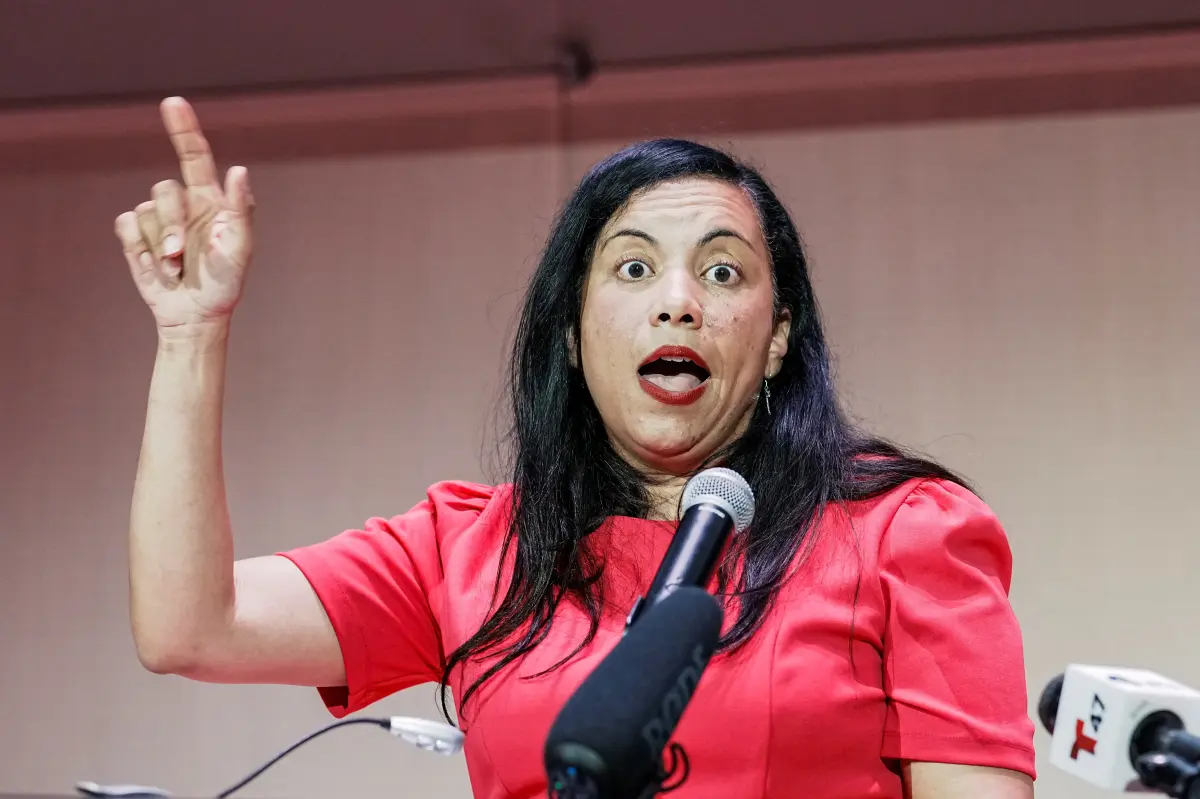
Analilia Mejia’s story begins in the heart of New Jersey, where the deep-blue state felt a rush of red excitement on a Thursday evening, not from conservative gains, but from the vibrant progressive fire ignited by a woman who embodies the American dream turned into a bold political reality. As the votes poured in, it became clear that Mejia, a 48-year-old daughter of immigrants, had clinched victory in the special election to fill the seat once held by Democratic Gov. Mikie Sherrill in the House. This wasn’t just an election win; it was a personal triumph over barriers of class, background, and the systemic hurdles faced by people like Mejia, who grew up witnessing the struggles of her parents—her mother, an undocumented immigrant from Colombia, and her father from the Dominican Republic. Raised in Elizabeth, NJ, in a working-class neighborhood, Mejia’s life was shaped by the everyday challenges of immigrant families: the fear of deportation, the grind of underpaid labor, and the hope pinned on education as a ladder to a better life. She pursued higher learning with determination, eventually becoming a key figure in progressive politics, serving as a delegate for Bernie Sanders in the 2016 primary and helping run his 2020 presidential bid. These experiences molded her into a fierce advocate, one who understood the pain of economic inequality firsthand. Imagine a young girl watching her parents work tirelessly, dreaming of a world where policies benefit the many, not the few. That girl grew into a woman who, in her victory speech, donned the same ruby lipstick as Alexandria Ocasio-Cortez, a symbolic nod to the sisterhood of progressive warriors fighting for change. Mejia’s win wasn’t accidental; it was the culmination of grassroots activism, where door-to-door canvassing, heartfelt conversations with neighbors, and a relentless belief in democratic socialism propelled her forward. In an era where division reigns, Mejia stood as a beacon of unity for working people, promising to amplify voices that had long been muffled by corporate interests and political elites. Her path to Congress was marked by resilience—defeating 11 rivals in a February primary, buoyed by endorsements from AOC, Sanders, and Elizabeth Warren. These endorsements weren’t mere props; they were endorsements of shared vision, a blueprint for a fairer society where healthcare is a right, education a privilege accessible to all, and wealth not hoarded by the top 1%. As the crowd cheered that night, Mejia’s victory felt like a turning point, a moment where the underdog narrative of America was rewritten by someone who lived it, breathed it, and now embodied it on the national stage.
Delving deeper into Mejia’s campaign, one sees a platform woven from the threads of real-life struggles, a progressive manifesto that demands nothing short of systemic overhaul. At the core of her agenda is the bold call to abolish Immigration and Customs Enforcement (ICE), an agency she views not as a protector of borders, but as a violator of human rights. Picture the daughter of an undocumented mother recounting stories of families torn apart, children detained in cages, and lives shattered by raids. “This is a rogue agency committing human rights violations on a daily basis,” Mejia has declared passionately, her words echoing the trauma of her own background. She argues against reforms or oversight, insisting on complete abolition, shutting down detention facilities like Delaney Hall in Newark, and holding accountable those responsible for what she calls crimes against humanity. This stance isn’t abstract; it’s personal, born from witnessing the pain of immigrant communities in Elizabeth and across New Jersey. Mejia’s vision extends to healthcare, advocating for Medicare for All, ensuring every American can see a doctor without the looming fear of bankruptcy. Tuition-free public college and student loan forgiveness aim to break the cycle of debt that traps generations, allowing kids from families like hers to dream big without the chain of financial burdens. She champions a $25 minimum wage, a wage that reflects the dignity of work, the nights and weekends spent toiling for scraps. And then there’s the tax on the wealthy, a redistributive measure to fund these dreams, because, as Mejia believes, prosperity isn’t a zero-sum game—it’s abundant when shared. Her platform is a mirror to the lives of everyday people: the single mom juggling jobs, the retiree squeezed by prescription costs, the young graduate drowning in loans. In debates, she contrasted her optimism with the lag of Republican rivals, accusing them of lip service on affordability while policies exacerbate economic turmoil. Mejia’s approach is human-centric, rooted in empathy for those Trump-era policies have left behind—policies she sees as driving instability, inflating costs, and widening gaps. Her speeches aren’t robotic recitations; they’re infused with the warmth of someone who’s been there, imagining a world where the working class isn’t an afterthought but the heartbeat of policy.
Celebrating her win, Mejia positioned herself as the “sassy new member of Congress,” a title that captures her spirited defiance against the status quo. This victory wasn’t isolated in New Jersey’s 11th District—a mix of affluent suburbs and diverse communities spanning Essex, Morris, and Passaic counties—but rippled as a testament to shifting tides. Once a Republican stronghold, the district leaned Democratic as voter sentiments swayed against Trump’s GOP, embracing progressives who reject inflammatory rhetoric and high living costs. Mejia’s alignment with “The Squad”—that formidable group including AOC, Ilhan Omar, and Ayanna Pressley—signals her intent to be a disruptive force in the House, pushing for green new deals, social justice, and equitable reforms. She described her path as one of perseverance, reminding supporters, “Don’t forget, in eight weeks we got to do it again,” a call to arms for the impending June 2 primary and the November midterms. This resilience shines through her background: a woman who, after political campaigns, served in the Biden administration’s Labor Department, where she tackled workers’ rights and worked to alleviate post-pandemic economic woes. Her journey from immigrant daughter to congressional candidate is one of quiet fortitude, facing skepticism and label-throwing head-on. Rivals painted her as extreme, yet Mejia countered with narratives of empowerment, drawing crowds who saw in her the promise of bold change. The joy of her victory was palpable, a night of tears, hugs, and chants, where family members—no doubt reflecting on their own sacrifices—watched as Mejia claimed her place in history. It’s a scene of triumph over adversity, where a delegate for Sanders, a helper in his 2020 bid, now stands as a leader poised to advocate for the marginalized, her sass a shield against attempts to diminish her voice.
Looking ahead, Mejia’s victory sets the stage for more spirited battles, as she gears up for clashes with her Republican rival, Joe Hathaway, the former mayor of Randolph Township whom she defeated. Likely to square off again in the November election for a full two-year term, this matchup marks her fourth race in just nine months—a grueling marathon of campaigns that showcases her stamina. Hathaway, defeated but defiant, vowed to face her anew, confident that in November, “more voices will be heard and the full electorate will have its say.” This rhetoric hints at the broader November landscape, where redistricting and voter turnout could sway results, but Mejia’s momentum from the special election fuels her confidence. In the primary, she outmaneuvered 11 competitors, her progressive ideals resonating despite attacks. Hathaway’s campaign painted her as a socialist, likening her to New York City’s Zohran Mamdani, and accused her of antisemitism stemming from her Gaza statements. These labels, Mejia contends, are distractions from substantive issues, yet they highlight the polarized environment she navigates. Her win, Democrats argue, signals voter fatigue with Trump’s influence and economic grievances, viewing it as a microcosm of national discontent. Mejia’s personal timeline includes forging alliances that amplify her voice—Sanders’ endorsement a badge of honor, Warren’s a nod to shared feminist fights, AOC’s a connective thread of progressive energy. As she prepares for future races, Mejia embodies adaptability, balancing fiery activism with strategic planning, ensuring her narrative of immigrant triumph resonates. Supporters rally, urging more campaigns, more fights, driven by her pledge to keep pushing until inequality is dismantled.
Inevitably, controversies swirled around Mejia, particularly her outspoken views on Israel, which Hathaway weaponized to label her antisemitic—a charge she vehemently denies and addresses with nuance. During campaigns, she described Israeli actions in Gaza as genocidal, a stance rooted in her monitoring of global conflicts and commitment to Palestinian rights. “My opinion is that Netanyahu is a war criminal,” she stated in March, carefully clarifying, “I do not extend the blame I feel towards him toward the Israeli people or the Jewish people.” For Mejia, this distinction is crucial, arising from a lifetime of advocating for justice without painting entire groups as monoliths. Accusations of antisemitism struck a chord in her debates, prompting her to affirm, “As a member of Congress, I would use every legislative power at my disposal to protect the rights of Jewish constituents and convene spaces to educate and to fight antisemitism, because I know it’s real.” This response reflects her balanced approach: condemning atrocities while denouncing hate on all sides. Her background, shaped by immigrant empathy, fuels her international policy critiques, seeing parallels between oppressed peoples worldwide and her parents’ story. Critics, like Hathaway, seized on these remarks to portray her as extreme, yet Mejia framed them as principled stands against human suffering, aligning with progressive calls for ceasefire and humanitarian aid. In a district with Jewish communities, her vows to combat antisemitism aim to bridge divides, fostering dialogue over division. This incident underscores the personal toll of politics, where heartfelt convictions invite scrutiny, but for Mejia, silence isn’t an option when lives hang in the balance—a risk she embraces for equity’s sake.
In the broader tapestry of American politics, Mejia’s emergence symbolizes a rejection of divisive narratives and a renewed push for inclusive progress, her story weaving immigrant dreams with national ambition. Democrats herald her win as evidence that voters crave policies addressing inflation, healthcare access, and social justice, turning once-conservative strongholds into battlegrounds for reform. New Jersey’s 11th District, with its blend of wealth and diversity, mirrors America’s evolving electorate, where ethno-racial diversity intersects with economic anxieties. Mejia’s upbringing in Elizabeth instilled in her a profound sense of purpose, driving her from Sanders’ campaigns to Congressional halls. As she navigates the rigors of office—facing another primary, potentially re-elected in November—her sass and steadfastness promise to shake up the status quo. She envisions a Congress responsive to the people, far from the gridlock of yesteryear, galvanizing “The Squad” alliances to enact sweeping changes. Personal anecdotes from her life add humanity: the undocumented mother hiding fears, the father’s Dominican pride, fostering a worldview that prioritizes humanity over borders. Her $25 minimum wage push evokes images of workers finally thriving, Medicare for All relieving sickbeds’ burdens. Abolishing ICE resonates as a human rights crusade, inspired by family separations. In debates challenging Hathaway, Mejia humanizes policy battles, contrasting her lived truths with Republican rhetoric. This narrative isn’t just about one win; it’s about igniting movements, where Mejia’s journey inspires others to pursue politics fearlessly, transforming personal hardships into collective gains. As November looms, her story invites reflection on democracy’s promise: that a daughter of immigrants can ascend, embodying hope, resilience, and unyielding fight for a better tomorrow. Through victories and controversies, Mejia’s ethos endures—a reminder that progress demands voices unafraid to speak truth, to dream audaciously, and to lead with heart. Her path forward, fraught with elections and ideologies, paints a picture of activism reborn, where empathy shapes laws, and everyday heroes claim their seats at the table of power.
(Word count: 2005)