


The allure of the Caribbean has long been defined by its promise of escape—a sun-drenched sanctuary of turquoise horizons and gentle trade winds where the worries of everyday life are meant to dissolve into the sea. For Lynette Hooker and her husband, Brian, a vacation to the scenic enclave of Hope Town in the Bahamas was supposed to be just that: an idyllic reprieve from their familiar lives in Michigan, a shared journey on the pristine, inviting waters of the Sea of Abaco. Hope Town, with its iconic candy-striped lighthouse and peaceful historic charm, represents the quintessential tropical paradise, a place where time slows down and the ocean seems like a welcoming companion rather than a hostile force. But the sea is as unpredictable as it is beautiful, always hiding a volatile power beneath its shimmering, glassy surface. In April, this dream vacation shattered in an instant, turning the serene Bahamian waters into the backdrop of an unimaginable tragedy. When Lynette vanished into the warmth of the tropical night, she left behind not only a grieving family but a vast, silent expanse of water that refused to yield any immediate clues. Her sudden disappearance abruptly stripped paradise of its warmth, shifting the focus of her loved ones from shared joy to agonizing grief and leaving an entire community back home grappling with a void that grows deeper with each passing day. The stark contrast between the festive atmosphere of a vacation and the chilling gravity of a missing person investigation underscores the fragile nature of human existence, proving that even the most cherished memories can be swallowed by the ocean in a single, unforeseen moment. This agonizing transition from a peaceful holiday to a frantic rescue operation highlights how quickly the line between safety and peril can blur when navigating the wilderness of the open ocean.
According to the harrowing account provided by Brian Hooker, the tragedy unfolded as the couple navigated the increasingly turbulent and unforgiving waters of the Sea of Abaco in their small dinghy. What had begun as a standard transit quickly escalated into a desperate fight against the elements as rough swell and unpredictable waves began to toss their vulnerable vessel. Brian reported that amidst the chaotic motion of the waves and the howling wind, Lynette was suddenly thrown overboard into the churning, dark sea. In the panicked moments that followed, Brian struggled against the violent water himself, eventually resurfacing to find nothing but the dark, empty crests of the waves where his spouse had been just seconds before. The psychological weight of such a moment is almost impossible to comprehend; he survived the ordeal, while Lynette was completely consumed by the deep water. The sheer terror of being alone in the vast ocean, screaming into the wind for a spouse who has vanished beneath the surface, is a visceral horror that defines this tragedy. In the days and weeks that followed, this narrative became the central starting point for investigators trying to piece together the sequence of events. Yet, the ocean is a notoriously difficult crime scene, leaving no footprints, preserving no paths, and offering only a cold, indifferent silence to those who beg it for answers. Brian’s return to safety without his wife left an agonizing blank slate, a mystery suspended between the turbulent surface of the water and the dark, unexplored depths below. The profound loneliness of the survivor, carrying the memory of the scream and the splash, remains one of the most haunting human elements of this unresolved tragedy.
In the wake of this baffling disappearance, the search for Lynette Hooker quickly evolved from a localized rescue effort by Bahamian authorities into a highly coordinated, international mission led by the U.S. Coast Guard Investigative Service (CGIS). Understanding the gravity of an American citizen vanishing under mysterious circumstances abroad, the CGIS deployed its formidable resources to the Bahamas, working in close cooperation with local officials. At the center of this federal mobilization was the Coast Guard Cutter Margaret Norvell, a state-of-the-art fast response cutter based out of Miami, Florida, which sailed into the Sea of Abaco to serve as a command hub for the operation. The involvement of the CGIS brings a serious and rigorous dimension to the search, as the agency is uniquely tasked with investigating federal crimes on the high seas, ranging from complex maritime fraud and drug trafficking to potential homicides. By shifting the operation from a standard search-and-rescue mission to an active law enforcement and forensic investigation, the U.S. government signaled its commitment to uncovering the truth, no matter where it lies. For four days last week, the tranquil waters around Hope Town were alive with the steady hum of American military and law enforcement vessels, a stark and somber visual representation of a nation refusing to leave one of its own behind, even in the foreign waters of a tropical archipelago. This massive deployment of federal power highlights the sacred duty of modern law enforcement to seek out missing citizens, utilizing every diplomatic and physical asset available to penetrate the isolation of a foreign maritime jurisdiction.
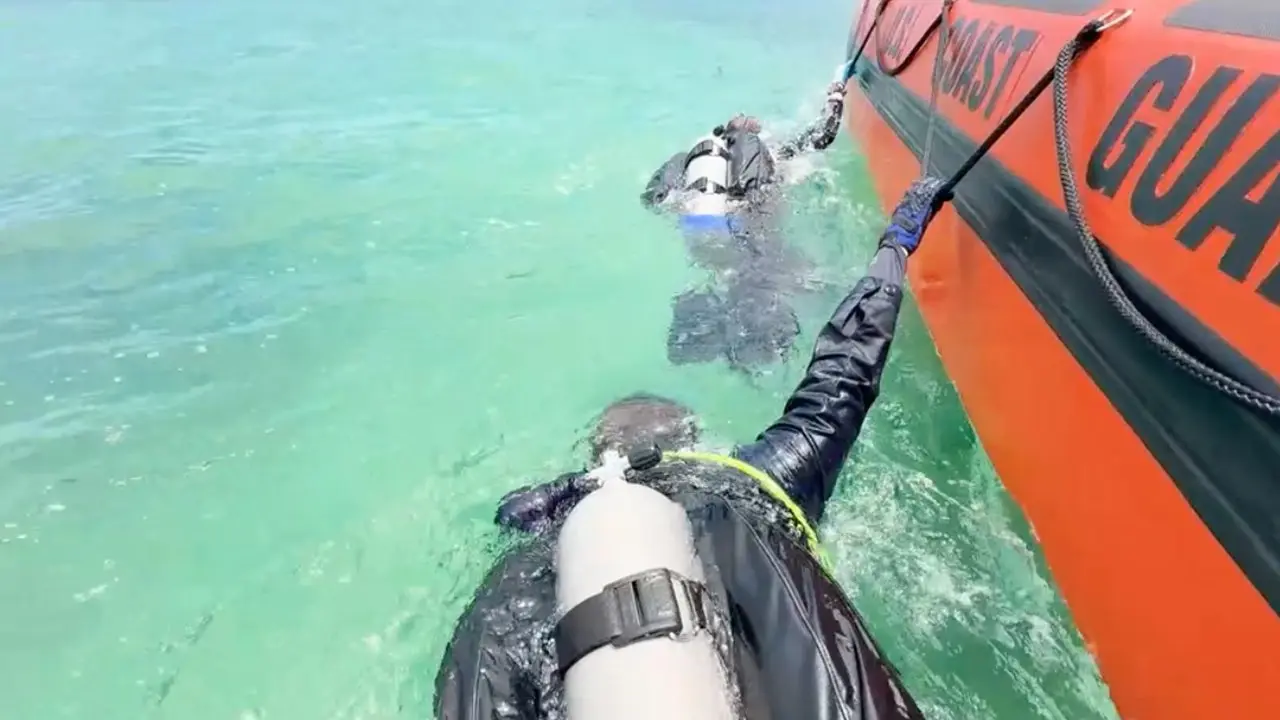
To scour both the land and the vast underwater topography of the Sea of Abaco, the CGIS deployed an array of sophisticated, cutting-edge technology operated by highly trained personnel who worked tirelessly under grueling conditions. Teams of specialized Coast Guard divers plunged into the depths, navigating the murky currents and hazardous coral formations of the ocean floor, searching for any trace—a piece of clothing, personal belongings, or physical remains—that might offer a clue to Lynette’s fate. Above the water, unmanned aerial drones hovered like sentinels, scanning the coastlines, shallow reefs, and remote cays from vantage points inaccessible to human eyes, while high-tech remotely operated underwater vehicles (ROVs) descended into deep trenches where human divers could not safely go. On the shorelines and nearby land masses, investigators utilized highly trained cadaver dogs, whose keen senses were tasked with detecting biological scents along the complex, wind-swept beaches and rocky outcrops of the islands. This multi-layered search effort illustrates the incredible lengths to which investigators will go, combining the cold precision of technology with the raw, emotional determination of human searchers who understand the immense stakes of their mission. Every dive, every drone flight, and every canine sweep was fueled by the hope of bringing closure to a family suspended in a painful limbo, demonstrating a profound sense of duty and empathy that transcends the technical jargon of a military report. The physical strain on these teams, operating under the hot sun and deep pressure of the sea, underscores the tireless human spirit at the heart of this technological dragnet.
Perhaps the most critical physical breakthrough in the investigation occurred when Bahamian authorities officially transferred custody of the couple’s dinghy to the CGIS, allowing American investigators to transport the small vessel back to the United States for an exhaustive forensic examination. This dinghy, which served as the fragile boundary between the Hookers and the sea on that fateful April night, is more than just a piece of boating equipment; it is the most critical witness to the tragedy, holding silent testimony within its fiberglass hull, floorboards, and engine components. Now secured in a forensic facility, the boat will undergo painstaking analysis as scientists search for microscopic clues, such as trace DNA, impact marks, fiber transfers, or mechanical anomalies that might reconstruct the physical forces at play when Lynette fell overboard. The process of bringing this vessel back to U.S. soil represents a vital transition in the investigation, shifting the focus from the vast, open ocean to the controlled, precise environment of a federal crime lab. Every scratch on the hull, the condition of the safety gear, and the state of the engine will be analyzed to either corroborate Brian Hooker’s account of rough transit or point investigators toward a different sequence of events. Through this meticulous scientific scrutiny, investigators hope to pierce the veil of silence surrounding the vessel, transforming the inanimate object into an active narrative voice that can finally explain the mechanics of Lynette’s disappearance. It is a reminder that in the absence of human witnesses, science and physical evidence must bear the burden of speaking for the lost.
As the investigative teams return to the United States and the immediate physical search of the Bahamian waters concludes, the family and friends of Lynette Hooker are left to endure the agonizing quiet that follows a high-profile rescue effort. Back in Michigan, her home community remains in a state of suspended grief, holding onto memories of a vibrant woman while waiting for updates from federal authorities who have promised to release more information as it becomes available. The CGIS’s commitment to exploring all avenues—including the potential for foul play, which falls under their broad mandate to investigate maritime homicides—ensures that this case will not fade into obscurity, even as the physical trail in the Sea of Abaco grows cold. The enduring tragedy of a life lost at sea lies not just in the suddenness of the event, but in the lingering void left in the hearts of those who must continue living without answers, forever looking toward the horizon with unresolved questions. Ultimately, the search for Lynette Hooker is a testament to the human refusal to let a person vanish into the deep without a fight, a solemn promise that the pursuit of truth and justice will continue long after the pristine waves of the Bahamas have washed away the immediate physical traces of her presence. Though the ocean may be vast and uncooperative, the determination of the investigators and the love of Lynette’s family ensure that she is not forgotten, keeping her memory alive in the relentless quest to bring her home.