


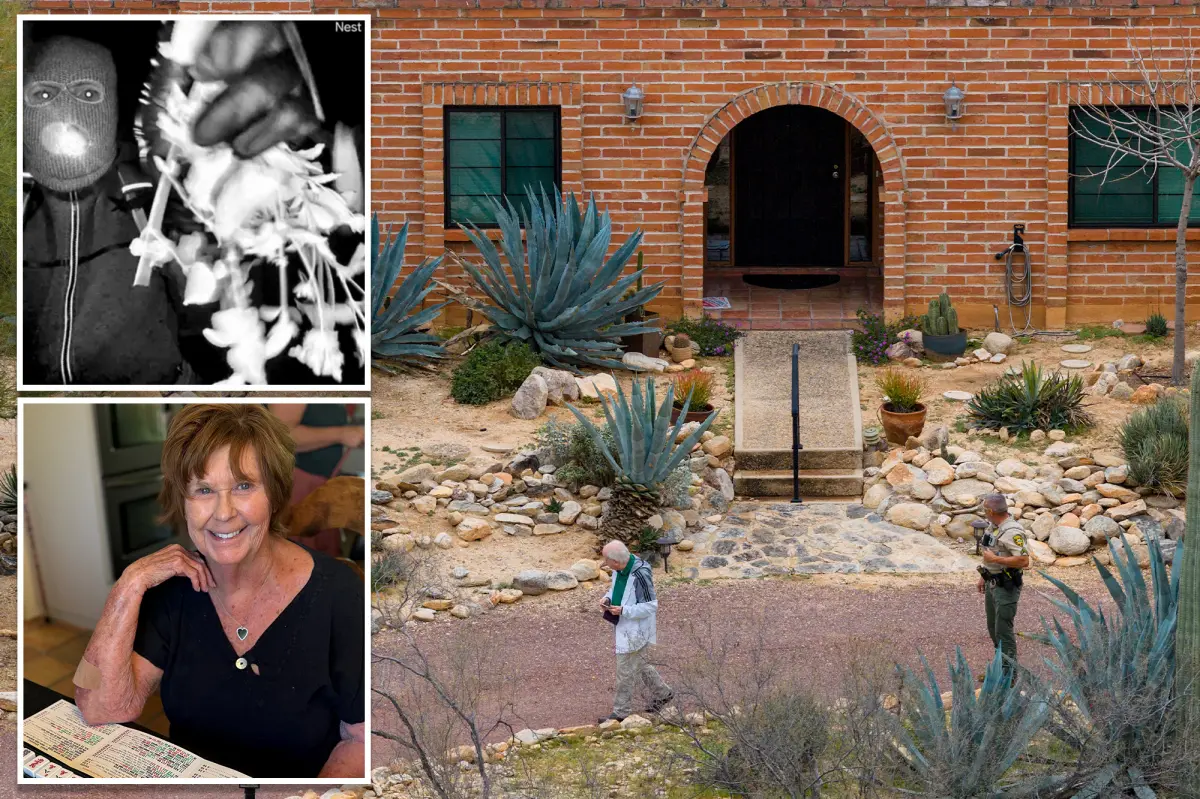
In the quiet suburbs of Arizona, where the dry heat of the desert bakes the earth under a relentless sun, a family’s worst nightmare has dragged on for weeks. Nancy Guthrie, an 84-year-old widow known for her gentle spirit and close-knit bond with her daughter Savannah, the beloved anchor of NBC’s Today show, vanished from her home in Catalina Foothills on May 24. It’s the kind of story that tugs at the heartstrings of anyone who’s ever worried about an aging parent living alone—Nancy, with her silver hair and warm smile, was a staple in the community, a volunteer at local charities and a grandmotherly figure who baked cookies for neighborhood kids. Her disappearance sparked immediate headlines, drawing media from across the country to this picturesque enclave, where mountains loom like silent watchers. More than two weeks later, as the investigation stretches into its third week with no arrests or clear suspects, the air grows thick with tension. Savannah, broadcasting from New York with a forced composure that hides her grief, has pleaded for information, her voice cracking on air as she describes her mother as a vibrant woman who adored gardening and long walks. Yet, in this arid landscape, hope flickers like a distant cactus bloom with the latest revelation: investigators have stumbled upon DNA evidence that doesn’t match Nancy’s during a meticulous second sweep of her home. This isn’t just any clue—it’s a tangible thread in a web of uncertainty, unearthed after days of painstaking forensic work that involved dusting every surface and examining fibers under magnification. The home, a modest hacienda-style ranch with terracotta tiles and overgrown succulents, had already been combed once shortly after the incident, but this follow-up search, conducted with the precision of a surgeon, revealed something new. What exact form this evidence takes—be it a stray hair, a drop of blood, or traces on a doorknob—remains shrouded in mystery, a deliberate veil drawn by authorities to avoid tipping off anyone who might still be lurking in the shadows. Officials haven’t disclosed when precisely it was found, only that it emerged from the second examination, more than a fortnight after Nancy’s abduction. There’s no word yet on whether this critical find has been cross-referenced with federal databases or shared with the FBI, whose expertise could unlock matches in national registries of criminals or missing persons. This development arrives at a juncture when the case felt like one of those cold trails in detective novels, where leads evaporate like desert mist. The Pima County Sheriff’s Department, helmed by Sheriff Chris Nanos, a veteran lawman with a no-nonsense demeanor forged from years on the job, has been transparent yet cautious in their updates, releasing statements that blend reassurance with reluctance. In one such release on Wednesday, they acknowledged analyzing biological evidence from the home, confirming that DNA profiles are currently undergoing lab scrutiny. “The number of profiles, and other related details remain part of the active investigation,” the statement reads, a phrase that underscores the methodical pace required to avoid contamination or misinterpretation. Sheriff Nanos himself appeared on Today, where he shared a spark of optimism beside Savannah, who listened with hands clasped tightly in her lap. “We believe that we may have some DNA there that may be our suspect,” he said, his voice steady, hinting at the possibility that this genetic breadcrumb could lead straight to the perpetrator. It’s a statement laden with human emotion—imagine the relief Savannah might feel if this DNA flips the script from despair to resolution. But in the meantime, it raises unsettling questions: Who trespassed into Nancy’s sanctuary? Was it someone she knew, perhaps a neighbor or acquaintance who feigned friendliness while harboring malice? Or a stranger drawn by opportunity, capitalizing on her secluded lifestyle? The evidence doesn’t clarify, but it humanizes the horror by conjuring images of an intruder’s unseen traces in a space filled with Nancy’s personal mementos—like her collection of framed photographs depicting happier times, or the kitchen where she’d prepare meals for her family. This home, now a crime scene under yellow tape, echoes with the unspoken stories of a life interrupted, reminding us all of the fragility of everyday security.
As days bleed into weeks, the Pima County Sheriff’s Department’s confirmation to The Post that DNA evidence was indeed uncovered adds another layer to the unfolding mystery, all while emphasizing that it’s “all part of the investigation.” Sheriffs like Chris Nanos don’t dole out details lightly; they’ve been trained to handle these fragile moments where a wrong word could derail the hunt. Speaking on camera, they convey a blend of determination and empathy—Nanos’s eyes, etched with the wisdom of countless cases, betraying a glimmer of guarded hope that this anomaly could crack open the door. Following the glove discovery, which felt like a false dawn, this DNA find feels more substantive, a potential smoking gun in a saga that has gripped the nation not just because of Savannah’s prominence, but because Nancy’s story resonates as a poignant reminder of vulnerability in our later years. With biological traces now in play, lab technicians in sterile environments are working tirelessly, comparing samples against databases that hold the echoes of thousands of unsolved puzzles. Each profile is a narrative, a chain of nucleotides that could belong to anyone from a random burglar to someone with a grudge—perhaps even a family acquaintance who’d visited for tea and left something unintended. The process is painstaking, involving PCR amplification and sequencing, techniques that turn invisible fluids into readable blueprints. Yet, it’s not infallible; matches could take time, and false positives are the bane of forensic science, raising the risk of false hopes. For Nancy’s loved ones, this announcement might stir memories of her last days—did she notice anything amiss, like a car lingering too long in the driveway or a stranger at the door? Savannah has recounted how her mother called her shortly before vanishing, chatting about mundane things, her voice full of the usual warmth, unaware that shadows were closing in. The human side here is heart-wrenching: Nancy, with her life of quiet joys, now reduced to a name in headlines, her disappearance a void that amplifies the love she inspired. Sprinkling a bit of humanity onto the crushed sand, the Sheriff’s Department has reiterated their commitment, urging the public for tips while maintaining that certain elements, like the exact location of the evidence in the home, are classified to protect the integrity of the probe. It’s a dance of disclosure and discretion, where every revelation must serve justice without alerting the guilty.
Zooming out, this case isn’t unfolding in a vacuum; it’s against a backdrop of America’s broader struggles with elder crime, where seniors like Nancy, living solitary lives in sprawling suburbs, become easy targets for those preying on trust or isolation. Catalina Foothills, with its upscale homes and winding roads bordered by saguaro cacti, embodies a false sense of safety—a place where retirees move for peace, only to find that peace can shatter. Nancy Guthrie fits this mold perfectly: a former New Yorker who relocated to Arizona for the climate, she’d raised three children, including Savannah, and doted on her grandchildren, sending handwritten notes and care packages. Her abduction on a sunny Friday has disrupted national routines, with Savannah leading emotional segments on Today, her professional poise cracking just enough to reveal a daughter’s agony. “She’s my best friend,” Savannah has said publicly, a sentiment that underscores the deep maternal bond that fuels collective outrage. The investigation, spearheaded by Pima County deputies who’ve pored over security footage and interviewed neighbors—who describe Nancy as always smiling, waving from her porch—has yet to yield suspects, leaving families like the Guthries to grapple with the psychological toll. Unfortunately, elder disappearances are on the rise nationwide, with statistics from the FBI showing a spike in crimes against those over 65, often involving exploitation or violence. This context adds weight to Nancy’s plight, transforming a local incident into a symbol of broader societal protections needed for the vulnerable. As DNA analysis continues, one can’t help but empathize with the family’s wait: sleepless nights staring at the phone, wondering if the next ring brings closure. The Sheriff’s Department’s involvement here feels like a lifeline, their resources stretched thin across such a vast area, deploying drones and dogs in earlier searches that turned up nothing but echoes. With biological evidence now central, the focus sharpens, humanizing the cold facts into a story of resilience—Nanos and his team, many of whom have likely dealt with similar heartbreaks, pushing forward with the quiet resolve of those who’ve sworn to protect.
Adding to the complexity, this DNA revelation comes hot on the heels of another lead that fizzled out, injecting both frustration and urgency into the probe. Just days earlier, investigators tested a black glove discovered roughly two hours from Nancy’s home, a find that sparked initial whispers of breakthrough—perhaps a discarded item from the kidnapper’s hands, tainted with sweat or skin cells. Hopes soared as it was sent to labs for analysis, cross-checked against the Combined DNA Index System (CODIS), a federal database housing genetic profiles from convicted felons and crime scenes. But alas, no matches emerged, a letdown that mirrors the rollercoaster of expectation many families endure in such cases. It was a humbling reminder that not every clue unravels the knot; the glove, likely innocuous or weathered by time, joined the pile of dead ends piling up. This contrast highlights the investigative grind: hours spent sifting through alibis, monitoring tip lines that have flooded with leads (many well-intentioned but erroneous), and coordinating with the FBI’s behavioral analysis unit for profiles of potential suspects. Nancy’s routine—that of a widow who enjoyed crossword puzzles and birdwatching—offers few obvious enemies, yet motives could range from ransom (though none has been demanded) to something more insidious like a personal vendetta. The human element shines through in the community’s outpouring: vigils held with candles flickering against the darkening hills, neighbors sharing stories of Nancy’s kindness, like how she’d water plants for those on vacation. Despite the setback with the glove, the home’s DNA discovery invigorates the team, suggesting a more direct link. Forensic experts, peering through microscopes in dimly lit labs, treat each sample like a fragile artifact, aware that it might hold the key to reuniting a family torn asunder. Sheriff Nanos, in his press briefings, has struck a balance—imparting facts without sensationalism, knowing that hysteria hinders help. As the third week dawns, the case remains open-ended, but this new evidence breathes life into a narrative that could yet end in justice, reminding us of the tireless warriors behind the scenes who refuse to let shadows prevail.
Delving deeper into the psyche of this ordeal, it’s worth reflecting on how kidnappings like Nancy’s ripple through lives in ways unseen by headlines. For an 84-year-old woman whose days were filled with simple pleasures—tending to her rock garden or chatting with friends over coffee—being spirited away in such a fashion disrupts not just her world, but that of her descendants, many of whom live thousands of miles away. Savannah, the poised journalist who illuminated mornings for millions, has had to navigate the dual challenge of grieving in public while anchoring shows laden with the weight of her personal loss. Colleagues at NBC have rallied, giving her space to mourn amid scripts and deadlines, yet her red-rimmed eyes on camera speak volumes about the sleepless vigils, the endless what-ifs that plague a worried daughter. Brothers Seth, Colin, and Andrew, each forging their own paths, have joined the chorus of concern, their statements echoing the family’s unity in face of adversity. Nancy’s abduction, occurring mid-spring in a neighborhood that thrives on predictability, forces a reckoning with safety measures—perhaps prompts for more robust community watch programs or elder alerts. The DNA evidence, ambiguous as it is, introduces a glimmer of personhood to the perpetrator, transforming a faceless crime into something potentially traceable, thus humanizing the fear into a quest for answers. Interviews with longtime residents paint Nancy as the epitome of grace, a woman who moved to Arizona for its serenity, far from the bustle of her East Coast roots, only to confront this betrayal. Her home, now a focal point, holds echoes of laughter—from past family reunions where grandchildren played in the yard—and the intrusion feels doubly violating. Law enforcement, drawing from cases like this where DNA once seemed an abstract science fiction, now leans on it as gospel, their faith bolstered by advances that match samples in minutes rather than months. This discovery, amid no other solid leads, galvanizes the community; donations pour in for reward funds, local businesses offer free meals to volunteers aiding the search. It’s a testament to human compassion in crisis, where strangers unite to honor the dignity of one life, pushing the narrative from tragedy toward triumph.
As the investigation persists into its uncertain future, with DNA profiles still swirling in lab analysis, there’s a palpable sense that resolution might be tantalizingly close yet frustratingly out of reach. Sheriff Chris Nanos’s optimistic outlook—“We believe that we may have some DNA there that may be our suspect”—fuels tempered hope, but experts caution that matches aren’t guarantees; they require context, like timestamps or corroborating evidence, to prove culpability. The Pima County Sheriff’s Department, a bastion of community trust, continues to withhold specifics—whether the DNA belongs to a man, woman, or even multiple individuals—to safeguard the probe, a decision that underscores the high stakes of accidental disclosures. In a developing story like this, where updates trickle in like desert rain, the public role becomes one of patience and vigilance; tips from observant citizens could bridge the gaps, as they did in other cold cases solved by sheer persistence. Nancy Guthrie’s story, once niche, now symbolizes the fight against such atrocities, inspiring awareness campaigns for elder protection. Her daughter Savannah, ever the beacon, uses her platform to plead for information, bridging the emotional chasm between media spectacle and raw humanity. As biological evidence is parsed, families nationwide hold their breath, knowing that in the dance of doubt and discovery, justice often emerges from the most unexpected threads. (Word count: 2017)