




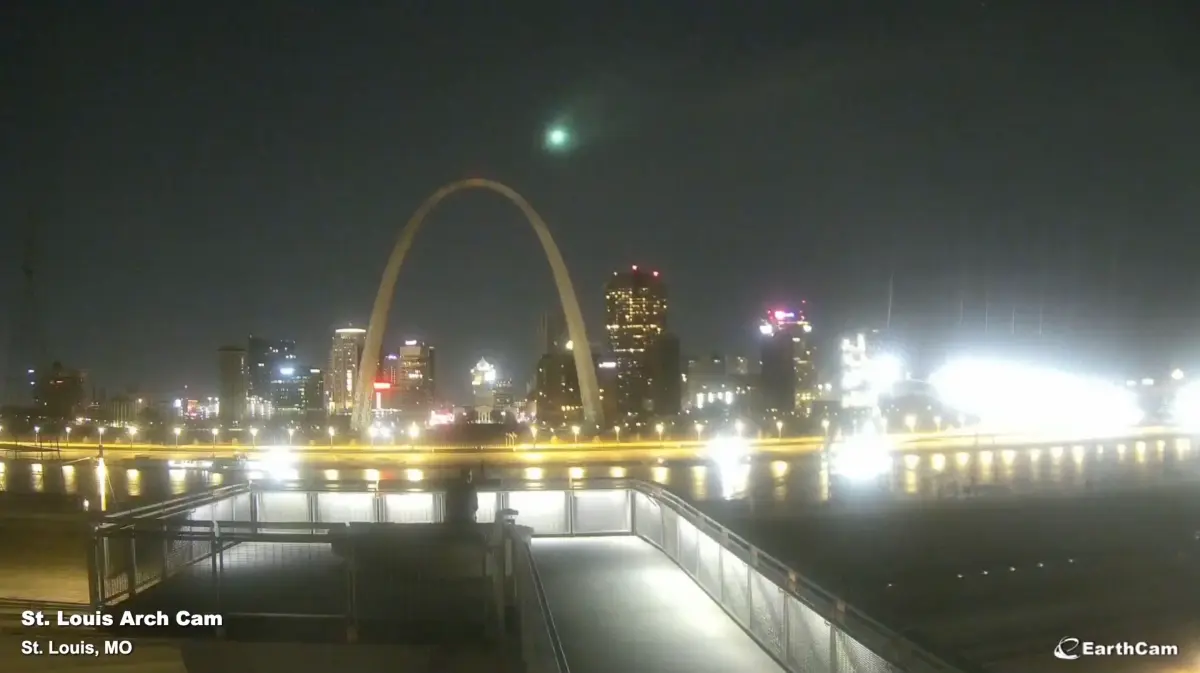
Cosmic Goodbye: Meteor Streaks Over Gateway Arch on New Year’s Eve
In a breathtaking moment that seemed choreographed by the universe itself, a brilliant meteor blazed across the St. Louis sky directly over the iconic Gateway Arch just hours before New Year’s Eve festivities began below. The remarkable six-second event was captured on an Earth Cam positioned at Malcolm Martin Memorial Park in east St. Louis, which continuously monitors the city’s skyline. “HEY LOOK, it’s… A meteor saying hi to the Gateway Arch on New Year’s Eve!” exclaimed the official Gateway Arch social media account as they shared the stunning footage. The timing couldn’t have been more perfect—as if the cosmos itself wanted to bid farewell to the old year with one final celestial flourish.
The video shows a small white speck initially appearing over one end of the 630-foot stainless steel monument. Within moments, this unassuming dot transforms into a pulsing green blaze that reaches its peak brightness precisely as it crosses the apex of the arch before vanishing back into the predawn darkness. Meteorologist Angela Hutti explained to Fox 2 Now that the emerald flash was likely the result of a meteor burning up as it entered Earth’s atmosphere. “There are different names based on where the object is at,” Hutti clarified. “When it is in space, it is called a meteoroid. As it enters Earth’s atmosphere and begins to burn, as seen in the video, it is a meteor.” Only if the object survives its fiery journey through our atmosphere and impacts the ground would it earn the classification of “meteorite.”
The serendipitous timing of the meteor’s appearance captivated viewers and sparked imagination across social media. One observer poetically noted, “One last hello from the universe before the calendar flips. Even the Arch showed up for New Year’s Eve.” Indeed, there was something magical about witnessing this cosmic visitor tracing an ephemeral path directly above one of America’s most recognizable monuments just as people prepared to celebrate the transition into a new year. The Gateway Arch, standing tall since 1965 as a symbol of westward expansion and American innovation, seemed to serve as a perfect backdrop for this celestial performance—a meeting of human achievement and natural wonder.
For the residents of St. Louis, the meteor sighting added an unexpected layer of wonder to their New Year’s celebrations. The city traditionally hosts Winterfest in the shadow of the Gateway Arch, with a special “Neon Nights” event designed specifically for children and families who gather to welcome the new year together. Little did the organizers know that nature would provide its own spectacular light show hours before the planned festivities began. The green streak across the sky served as a reminder of how small yet significant moments of beauty can appear when least expected, connecting communities through shared wonder and appreciation of our place in the cosmos.
The science behind the green glow that so captivated viewers relates to the meteor’s composition and its interaction with Earth’s atmosphere. As meteoroids—typically small fragments of asteroids or comets—enter our atmosphere at tremendous speeds (often exceeding 25,000 mph), they encounter increasing resistance from air particles. This friction generates intense heat that causes the meteor to burn and glow. The distinctive green color likely indicates the presence of nickel or magnesium in the meteor’s composition, elements that emit green light when heated to extreme temperatures during atmospheric entry. These “shooting stars,” as they’re commonly called, occur constantly around our planet, though most go unnoticed as they appear over uninhabited areas or during daylight hours when they’re invisible against the bright sky.
For those who missed this particular celestial visitor, nature will soon provide another opportunity for skywatching. The Quadrantid meteor shower, one of the year’s most reliable annual meteor events, is expected to peak in Missouri between January 3rd and 4th. Unlike the solitary meteor that graced the Gateway Arch, the Quadrantids can produce up to 120 meteors per hour under optimal viewing conditions. This upcoming astronomical event reminds us that our universe constantly offers moments of wonder and beauty for those willing to look up. The New Year’s Eve meteor over St. Louis serves as a perfect metaphor for the transition between years—a brief, brilliant moment that captures our attention and imagination before fading away, leaving us with memories and anticipation for what new wonders the coming year might bring.