


A Monument to Hesitation: The Silent Decay of Canada’s Historic Prime Ministerial Manor
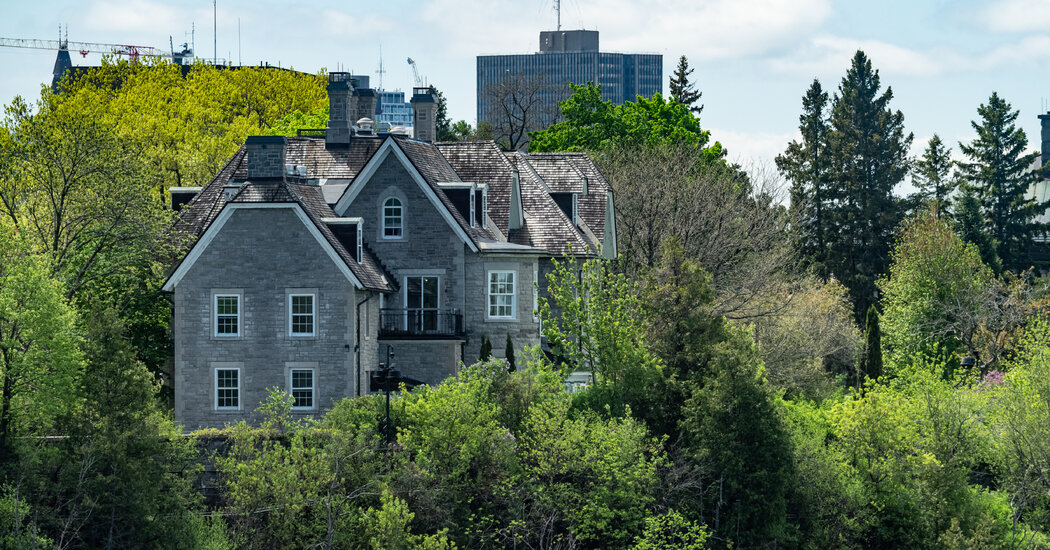
No representative of the Canadian state has called the official residence of the nation’s prime minister home for over a decade, and the profound physical consequences of this prolonged abandonment are now on display for any curious passerby. A brief glimpse through the rusted iron gates and security fences of 24 Sussex Drive reveals a desolate scene of neglected flower beds, unmanaged brush, and dandelions running rampant across the front lawn, evoking the image of a forgotten relic rather than the domestic heart of a G7 democracy. While world leaders elsewhere enjoy meticulously maintained, historic executive estates—exemplified by American presidents overseeing the construction of grand new ballrooms within the gilded, historic walls of the White House—Canada’s primary political address sits entirely empty, deemed fundamentally unfit for human habitation, let alone the head of a major Western government. The roots of this public embarrassment run deep, stretching back to 2015 when then-newly elected Prime Minister Justin Trudeau bypassed the crumbling mansion in favor of temporary, albeit highly secure, official quarters a short drive away at Rideau Cottage. His successor, Prime Minister Mark Carney, has inherited both this awkward living arrangement and the long-simmering domestic crisis it represents. Before the property was gutted and boarded up in December 2024, decades of deferred maintenance and political timidity had left the 19th-century stone mansion structurally compromised and environmentally hazardous. The building was heavily infested with rodents, completely devoid of modern central air conditioning, and burdened with an antiquated, failing electrical system dating back to the 1950s. Its heating was dependent on an ailing, inefficient boiler, while the sweltering Ottawa summers were combated only by poorly fitted window air-conditioning units—all of which sat encased in toxic laths of asbestos inside a shell perched precariously on a shifting, unstable cliff overlooking the Ottawa River.
The Carney Manifesto: Linking Infrastructure Sovereignty to Heritage Revival
                       ┌───────────────────────────┐
                       │   24 Sussex Drive:        │
                       │   A Monument in Transition│
                       └─────────────┬─────────────┘
                                     │
             ┌───────────────────────┴───────────────────────┐
             ▼                                               ▼
┌───────────────────────────┐ ┌───────────────────────────┐
│ The Architectural │ │ The Geopolitical │
│ Emergency │ │ Framework │
├───────────────────────────┤ ├───────────────────────────┤
│ • Decades of neglect │ │ • Broad infrastructure │
│ • Asbestos & aging wiring │ │ revitalization efforts │
│ • Landmark oversight run │ │ • Symbol of national │
│ by architect Moshe │ │ determination amidst │
│ Safdie’s jury panel │ │ tariffs & global trade │
└───────────────────────────┘ └───────────────────────────┘
After nearly twenty years of successive federal governments nervously dithering over the optics of home improvement, Prime Minister Mark Carney broke the institutional deadlock on Friday by announcing that the government will launch an ambitious, nationwide design-and-build competition to fully restore 24 Sussex Drive. Emphasizing a collective sense of civic duty and pride, Carney declared that the country would no longer permit its primary executive symbol to rot, stating, “We will not let it crumble. We will set it right, and we will do this in a manner that reflects the very best of Canada.” While this historic home restoration project does not match the massive scale of Carney’s other sweeping plans to rapidly construct nuclear reactors, build critical pipelines, and overhaul national transportation networks, his willingness to tackle this notorious political hot potato aligns closely with his broader executive doctrine. His administration has consistently sought to push the cumbersome machinery of the federal civil service to rapidly rebuild and modernize Canada’s physical infrastructure, a policy designed to bolster both Canadian economic resilience and national sovereignty in an era defined by aggressive American economic rhetoric, protectionist tariffs, and talk of annexation. To ensure the design meets the highest aesthetic and structural standards, the Royal Architectural Institute of Canada will establish an independent selection jury chaired by the internationally renowned architect Moshe Safdie—the visionary force behind Ottawa’s landmark National Gallery of Canada. The winning firm, tasked with both the artistic design and the comprehensive physical reconstruction of the property, is scheduled to be announced on Canada Day, July 1 of next year, signaling a symbolic rebirth of the nation’s political hearth.
The Ethics of Benevolence: Mitigating Influence in a Public-Private Philanthropic Venture
┌────────────────────────────────────────────────────────┐
│ RIDEAU HALL FOUNDATION FUNDING │
├────────────────────────────────────────────────────────┤
│ [X] Strict Corporate Contribution Bans │
│ [X] Hard Individual Giving Limits │
│ [X] Full, Unrestricted Public Registry of Donors │
│ [X] Absolute Separation from Private Executive Utility │
└────────────────────────────────────────────────────────┘
In an effort to shield the reconstruction from the inevitable political backlash regarding the use of public funds, the federal government has designed a unique, largely non-governmental financial path to cover the multi-million-dollar price tag. The vast majority of the restoration costs will be offset through a coordinated national fundraising campaign led by the Rideau Hall Foundation, a prominent non-profit organization closely associated with the office of the Governor-General. While an official, final budget for the massive undertaking has not yet been publicly disclosed, the decision to rely on private and philanthropic generosity has immediately raised eyebrows in a capital city highly sensitive to lobbying and political influence. To actively mitigate public concern that wealthy donors might attempt to buy access or curry favor with the Prime Minister’s Office, Carney announced a series of strict ethical firewalls: corporate donations will be legally banned, a hard cap on individual donations will be established, and the names of all donors will be made public in a transparent registry. Critics remain skeptical about whether these measures can fully sanitize the process of funding a politician’s home, but Carney has attempted to disarm his opponents by noting that he will never personally reside in the restored manor. The initiative represents a delicate balancing act, attempting to reconcile Canada’s historic discomfort with elite political privileges with the practical, modern necessity of preserving a crown asset that serves as a vital backdrop for high-level statecraft.
From Luxury Hotels to Lumber Baron Estates: The Strange History of Ottawa’s Official Residencies
To understand how the prime minister’s official residence degenerated into a national embarrassment, one must examine the complex and often reluctant history of executive housing within the capital. Prior to 1950, Canada did not provide its heads of government with an official home, forcing prime ministers to secure their own private accommodations or rent houses on the open market, sometimes with striking results. During the depths of the Great Depression, the millionaire Prime Minister R.B. Bennett lived in a lavish, 5,000-square-foot suite at the Château Laurier—the opulent castle-style hotel situated next door to Parliament—a choice that starkly contrasted with the widespread economic misery of the era. The transition to a permanent, state-owned residence began in the late 1940s when the National Capital Commission, the federal agency overseeing official properties, acquired the 19th-century stone mansion at 24 Sussex Drive, which had originally been built in 1868 by an American-born lumber baron named Joseph Merrill Currier. When the Liberal Prime Minister Louis St. Laurent was asked to move into the newly renovated home in 1950, he did so with extreme hesitation, famously insisting on paying a symbolic monthly rent to the government to completely avoid any public accusation of freeloading. The building itself was stripped of much of its Victorian ornamentation during that era in a misguided nod to mid-century modernization, creating a structure that future capital commission studies would identify as structurally dysfunctional: its dining spaces were far too large for a normal family, yet not nearly expansive enough to host modern, large-scale diplomatic banquets.
Historic Timeline of Canadian Prime Ministerial Accommodations:
Pre-1950 ───► No official residence provided; PMs found private housing.
1930–1935 ───► R.B. Bennett lived in a luxury suite at the Château Laurier.
Late 1940s ───► National Capital Commission acquired 24 Sussex Drive.
1950 ───► Louis St. Laurent moved in, insisting on paying rent.
2015 ───► Justin Trudeau relocated to Rideau Cottage due to decay.
Dec 2024 ───► 24 Sussex Drive officially closed and gutted.
Present/Future ───► National design competition launched by PM Mark Carney.
A Battle of Visions: Dismantling, Repurposing, or Preserving a Flawed Foothold
              PERSPECTIVES ON THE FUTURE OF 24 SUSSEX
              ───────────────────────────────────────
[THE CONSERVATIONISTS] ──────────► Restore and preserve the heritage property
using public-private donor funds.
[THE MODERNIZERS] ───────────────► Demolish the building entirely to showcase
cutting-edge Canadian design.
[THE SECURITY REALISTS] ─────────► Convert the site into a secure conference
center; build a new residence elsewhere.
The years of vacancy at 24 Sussex Drive have sparked a lively, sometimes polarized debate among former prime ministers, architectural preservationists, and security experts regarding the best path forward for the property. In 2024, an unexpected bipartisan alliance emerged when former Liberal Prime Minister Jean Chrétien and his onetime Conservative rival Stephen Harper volunteered to personally lead a private fundraising foundation to restore the house, though their offer was rejected by the Trudeau administration at the time. Others, like Kim Campbell, who served as prime minister in 1993, have strongly advocated for demolishing the building entirely, suggesting that a brand-new residence would provide an opportunity to showcase modern, sustainable Canadian architecture and indigenous design to the world. A third faction of urban planners has proposed converting the historic, stone building into a secure government conference and reception center while building a modern, highly secure residential complex for the prime minister at a different, less vulnerable location. Unlike the highly defensible compound of 10 Downing Street in London, which is protected by heavy security gates and a closed street, 24 Sussex Drive is positioned directly on a busy, open commuter thoroughfare that cannot be closed to the public without causing major traffic disruptions in the capital. The cost to resolve these security vulnerabilities, upgrade the building’s basic mechanical systems, and remove toxic materials was estimated at approximately 38 million Canadian dollars nearly eight years ago, a figure that experts agree has grown significantly due to inflation, rising material costs, and structural degradation.
The Absurdity of the Status Quo: Kitchen Violations and Crown Conflicts at Rideau Cottage
Ultimately, the prolonged delay in addressing the crisis at 24 Sussex Drive has created an unsustainable and highly unusual living arrangement for Canada’s leadership at Rideau Cottage. Former Governor General Mary Simon spoke out against the arrangement prior to ending her tenure, noting that housing the active head of government on a historic estate reserved for the personal representative of the British Monarch is constitutionally and diplomatically inappropriate. The arrangement also presents daily logistical challenges: Rideau Cottage possesses only a standard residential kitchen that fails to meet federal workplace health and safety standards for professional culinary staff, meaning that Prime Minister Carney’s daily meals must be prepared at an off-site commercial kitchen and driven to his residence in insulated containers. This logistical workaround has become a symbol of what Peter Donolo, the former communications director for PM Jean Chrétien, describes as a chronic legislative paralysis, stating, “This kind of endless shilly-shallying has been emblematic of the inability, generically, of governments to come to ground on issues, even the most minor ones.” As the national design competition moves forward under the watchful eye of Moshe Safdie’s jury, the project presents a critical test of whether the federal government can overcome its long-standing aversion to capital spending inside its own backyard and finally restore a key piece of Canada’s political heritage.