



Rising from the Deep: How the 7.8-Magnitude Celebes Sea Earthquake Exposed the Fragility and Resilience of the Pacific Rim
A Sudden Awakening: The Deep Crustal Rupture of the Celebes Sea
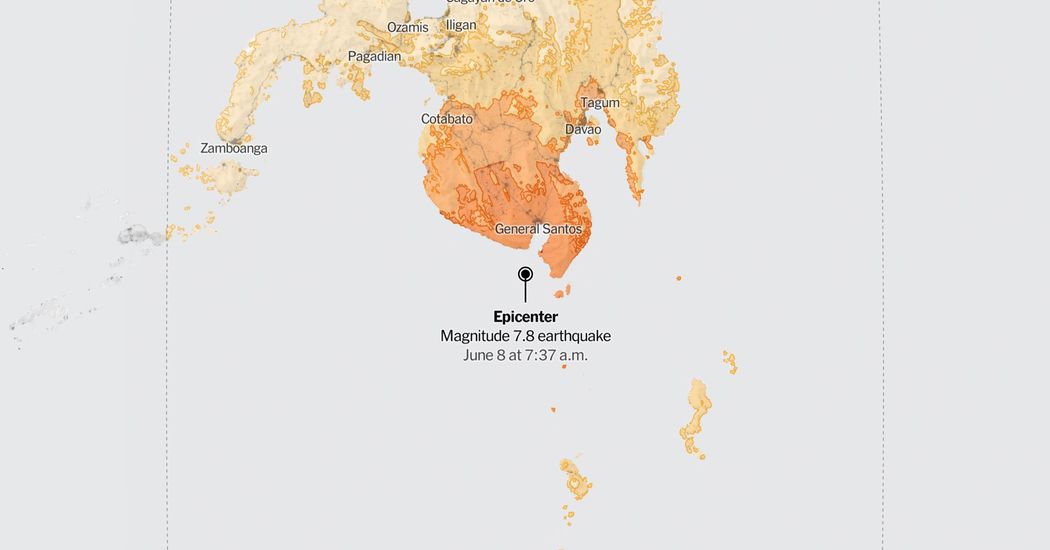
On a seemingly quiet Monday morning, a violent convulsion deep within the Earth’s crust disrupted the daily rhythm of the southern maritime corridors of the Philippines. At precisely 7:37 a.m. Philippine time, a massive, 7.8-magnitude earthquake ruptured the seafloor of the Celebes Sea, sending powerful seismic waves radiating through the surrounding archipelago and across vast oceanic basins. According to the United States Geological Survey (USGS), the epicenter of this major earthquake near the Philippines was located approximately 15 miles southwest of Burias, a region of the island nation that sits directly on the frontlines of some of the world’s most volatile tectonic boundaries. The sudden release of energy, originating deep beneath the ocean floor, rattled communities with an intensity that registered widely across regional monitoring networks. Residents in coastal and inland towns alike were thrust into immediate state of emergency as structures swayed, loose objects fell, and the ground rolled with the unmistakable, low-frequency rumble of a major geologic event. The sheer magnitude of this Celebes Sea earthquake—registering search parameters as one of the most powerful undersea tremors of the season—immediately triggered automated warning systems globally, dispatching urgent telemetry data to disaster response hubs from Manila to Honolulu. For the millions of citizens dwelling along the adjacent coastlines, the timing of the quake compounded the initial panic, catching families as they prepared for the school and work week, and forcing local civil defense authorities into a race against time to determine the scale of the subterranean destruction.
Oceanic Sirens: Tracking the Tsunami Threat Across Pacific Basins
In the immediate aftermath of the initial rupture, the focus of emergency agencies rapidly shifted from the shaking ground to the volatile behavior of the ocean itself, as the threat of a potential tsunami began to loom over coastal populations. The U.S. Tsunami Warning System quickly analyzed the bathymetric displacement caused by the fault slip, promptly issuing a critical tsunami warning for the Philippine coastline, while simultaneously extending a tsunami advisory to the remote American federal territory of Guam. The warnings served as a stark reminder of the speed with which undersea geologic events can translate into catastrophic marine hazards, prompting local maritime boards, port authorities, and naval deployments to suspend operations and direct vessels to seek deeper waters. In stark contrast to the heightened anxiety across the Western Pacific, emergency responders on the continental side of the basin offered a sigh of relief when the agency confirmed that there was no threat to the Pacific coastlines of the United States and Canada. This geographic divergence in risk highlighted the intricate way undersea topography and wave dynamics directionalize seismic energy, sparing the Western hemisphere from danger while leaving communities in the immediate path of the Celebes Sea plate convergence on high alert. Within coastal villages in the southern Philippines, emergency sirens wailed through the morning air, driving thousands of residents to seek higher ground under the guidance of evacuation protocols designed to mitigate casualties in the event of sudden shoreline inundation.
The Anatomy of a Tsunami: Understanding the Silent Dynamics of Displacement
To comprehend the sheer magnitude of the threat generated by this 7.8-magnitude earthquake, one must examine the physical and oceanographic mechanics that govern the propagation of a tsunami. Unlike waves generated by wind, which only agitate the surface layers of the ocean, a tsunami is a series of massive, long-wavelength water columns set in motion by a sudden, large-scale displacement of the seabed, typically caused by a thrust-fault rupture during a subduction zone earthquake. When the ocean floor drops or lifts during a seismic event, it carries the entire water column above it, generating waves that can travel across the deep ocean at speeds exceeding 500 miles per hour—comparable to the velocity of a commercial jetliner. In the open ocean, these waves are barely noticeable, often measuring only a few inches high with hundreds of miles separating successive crests, but as they approach the shallow waters of coastlines, a dramatic transition occurs. The process of bathymetric shoaling slows the wave down, compressing its energy and forcing the water column upward into a towering wall of water capable of obliterating coastal infrastructure and carrying heavy debris far inland. Scientists warn that one of the most insidious and dangerous features of a tsunami is the potential drawback phenomenon; just before the first wave crest strikes the shore, the seawater is often drawn rapidly out to sea, exposing vast swaths of reefs and seabeds. This illusion of a retreating ocean can draw curious onlookers down to the shoreline, placing them in extreme vulnerability just minutes before a catastrophic deluge returns to inundate the land.
The Unending Tremor: Analyzing Aftershocks and Structural Degradation
The terror of a major seismic event rarely ends with the main shock, as manifested by the series of subsequent aftershocks that rattled the Celebes Sea region in the hours following the initial Monday morning rupture. Geophysicists define aftershocks as minor, yet potentially destructive, structural adjustments along the fault plane that slipped during the initial energy release, as the bruised and fractured crust of the Earth struggles to find a new state of mechanical equilibrium. In the zone extending 100 miles around the epicenter near Burias, seismometers logged multiple tremors, some reaching moderate to strong intensities that further compromised buildings already structurally weakened by the primary 7.8-magnitude shock. These subsequent tremors are a major hazard for disaster response teams and search-and-rescue personnel, who must navigate unstable ruins, compromised bridges, and landslide-prone cliffs while the earth continuously shifts beneath them. Expert agencies emphasize that secondary quakes can persist for days, weeks, or even years after the initial disturbance, and can occasionally reach magnitudes equal to or greater than the original earthquake, triggering renewed tsunami threats and compounding local humanitarian crises. The psychological impact of these continuous tremors on survivors cannot be overstated, as the constant state of vigilance and fear of structural collapse disrupts basic services, halts recovery efforts, and forces displaced families to remain in temporary open-air shelters despite inclement tropical weather.
The Crucible of Tectonic Fire: Geologic Context of the Philippine Plate Boundary
The occurrence of such a powerful earthquake in the Celebes Sea is not an isolated anomaly, but rather a predictable, albeit terrifying, manifestation of the complex tectonic interactions that define the circum-Pacific Belt, colloquially known as the Ring of Fire. The Philippine archipelago sits directly atop a chaotic convergence zone where several major and minor tectonic plates—including the Philippine Sea Plate, the Eurasian Plate, and the Sunda Plate—collide, subduct, and slide past one another at some of the fastest rates observed on Earth. This volatile dynamic creates deep oceanic trenches, active volcanic chains, and intricate networks of strike-slip and thrust faults that continuously reshape the regional marine landscape. The Celebes Sea basin itself is bordered by active subduction zones where oceanic crust is forced down into the high-temperature, high-pressure environment of the Earth’s mantle, creating the ideal conditions for accumulated strain to slip in catastrophic ruptures. Historical records indicate that this region has been the birthplace of numerous devastating earthquakes and tsunamis, such as the catastrophic 1976 Moro Gulf disaster, which serve as historical warnings of the destructive capacity latent within these deep undersea faults. As researchers gather more data from this latest event, they continuously refine their understanding of the complex stress distributions along these deep fault lines, hoping to map the next potential rupture zones before the Earth decides to release its built-up tension once more.
Shields Against the Sea: Emergency Preparedness and the Future of Early Warning Systems
While humanity remains powerless to stop the fundamental shifting of tectonic plates, the global response to the Celebes Sea earthquake highlights how advancements in seismic telemetry, early warning systems, and community readiness can save lives. In the hours following the event, the collaboration between international agencies like the USGS, regional watchdogs like the Philippine Institute of Volcanology and Seismology (PHIVOLCS), and the U.S. Tsunami Warning System demonstrated a highly coordinated safety infrastructure designed to process complex geological data in real time. Deep-ocean assessment systems, known as DART buoys, deployed across the Pacific basin, monitored sea-level fluctuations to verify the existence of tsunami waves, providing emergency managers with the verified data needed to issue precise evacuation orders. However, technology is only as effective as the human systems built around it; the ultimate line of defense rests upon grassroots disaster preparedness, robust building codes, and regular evacuation drills in vulnerable coastal communities. By educating populations on the natural warning signs of a tsunami—such as ground shaking, a loud roaring sound from the ocean, or a rapidly retreating tide—and enforcing zoning laws that prevent high-density construction in low-lying hazard zones, nations along the Pacific Ring of Fire can build an adaptable society capable of weathering the inevitable fury of our living planet.