


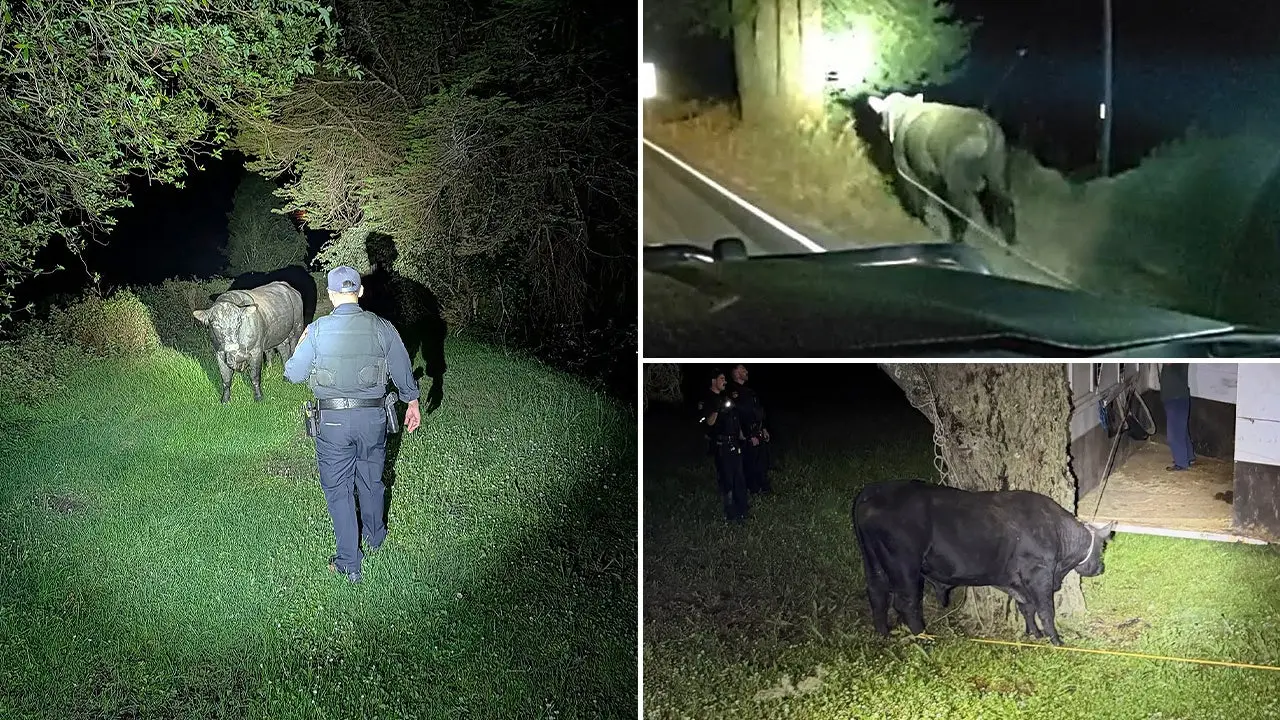
It began as a routine dispatch, the kind that lights up a radio with clipped, professional urgency—yet it would quickly spiral into a midnight saga that pitted modern law enforcement against a four-legged force of nature. On a chilly Tuesday evening, the San Mateo County Sheriff’s Office received a call that jolted the calm of the California coast: a massive bull had broken free and was tearing down the asphalt ribbon of Highway 35. For any officer, the sight is jarring—a thousand pounds of muscle and menace, hooves clattering against pavement where only cars should glide. The California Highway Patrol had already arrived, their patrol cars flashing like beacons in the dusk, but the animal was having none of it. It trotted, veered, and charged unpredictably, its hot breath steaming in the air as motorists veered dangerously to avoid a catastrophic collision. The deputies on scene quickly realized that standard procedure—cornering, containment, and careful approach—would not work against a creature that did not recognize flashing lights or sirens. This was not a suspect who could be handcuffed or talked down; this was a wild, panicked animal, and the ever-present threat of a deadly crash on the busy highway hung over every passing second.
As the hours peeled away, the situation grew more tense. The sun dipped below the horizon, plunging the scene into darkness, and still the bull roamed, elusive and defiant. Deputies tried everything they could think of—forming slow-moving barriers with their cruisers, attempting to rope the animal from a safe distance, and coordinating with CHP officers to block off lanes. But the bull, driven by pure instinct and adrenaline, kept slipping through the gaps, its powerful legs carrying it miles down the roadway. The officers could see the frustration mounting in each other’s eyes. Every attempt at corralling the animal was met with a wild buck or a sudden change of direction, as if the bull took a perverse pleasure in outwitting the entire patrol. It was a standoff, and under the cold stars, the law enforcement officers were losing. Realizing that modern tactics and equipment were simply not enough to tame this untamed creature, the deputies made a pivotal decision: they needed someone with a different kind of knowledge. They needed a person who spoke the language of the land, who understood the rhythm of hooves and the stubbornness of livestock. They needed a cowboy, a rancher, a local legend—and so they picked up the phone and dialed into the heart of the Half Moon Bay community.
That call connected them to Samuel Ramos Palomino, a foreman at the Sea Horse Ranch, a man whose life had been intertwined with large animals for over three decades. With 35 years of experience under his belt, Samuel was more than just a ranch hand; he was a master of his craft, someone who could read the body language of a bull like a book. But when the phone rang shortly after midnight, he was fast asleep, his body coiled in the precious, brief respite between a long day and an even earlier morning. The voice on the other end was urgent, crisp with the unmistakable tone of a professional asking for help. Yet, beneath the urgency, there was a plea—a human acknowledgment that they had reached their limits. For most people, the instinct would have been to groan, to cite the early alarm clock, to suggest they try someone else. Samuel had to be up for his shift at 4 a.m., a mere three and a half hours away, and the thought of grappling with a feral bull in the pitch black was far from appealing. But Samuel Ramos Palomino was not most people. His reputation was built not just on skill, but on character. Without hesitation, he swung his legs out of bed, pulled on his boots, and got dressed. In his mind, there was no question of whether to help; there was only the matter of how to help. He gathered his keys, hopped into his truck, and hitched up his livestock trailer. Within moments, the headlights of his pickup cut through the dark, guiding him toward a field they called Highway 35, where chaos awaited.
What unfolded next was a masterclass in patience, precision, and primal coordination—a dance between man, beast, and machine under the watchful glow of headlights and the distant pulse of police lights. Samuel arrived on the scene and joined forces with the Sheriff’s Office deputies and CHP officers, forming an unlikely posse. For miles, they trekked alongside the bull, their boots crunching on the gravel shoulder while the animal’s heavy breathing echoed in the still night air. The plan was simple in theory but brutally difficult in execution: they had to get close enough to rope the beast, but not so close that they triggered a dangerous charge. Samuel’s eyes were keen, measuring the distance, the bull’s gait, and its flickering ears. He knew that a panicked bull is a lethal weapon; a single kick could shatter ribs, and a backward step could crush a person. The officers kept the perimeter light, their flashlights carving arcs in the darkness, while Samuel moved with a practiced grace that defied the hour. They made repeated attempts, swinging their ropes in wide arcs, but each time the bull sidestepped or bolted, forcing the entire party to start the pursuit anew. The minutes stretched into an anxious hour, but Samuel never wavered. He called out calming sounds, a low, guttural murmur that seemed to soothe the animal just enough to keep it from full rage. Finally, with a burst of perfect timing and raw strength, the rope tightened around the bull’s horns. The moment was electric—a collective breath held—as they took the bull literally by the horns, anchoring the line to a sturdy point. The fight wasn’t over, though; the bull protested with a thunderous bellow, its legs churning the earth, but Samuel’s grip was unyielding.
The hardest part came next: loading the captured beast into the trailer. It’s one thing to rope a bull on open ground; it’s another to convince a terrified creature that a dark, confined metal box is a safe haven. Samuel worked with the fluidity of muscle memory, his hands steady as he guided the animal toward the ramp. He used a combination of gentle pressure, a tail rope, and pure psychological calm to ease the bull’s transition. The officers watched in awe as the foreman maneuvered around the massive animal, his steps deliberate and sure. With a final nudge, the bull stepped into the trailer, its weight causing the suspension to groan, and Samuel swung the gate shut with a satisfying clang. But his duty wasn’t finished. Because it was the middle of the night and the bull’s owner was likely unaware of the drama unfolding, Samuel went one step further. He offered a secure location at his ranch, a safe pen where the bull could spend the remainder of the night, allowed to catch its breath before being returned home at daybreak. By the time the trailer doors were locked and the paperwork was done, the clock read 2:30 a.m. Samuel looked at his watch, feeling the familiar weight of exhaustion settle into his bones. He had just 90 minutes left before his alarm would shriek, demanding he report to work at 4 a.m. for another day of labor. Yet, as he climbed back into his truck, there was no resentment in his heart—only the quiet satisfaction of a job done right.
The implications of his actions were not lost on anyone. The sheriff’s department later lauded Samuel’s hands-on assistance, noting that his skill likely prevented a serious collision or a devastating injury on that busy highway. At any moment, the bull could have darted into traffic, causing a multi-vehicle pileup, or struck an officer attempting to get too close. Samuel’s presence de-escalated a volatile situation and transformed a potential tragedy into a mere anecdote. Days later, the recognition caught up with him in a formal, heartwarming way. Coastside Patrol Bureau Captain Allen and Half Moon Bay City Manager Chidester made a point to meet Samuel in person, not just to shake his hand, but to genuinely thank him for answering the call when the community needed him most. They presented the encounter with a warmth that cut through bureaucratic formality, acknowledging the profound role a single private citizen played in a public emergency. For Samuel, though, the reward was simpler. He got home, stole a few minutes of sleep, and showed up at the ranch right on time, the tiredness in his eyes masked by the quiet pride of a man who knows his work matters. His actions had made the Coastside safer that night, not through a badge or a gun, but through experience, courage, and a willingness to give up his own comfort for the well-being of strangers.
In reflecting on this story, one is reminded that heroes often don’t wear capes; they wear dusty work boots and smell of hay and leather. Samuel Ramos Palomino embodies a kind of vanishing American spirit—the neighbor who drops everything, the expert who shares his craft, the quiet guardian of the rural byways that wind through our modern world. When the sheriff’s department released its statement, it captured this sentiment perfectly: “Samuel, thank you for answering ours. Your skill, courage, and willingness to help made the Coastside a safer place that night.” Those words resonate far beyond the confines of Highway 35. They speak to the universal truth that in moments of crisis, the fabric of community is woven by individuals who choose to act, who recognize the delicate balance between human life and the wild world just beyond the city lights. The bull, now safely returned to its field, likely has no idea of the chaos it caused or the extraordinary man who shepherded it home. But the deputies, the motorists who unknowingly passed by the scene, and the entire Half Moon Bay community know. In a world often dominated by division and disconnection, a simple rancher’s 2 a.m. act of service becomes a poignant testament to solidarity—a reminder that when the chips are down, the true measure of a person is not their schedule, but their sacrifice. Samuel went to work exhausted that morning, but he carried with him the weightless glory of a good deed, proving that sometimes the most profound help comes not from a fleet of cars or a barrage of advanced technology, but from a single, steady heart.