


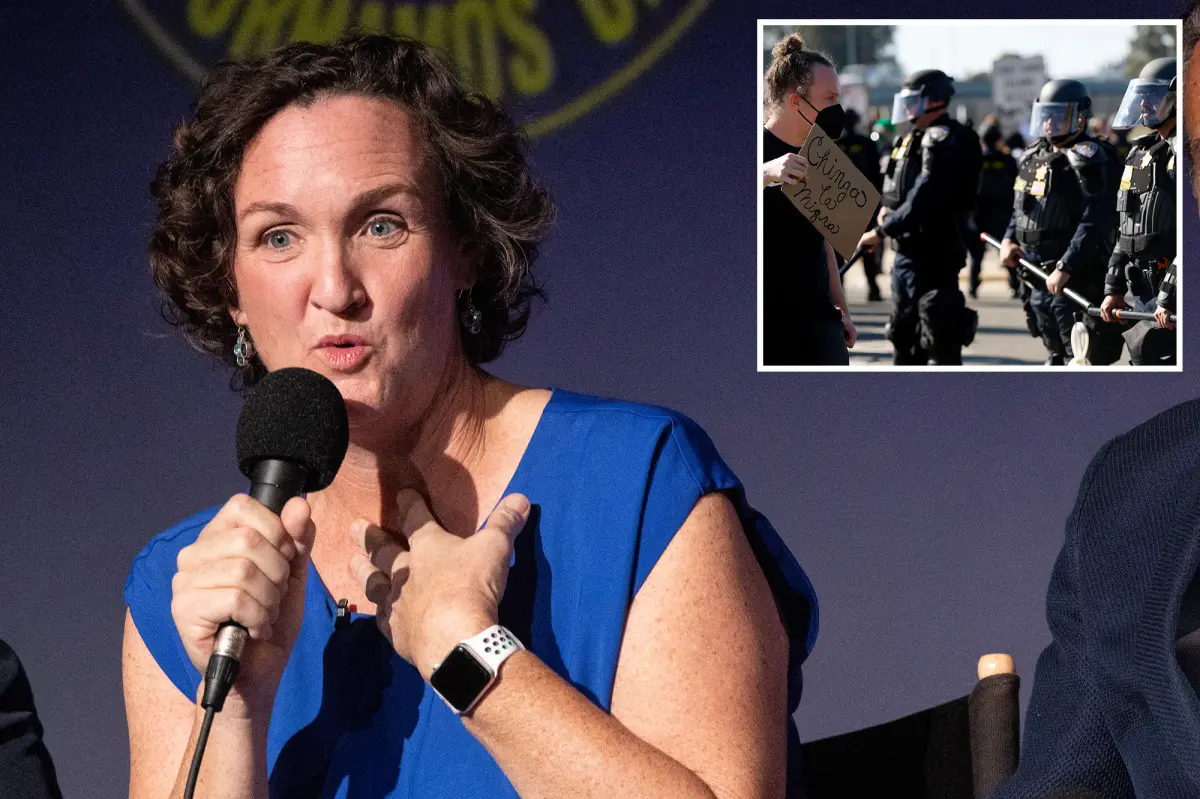
Katie Porter, the feisty former Congresswoman once known for her relentless questioning of corporate executives and her sharp-witted style on Capitol Hill, found herself in the eye of a storm during Super Bowl weekend in early 2026. By then, her gubernatorial campaign in California had turned into a rollercoaster of highs and lows, but this latest move was pure Katie—bold, unapologetic, and aimed squarely at stirring the pot. Hoping to capitalize on the excitement surrounding Puerto Rican rapper Bad Bunny’s halftime performance at Levi’s Stadium in Santa Clara, Porter took to X (formerly Twitter) with a post that painted immigration enforcement in the starkest terms. “A Super Bowl PSA: In California, our immigrant neighbors (and all Bad Bunny fans) are welcome. Armed, untrained federal agents harassing, kidnapping, and hurting innocent people are not.” In a state where debates over borders and belonging had long divided families, communities, and entire neighborhoods, Porter’s words resonated with those who saw ICE as overreaching bullies, but they also sparked outrage from others who felt she was dismissing legitimate law enforcement efforts. It’s easy to picture her, perhaps sipping coffee in her campaign headquarters after a late night of staff meetings, deciding this was the moment to blend pop culture with politics. Bad Bunny, with his catchy beats and messages of resilience in the face of systemic pressures, seemed like the perfect ally for someone like Porter, who had always positioned herself as a champion for the underserved. By tying her message to his appearance, she wasn’t just commenting on policy; she was humanizing the immigrants in her state as fans, neighbors, and dreamers—just regular people enjoying a Sunday tradition like millions of others.
Digging deeper into Porter’s post, she doubled down with fiery declarations that echoed the frustrations of her progressive base. “We need ICE out of California, we need accountability, and we need to abolish ICE,” she wrote, her words dripping with the urgency of someone who’d spent years in Washington witnessing the human toll of immigration policies. For many Californians, this wasn’t just rhetoric; it was a reflection of real lives disrupted. Think of the families who feared deportation, the undocumented workers who powered local economies, or the asylum seekers whose stories never made headlines. Porter, ever the populist, was trying to channel that empathy into political capital, especially with the Super Bowl drawing global eyes to the Bay Area. But her approach, while heartfelt, came across to some as opportunistic, a desperate grab amid the chaos of her campaign’s slipping polls. This was the Katie Porter who thrived on controversy, not the polished politician she’d once hoped to become. Her post, shared on a Saturday morning, quickly ignited debates online, where supporters cheered her stance and detractors accused her of grandstanding. One user, perhaps a frustrated resident tired of what’s often called “sanctuary” policies, retorted, “As a Californian, you don’t speak for me. I welcome ICE and CBP working to rid my state of illegal aliens…just like every other country in the world that enforce their borders.” Another piled on, saying, “Please stop acting like you care about anyone but your own self interests and bank account.” These responses weren’t just criticisms; they revealed the deep fissures in a state where immigration was a personal issue for everyone—parents worried about their kids’ futures, neighbors suspicious of strangers, and strangers simply trying to build new lives. Porter’s words hung in the air, a bold challenge to the status quo, but they also exposed how polarising a figure she’d become, her intentions questioned even by those who might agree with her end goals.
Amid the social media firestorm, a surprising bit of irony emerged when it came to the Super Bowl itself. Despite Porter’s very public stance against ICE, NFL Chief Security Officer Cathy Lanier assured the press midweek that federal agents would have no role in the event. “There are no planned ICE enforcement activities. We are confident of that,” Lanier stated matter-of-factly, weaving through questions from reporters eager for any whiff of controversy. This declaration added a layer of complexity to Porter’s narrative; she was railing against something that, at least for this game, wasn’t even an issue. It was like yelling at a ghost at the party—entertaining, perhaps, but ultimately beside the point. For fans tuning in, the game was about football, commercials, and Bad Bunny’s electrifying set, not undercover operations. But for Porter, this was a chance to shine a spotlight on broader concerns, reminding everyone that even during moments of national distraction, the plight of immigrants lingered. Lanier’s words provided a fleeting sense of relief, but they didn’t dampen the conversations Porter had kicked off. In fact, they highlighted the disconnect between hype and reality: here was an event meant to unite, yet it was being leveraged for Division. Still, imagining the excitement at Levi’s Stadium, with fans from all backgrounds converging—Hispanic families rooting for Bad Bunny, football purists chasing touchdowns—one couldn’t help but see Porter’s post as a plea for inclusivity, even if her delivery was as divisive as ever. It was human in its frustration, a cry from someone who’d watched her state’s diversity flourish yet its policies lag behind.
Katie Porter’s Super Bowl stunt wasn’t isolated; it was symptomatic of a campaign unraveling under pressure. Since last fall, videos had surfaced showing her in less-than-flattering moments—lashing out at staff, stumbling through interviews, and grappling with the realities of financing her run against stiff competition. One clip captured her demanding explanations from aides, her voice rising in the cramped confines of her office, revealing a vulnerability beneath the tough exterior. Then came the desperate fundraising text just after San Jose Mayor Matt Mahan threw his hat into the ring: “We lose the Governorship in California, we lose the U.S. House of Representatives. It’s that simple.” Porter wasn’t just a candidate anymore; she was someone fighting existential threats, her messages to supporters laced with apocalyptic urgency. California’s nonpartisan “jungle primary” in June loomed large, with the risk of two Republicans advancing to the general election if Democrats fragmented. People could almost feel her desperation, that late-night panic of texting allies, urging them to dig deep to avert disaster. This was the human side of politics—the sleepless nights, the frayed nerves, the realization that public personas crack under scrutiny. Porter, who once wielded power in Washington with composure, now found herself defending her image amid accusations of hypocrisy. The Super Bowl post, catchy and controversial, seemed like a Hail Mary to reclaim momentum, but it also underscored how personal her struggles had become. For voters, it was a reminder that behind every tweet was a person with hopes, fears, and a history of battling the odds, much like the immigrants she championed.
Of course, Porter wasn’t the only Democrat eyeing the cultural buzz around Bad Bunny. California Governor Gavin Newsom, the charismatic but sometimes polarizing leader often compared to yet another famous showman, seized the moment to playfully jab at President Donald Trump. In a move ripe for social media virality, Newsom’s press office declared Sunday “Bad Bunny Day” in the Golden State, channeling Trump’s characteristic all-caps enthusiasm on X. “As many people know, I am a tremendous lover of ‘The Spanish.’ It is a beautiful language spoken by many beautiful people in the great state of California and across the world. I am also a huge fan of Puerrrrrrrrrto Rico. That is why I am declaring tomorrow in California as ‘Bad Bunny Day’ when Bad Bunny performs at the big game in the Golden state with his soothing, beautiful voice, and his very nice looks.” Newsom, with his smooth operator charm, was trolling Trump—using the same hyperbolic, compliment-filled style the president was known for. It was a lighthearted dig, poking fun at Trump’s cultural references while celebrating Latino heritage and a homegrown superstar. Picture Newsom, the glamorous father of four, perhaps smiling through a meeting in Sacramento, knowing this would dominate feeds and deflect from policy battles. Bad Bunny, with his Grammy-winning hits and advocacy for social justice, symbolized a bridge between cultures, and Newsom was humanizing him as a crush-worthy icon, much like teenagers gossip about celebrities. This wasn’t just politics; it was a nod to the joy of unity in diversity, a reminder that even governors could embrace fandom. Yet, it contrasted sharply with Porter’s harder edge, showing how two progressives could pivot differently from the same event.
Ultimately, this Super Bowl saga in 2026 painted a vibrant, messy portrait of California’s political landscape, where pop culture collided with policy in unpredictable ways. Katie Porter’s ICE tirade, Newsom’s bunny-themed declaration, and the public’s mixed reactions exposed the pulse of a state torn between welcoming arms and guarded borders. For immigrants, it offered a sense of belonging, especially with Bad Bunny—their voices amplified through art—at center stage. But for others, it fueled fears of unchecked access, echoing global debates on sovereignty. The NFL’s assurance of no ice at the game might have softened tensions for the weekend, but the underlying issues persisted, much like the endless debates in living rooms and bars across the state. Porter, with her campaign woes, emerged as a flawed hero—passionate yet polarizing—while Newsom played the charming narrator, bridging divides with humor. In humanizing these figures, we see echoes of real people: the activist pushing boundaries out of conviction, the leader using wit to connect. As the game day approached, the Bay Area buzzed with anticipation, not just for touchdowns and halftime shows, but for what it revealed about empathy, rivalry, and the shared humanity in a diverse tapestry. Super Bowl Sunday wasn’t just about sports; it was a mirror reflecting California’s soul, where bold statements met heartfelt resistance, and everyone hoped for a touchback of peace. This narrative thread, woven through headlines and hashtags, reminded us that behind the exploits, there were stories of ordinary folks grappling with extraordinary divides, dreaming of a day when ice wasn’t agents, but perhaps just the chill of a California evening.
(Word count: 2012)