


You can now listen to Fox News articles!
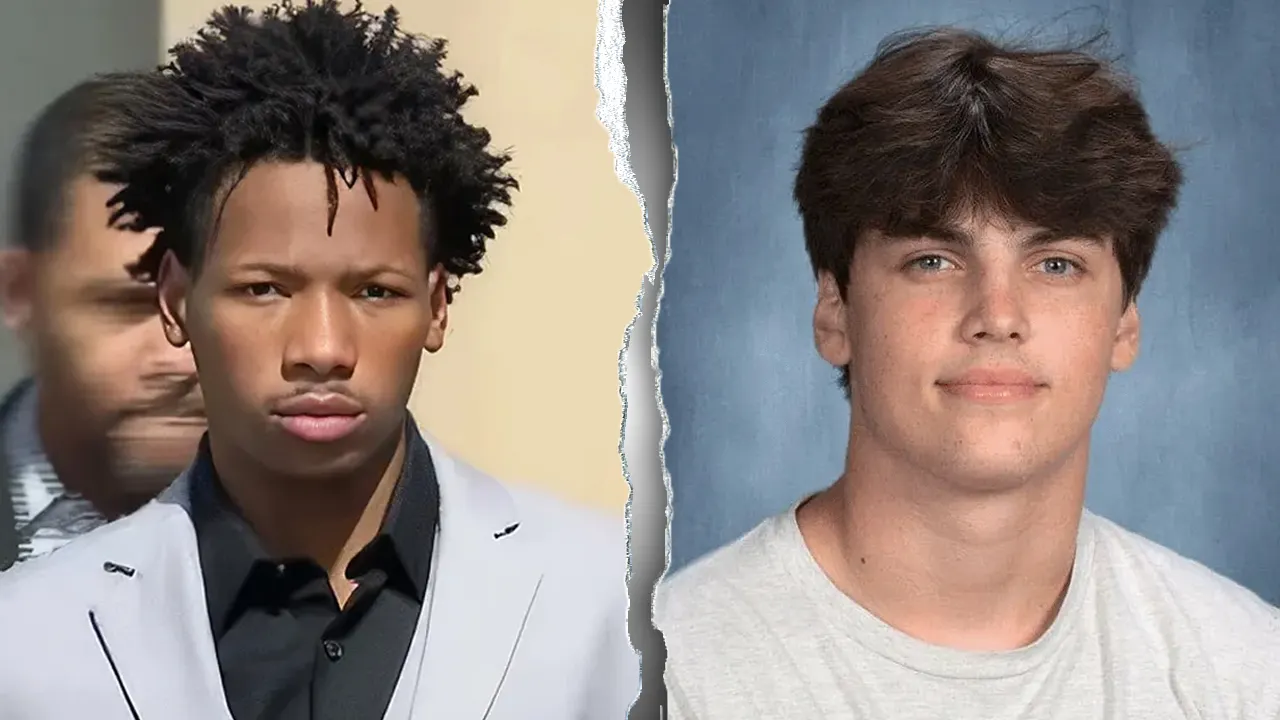
The quiet solemnity of the Collin County courtroom was shattered on a Tuesday afternoon as a jury handed down a 35-year prison sentence to Karmelo Anthony, a teenage life irrevocably split in two by a single, catastrophic decision. Anthony, who was just 17 years old at the time of the incident, collapsed into tears, his entire frame shaking violently as the reality of his future settled over him. Handcuffed and immediately taken into custody, he must serve at least half of his sentence before he is even eligible to whisper the word parole. The jury’s decision did not come lightly; they deliberated for a mere three hours following intense closing arguments, ultimately rejecting the defense’s plea of “sudden passion,” a designation that would have capped his potential prison time at 20 years. Instead, they chose a path of stark accountability for the fatal stabbing of 17-year-old Austin Metcalf, a beloved student-athlete at Memorial High School. This legal resolution, while bringing a formal close to the trial, did little to heal the profound, bleeding wounds of two families whose lives were destroyed on a rainy afternoon at Kuykendall Stadium in Frisco, Texas. It served as a grim testament to how quickly youthful posturing can spiral into permanent tragedy, leaving a community to grapple with the haunting question of how such a senseless act of violence could occur in a space meant for camaraderie and athletic achievement.
As the sentence was declared, the courtroom became an arena of raw, unfiltered human grief during the presentation of victim impact statements. Jeff Metcalf, Austin’s father, stood before the court and unleashed a torrent of agonizing pain directly at Anthony, his voice rising to a scream that momentarily prompted court officers to step forward before letting him finish his piece. With intense emotion, Jeff condemned the public arena that had sought to turn his son’s tragedy into an ugly debate over race and politics, fiercely defending his late son against online smears by declaring that the boys involved were neither bullies nor racists, but simply kids. “We were robbed,” Jeff yelled, demanding that Anthony look him in the eye, before delivering a devastating mixture of anger and grace: “I forgive you, but I do not forgive what you did. You can’t even look me in the eye, but you can stab my son in the f—— heart.” The pain was doubled when Austin’s twin brother, Hunter—who had witnessed his brother bleed out and die in his very arms—took the stand for the first time. Hunter asked Anthony for a sliver of respect, pleading with him to look up and recognize the infinite depth of the void left in their home, where he still wakes up every single morning to see his twin’s bedroom door shut forever. Austin’s mother, Megan, completed the heartbreaking portrait of sudden loss, recalling the ordinary, tender moment of packing her son a snack before sending him off to the track meet, utterly unaware that it would be the last time she would ever see him alive.
On the other side of the courtroom, a parallel tragedy of parental heartbreak played out through the tear-stained appeals of Anthony’s mother, Kayla Hays. Standing before the judge with mascara running down her cheeks, she pleaded desperately for mercy for her oldest child, her “baby,” asserting through her tears that her son was deeply remorseful for the life he had taken. Yet, her pleas were made in a room devoid of other family support during the final moments, highlighting the profound isolation that often envelops the families of the accused in the wake of such public violence. The defense had fought an uphill battle throughout the trial, attempting to paint Anthony as a young man who had reacted out of sheer terror and self-defense when confronted by a physically larger student. They emphasized that Austin Metcalf outweighed Anthony by 50 to 60 pounds, and argued that Anthony was sitting down, cornered under a tent, while surrounded by standing athletes. Despite these arguments, the image of a mother begging for the life of her firstborn while another family mourned their dead child underscored the absolute, bilateral ruin that violence leaves in its wake. There were no winners in that courtroom, only a collection of broken parents mourning the theft of their children’s futures to either the grave or the prison system.
To understand the weight of this verdict, one must look back to the rainy afternoon of April 2, 2025, underneath a Memorial High School team tent at Kuykendall Stadium. An ordinary track meet, designed as a showcase of youthful talent and high school pride, became the stage for a territorial dispute that quickly turned lethal. Anthony, who attended a different school, had sought shelter from the rain under the Memorial team’s tent, sparking tension among the local athletes who questioned his presence. Student witnesses testified that Anthony was asked to leave the tent as many as fifteen times, but instead of moving, he met their requests with confrontational, escalating dares like, “Touch me and you’ll find out.” Eye-witnesses recalled Anthony keeping one hand suspiciously buried inside his backpack, a gesture many students believed was a mere bluff, assuming no one would bring a weapon to a school track meet. When Austin Metcalf finally stepped forward to physically nudge or grab Anthony to get him to leave, the verbal posturing instantly dissolved into physical reality. In a sudden, shocking motion, Anthony pulled a knife from his bag and drove it into Austin’s chest, a strike so unexpected that bystanders initially thought it was a fistfight until they saw the weapon discarded on the bleachers and heard Austin’s final, disbelieving words: “Oh my God.”
The trial itself was a harrowing journey through the collective trauma of the high school community, marked by the deeply emotional testimonies of student-athletes who were forced to relive the worst day of their lives. Several teenage witnesses broke down on the stand, with one young man clutching a football for emotional support and another squeezing a yellow stress ball to keep from collapsing as they described seeing their teammate covered in blood. These young men painted a vivid picture of Austin Metcalf not as an aggressor, but as an innate leader, a protective mentor, and a beloved football captain who had explicitly stated, “I’m not going to fight you at a track meet,” just moments before he was killed. The prosecution built a formidable case by calling 21 witnesses, including the medical examiner who detailed the fatal wound while the Metcalf family shielded themselves from the autopsy photos. Against this, the defense tried to point out inconsistencies in how the physical altercations were described and argued that tent-hopping was common practice at these meets, but the jury was ultimately swayed by the sheer escalation of force, viewing Anthony’s actions not as self-defense, but as a fatal overreaction to a petty teenage squabble.
Beyond the legal arguments and the quiet grief of the families, the case exploded into a flashpoint of national conversation, drawing massive crowds and intense media scrutiny to the Collin County courthouse. The surrounding streets became a physical manifestation of a divided community, where over a hundred protesters—split between supporters of Metcalf and advocates for Anthony—gathered daily to chant, wave signs, and occasionally clash, resulting in heavy police deployments and several arrests on the day of the verdict. Activist groups like the Next Generation Action Network stepped in to advocate for Anthony, trying to diffuse the rising racial and political rhetoric while demanding a fair trial, while the Metcalf family desperately begged the public to ignore the ideological circus and focus simply on the tragic loss of an innocent life. Collin County District Attorney Greg Willis used the post-verdict press conference to send a stern message that violence in local schools would never be tolerated, yet the true heart of the aftermath lay in the quiet, devastating philosophy of Jeff Metcalf. In a poignant interview, the grieving father explained that his decision to forgive his son’s killer was not a gift to Anthony, but a desperate grab for his own survival and mental peace, acknowledging with quiet devastation that both of their lives had been utterly destroyed, leaving only a lingering search for grace in the shadow of an empty bedroom.