


Bill Essayli, the top federal prosecutor in Los Angeles and a fierce political ally of President Donald Trump, recently shattered decades of quiet legal protocol during an appearance on Glenn Beck’s conservative radio show. Armed with bold promises rather than concrete evidence, Essayli confidently predicted that his office would soon hand down criminal indictments for election fraud targeting California’s primary races, even as local election workers throughout the state were still meticulously sorting and counting ballots. For decades, the Department of Justice has operated under a strict, self-imposed code of silence during active elections, precisely to avoid using the immense power of federal law enforcement to sway public opinion or alter the course of democratic contests. Yet, Essayli cast this long-standing institutional caution aside, declaring that charges would materialize within a month or two, openly admitting that his office merely needed the election results to be certified so they could retroactively build cases around their preconceived allegations. This public performance was not simply an isolated act of political bravado; it served as a stark, humanizing illustration of how the nation’s preeminent law enforcement agency has been fundamentally repurposed under the Trump administration. Gone are the days of objective, behind-the-scenes verification; in public view stands a highly politicized apparatus where the threat of prosecution is wielded as a narrative weapon to cast doubt on the democratic process before the final votes are even tallied. By taking his theories straight to a polarized talk-radio audience, Essayli bypassed the customary guardrails of the justice system, signaling to everyday citizens that their local elections are inherently suspect and that the federal government is actively policing their ballots. This aggressive shift creates an environment of profound uncertainty for election workers and ordinary voters alike, transforming what should be a transparent civic ritual of vote-counting into a suspicious, highly surveilled theater of partisan warfare.
Behind this public offensive lies a quiet, systematic dismantling of the internal guardrails that have long protected the Department of Justice from becoming an instrument of partisan ambition. Historically, the department’s Public Integrity Section in Washington served as a vital, non-partisan buffer, operating round-the-clock during election cycles to advise local federal prosecutors on how to handle allegations of ballot rigging, threats, or irregularities. These experienced, career attorneys acted as voices of temperance, advising investigators to proceed with the utmost discretion to avoid validating baseless conspiracy theories or giving undue weight to rumors that could panic the electorate. Under the current administration, however, this crucial institutional check has been effectively neutralized, with the White House and department leadership actively encouraging local U.S. Attorneys to aggressively investigate and loudly promote allegations of voting fraud. As a result of this ideological realignment, the department has experienced a massive brain drain, losing thousands of veteran, non-partisan career lawyers who refused to compromise their ethical standards, only to replace them with less-experienced, highly partisan loyalists willing to carry out a political agenda. Representative of this transition is Essayli himself, a former state lawmaker who has consistently prioritized ideological battles over traditional legal triumphs, abandoning high-profile cases against the president’s political allies while pursuing aggressive, ultimately unsuccessful charges against local immigration protesters. This systemic replacement of seasoned legal minds with ardent partisans has crippled the agency’s internal credibility, transforming a department once dedicated to the dispassionate rule of law into a weaponized political tool that prioritizes narrative victory over established legal ethics. By stripping away the seasoned professionals who once kept partisan overreach in check, the administration has cleared the path for a new era of aggressive, unchecked federal interference that treats the American electoral system not as a sacred institution to be protected, but as an adversary to be conquered.
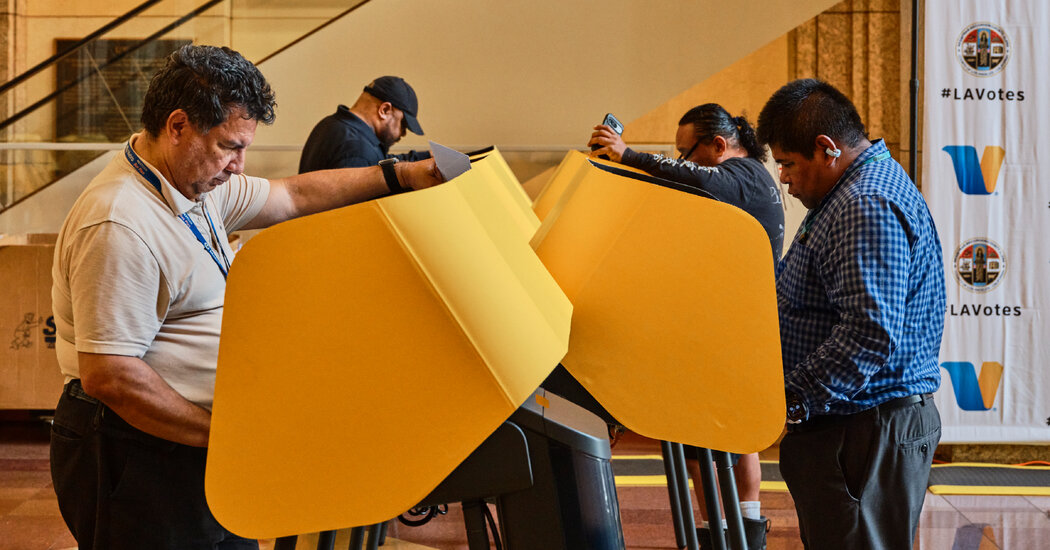
The escalating conflict in California provides a vivid microcosm of this broader national struggle, as Trump and his political allies attempt to exploit the state’s deliberate and highly inclusive voting process to sow widespread doubt about democratic outcomes. Because California relies heavily on mail-in ballots to ensure maximum voter participation, the physical process of verifying signatures, opening envelopes, and tabulating votes naturally stretches on for weeks after election day. Rather than recognizing this slow, methodical counting process as a reassuring sign of security and thoroughness, high-ranking conservative figures, including Speaker Mike Johnson, have weaponized the delay, claiming that the protracted timeline points to “diabolical” underhanded activities that are impossible to prove but “instinctively” felt. Conversely, advocates for voting accessibility, such as Dora Rose of the League of Women Voters of California, contend that these manufactured accusations are designed solely to generate panic and confusion where no actual evidence of fraud exists. Ms. Rose points out that a slow count is actually proof of a healthy, functioning democracy that prioritizes accuracy and voter verification over hasty, unchecked speed. Nonetheless, Essayli has aggressively amplified these conspiratorial narratives, even going so far as to dispatch federal prosecutors directly into local ballot-counting centers to monitor workers under a cloud of suspicion, while publicly begging the community for whistleblowers to validate his public claims. This aggressive federal footprint in local counting rooms turns everyday civil servants—neighbors, retirees, and community volunteers—into suspects in a grand, imaginary conspiracy, creating an atmosphere of intense intimidation and anxiety. By framing a careful, law-abiding bureaucratic process as an existential threat to democracy, federal prosecutors are not merely challenging the validity of individual ballots; they are actively alienating the very citizens who run our elections, threatening the foundational human trust required to keep local communities functioning.
This aggressive intervention in California is merely one front in a sprawling, coordinated nationwide campaign directed by the Justice Department to assert federal control over how individual states manage their own elections. Throughout the country, the administration is deploying an array of aggressive legal maneuvers, demanding sensitive voter registration data from dozens of states and quickly filing lawsuits against those local administrations that choose to resist these intrusive requests on privacy grounds. From launching an unprecedented criminal investigation into the already verified 2020 election results in Fulton County, Georgia, to demanding physical ballots from the 2024 race in Wayne County, Michigan, the Justice Department is attempting to retroactively litigate elections that have long been certified and validated. Voting rights experts, including former Justice Department lawyer David Becker, describe this frantic legal offensive as a desperate attempt to “throw everything against the wall” in the hopes that some wild accusation might finally stick, despite the fact that nearly all of their current investigations recycle debunked conspiracy theories from years past. This aggressive, nationwide fishing expedition represents a dramatic departure from the federalist values traditionally championed by conservative jurists, shifting the authority of election administration away from local communities and placing it firmly in the hands of federal political appointees. For ordinary citizens, this sweeping federal overreach means that their highly sensitive personal data—including addresses, voting histories, and partisan affiliations—is being swept up into broad, politically motivated federal databases under the guise of security. By treating local election administrators as hostile actors and turning the routine maintenance of voter rolls into a high-stakes legal battlefield, the administration is deliberately destabilizing the decentralized structure of American elections, leaving voters feeling vulnerable, exposed, and deeply cynical about the safety of their ballots.
Despite the administration’s relentless rhetorical onslaught and aggressive use of federal power, their campaign has encountered a formidable and highly revealing wall of resistance within the American judicial system. Federal judges across the country, tasked with evaluating these sweeping lawsuits on the basis of actual evidence and constitutional law rather than cable news rhetoric, have repeatedly and resoundingly rejected the Department of Justice’s demands for state voter data. In a striking testament to the groundless nature of these federal suits, at least eight different federal district judges have dismissed the administration’s cases, with half of those stinging defeats delivered by judges who were originally appointed to the bench by President Trump himself. This historic “zero-for-eight” losing streak highlights a profound, irreconcilable division between the sensationalized claims made on partisan talk radio and the rigorous standards of proof required in a real court of law. Legal scholars and voting rights advocates note that such a consistent and sweeping series of losses is almost unprecedented for the Department of Justice, illustrating how severely the agency’s legal credibility has been damaged by its transition into a political tool. The judiciary’s steadfast refusal to validate these politically motivated fishing expeditions serves as a critical democratic safety valve, protecting state-level election officials from federal harassment and preserving the privacy of millions of American citizens. However, this courtroom failure has done little to temper the aggressive rhetoric of justice department leaders, who continue to publicly insist without evidence that the system is thoroughly rigged and that their legal defeats are simply the result of hidden conspiracies. For instance, top figures like acting Attorney General Todd Blanche have openly claimed on television that there is massive evidence of rigging, while the administration has installed loyalists like Kurt Olsen, who previously tried to help overturn election results in 2020, to run election security teams at the department. This refusal to accept the rulings of the courts further isolates the administration, revealing a willingness to undermine the authority of the entire judicial branch in order to keep their politically lucrative narratives of election fraud alive in the court of public opinion.
The true tragedy of this aggressive federal campaign lies not just in its legal failures or its waste of public resources, but in the deep, enduring cultural scars it leaves on the fabric of American democracy. By utilizing the formidable credibility and vast investigative powers of the Department of Justice to legitimize completely unproven conspiracy theories, federal officials are actively eroding the essential public trust that sustains self-governance. When a federal prosecutor like Bill Essayli uses his official platform to tell citizens that their local election results are suspect before the votes are even fully counted, he is not protecting election integrity; he is actively dismantling it by convincing the public that the system is inherently corrupt. This toxic skepticism filters down through every level of society, transforming routine administrative processes into flashpoints of deep suspicion, encouraging political violence, and intimidating the dedicated volunteers who serve as the human backbone of our voting systems. Furthermore, the systematic hollowing out of the Justice Department’s professional workforce, replaced by ideologues who pursue flawed cases with poor legal reasoning, promises to degrade the integrity of the nation’s premier law enforcement body for a generation to come. As the administration continues to run out of legitimate legal avenues, their desperate efforts to sow chaos and fear represent a dangerous gamble with the nation’s stability, threatening to leave behind a deeply fractured electorate that no longer believes in the legitimacy of the ballot box. Ultimately, the preservation of a free and fair society relies not on federal prosecutors manufacturing crises, but on the quiet, collective belief of everyday citizens that their voices are heard, their votes are counted, and their democratic institutions remain worthy of their trust.