



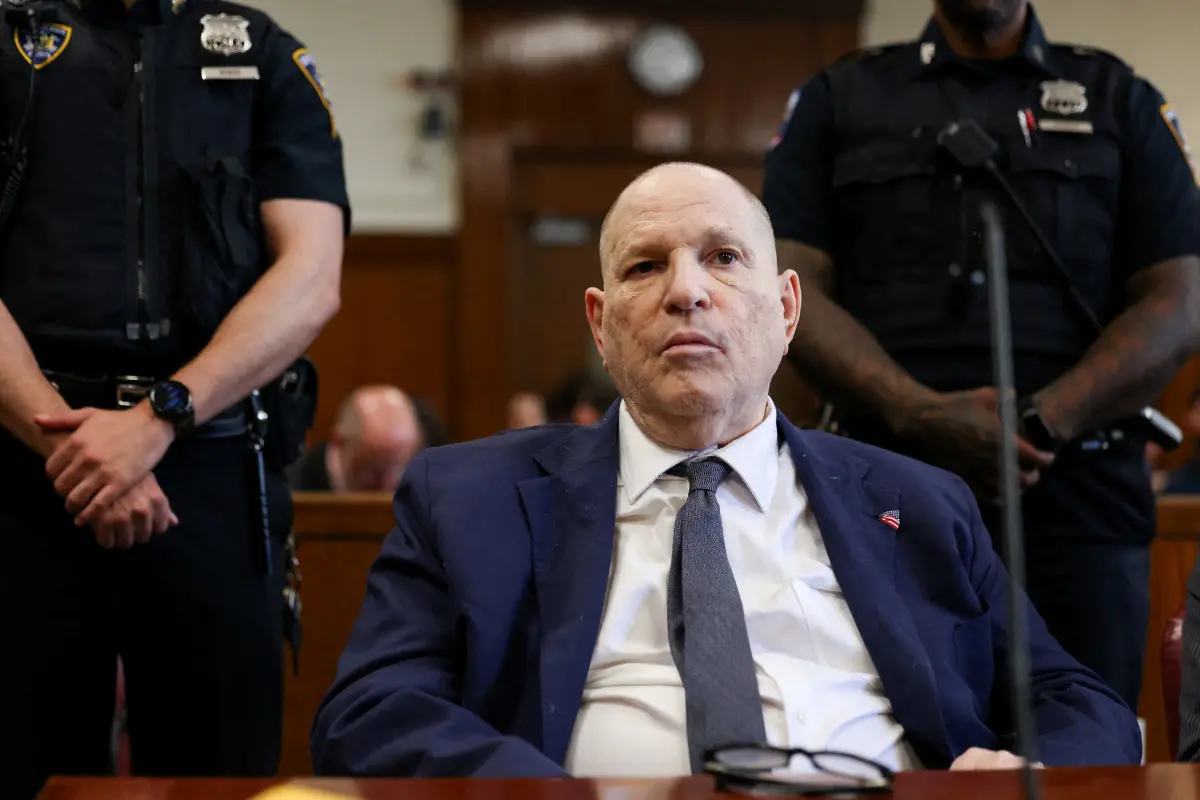
Harvey Weinstein, the once-powerful Hollywood producer, found himself in the midst of yet another contentious trial in Manhattan, facing charges related to an alleged rape back in 2013. At 74 years old and confined to a wheelchair, Weinstein cut a frail figure as he was wheeled into the courtroom, flashing a subtle thumbs-up to his legal team and a public relations representative. His lawyer, Jacob Kaplan, opened the proceedings by acknowledging that Weinstein was not a likable figure to many, especially given his history of legal troubles. Kaplan emphasized that this case wasn’t about personal popularity but about concrete evidence, urging the jury of seven men and five women to focus solely on the facts presented. Weinstein, dressed in a dark blue suit with an American flag pin, was reminded that his reputation as a former film mogul—behind hits like “Shakespeare in Love” and “Pulp Fiction”—was marred by years of accusations, but Kaplan insisted the trial hinged on proving wrongdoing beyond a reasonable doubt. This was Weinstein’s third trial in the city for sex-related crimes, a stark reminder of how far the man once at the center of the entertainment industry had fallen, grappling with physical ailments and legal battles that had dominated his life since 2018. As spectators and officials, including Manhattan District Attorney Alvin Bragg, observed, the atmosphere was charged with tension, reflecting broader societal conversations about power imbalances in high-profile industries. Weinstein’s team hoped to convince the jurors that emotions and public sentiment should not cloud their judgment, painting the defendant as a man whose life choices, however criticized, did not equate to criminal acts.
The prosecution, led by Assistant District Attorney Candace White, painted a starkly different picture, framing Weinstein not just as a disgraced businessman but as a manipulative predator who exploited aspiring women eager to break into the film world. White argued that the case boiled down to raw power dynamics, where promises of career advancement were used to lure vulnerable individuals into situations that turned abusive. She described how Weinstein allegedly built a web of control, targeting those with dreams of stardom, only to disregard their consent in moments of isolation. This portrayal echoed the narratives that had repeatedly surfaced in the media, portraying the former Miramax boss as someone who thrived on exploiting inequalities, often in luxurious hotel rooms or private spaces away from prying eyes. For the aspiring actress at the center of this trial, Jessica Mann, the encounter with Weinstein was depicted as a calculated assault on her autonomy, part of a pattern that had cost many women their sense of security and trust. The prosecution highlighted how such behavior corroded industries reliant on talent and ambition, urging jurors to see beyond Weinstein’s weakened state and recognize the lasting harm inflicted on survivors. In doing so, White positioned the trial as a referendum on accountability, where even powerful figures must answer for their actions, no matter how much time had passed. The courtroom gallery buzzed with the weight of these accusations, reminding everyone that beneath the spectacle were real human stories of ambition thwarted by predation.
To understand the gravity of this third trial, it helps to revisit Weinstein’s legal saga, which began with his arrest in 2018 on multiple charges stemming from allegations by several women. His first Manhattan trial in 2020 resulted in convictions for raping Mann and forcing oral sex on another accuser, Mimi Haley, a former production assistant on “Project Runway.” Haley, who had pursued her dreams in the competitive world of television, testified about an encounter that left her traumatized, underscoring how Weinstein’s influence in entertainment extended far beyond the silver screen. However, New York’s highest court overturned those verdicts in a surprising twist, citing judicial errors and concerns over the admissibility of evidence. This reversal led to a second trial last summer, where jurors convicted Weinstein again on the Haley charge but deadlocked on the Mann allegation after contentious deliberations that lasted nearly a week. The inability to reach a consensus on Mann’s case opened the door for this third prosecution, reflecting the challenges of achieving unanimous agreement in emotionally charged trials. Mann, now 41, had previously recounted how the 2013 incident unfolded in a Manhattan hotel, describing moments of vulnerability that were abruptly violated. The see-saw nature of Weinstein’s convictions highlighted the complexities of revisiting allegations years later, as memories faded and details blurred under the fog of time, making it harder for prosecutors to build airtight cases.
Mann’s planned testimony forms the crux of this current trial, detailing her alleged encounter with Weinstein at the Doubletree Hotel in Midtown on March 18, 2013. Describing herself as an aspiring actress, Mann would relay how the married producer purportedly coerced her into intimacy, only for her to discover unsettling evidence afterward—a spent syringe used for erecting-inducing drugs, tossed carelessly in the trash. This discovery, she claimed, compounded the shock and violation, revealing layers of premeditation that went beyond a simple meeting. Weinstein’s legal team, however, countered that such portrayals misrepresented consensual interactions that continued over the subsequent four years, suggesting Mann returned voluntarily, indicating mutual agreement. Kaplan emphasized during openings that it was her choice, reiterated multiple times, rather than an imposition, depicting Weinstein as someone whose personal faults, like infidelity, did not cross into assault. This framing attempted to humanize Weinstein as a flawed man whose relationships, though condemned, were not criminal in nature, drawing distinctions between moral lapses and legal violations. As Mann prepares to share her story, the trial invites juries to weigh personal agency against claims of force, a delicate balance in an era where #MeToo has redefined boundaries of consent.
Weinstein’s defense rested on a narrative that reframed his encounters with accusers as mistakes rather than crimes, insisting that years later, these were being spun into something sinister for personal or societal gain. Kaplan argued that prosecutors were weaponizing hindsight, encouraging jurors to view the case through a lens of empathy for consensual choices that evolved over time. Despite Weinstein’s unmoving denials, his lawyers acknowledged the public disgust toward him—a sentiment reinforced by his grotesque health decline and pale complexion—but urged a focus on evidence over outrage. This approach aimed to strip away the sensationalism, presenting Weinstein as a human being grappling with regret over poor decisions, not a monster preying on the weak. Kaplan’s words resonated in a courtroom that, at times, felt like a theater of judgment, where the defendant’s frailty underscored the passage of time and the toll of relentless scrutiny. By humanizing the defendant as someone who admitted to “moral failings” and infidelity, the defense sought to evoke understanding, reminding jurors that no one is immune to complex personal histories that defy easy categorization.
Ultimately, the outcome of this trial holds limited impact on Weinstein’s ongoing incarceration, as he already faces up to 25 years for the oral sex conviction related to Haley, with sentencing pending. The third-degree rape charge against Mann carries a maximum of just four years, meaning success here might not drastically alter his fate, which includes separate convictions, such as the 16-year sentence for raping a model in California. Weinstein, reflecting in a pre-trial hearing, firmly maintained his innocence, stating he never assaulted anyone despite confessing to unfaithfulness. This steadfast position speaks to a man entrenched in denial, perhaps shielding himself from further fallout, as he navigates life from behind bars in state and city custody. Outside the courtroom, his story continues to stir debates about redemption, justice, and the human cost of fame’s dark underbelly, prompting broader reflections on how power corrupts and how the legal system grapples with flawed individuals. As the trial unfolds, it’s a poignant reminder that beneath the headlines are stories of ambition, betrayal, and resilience, each demanding careful consideration in the pursuit of truth. Prosecutors hope this third attempt secures the conviction they believe is justified, while Weinstein’s team fights to preserve his freedom from additional charges, illustrating the enduring human drama of accountability in an imperfect world.