

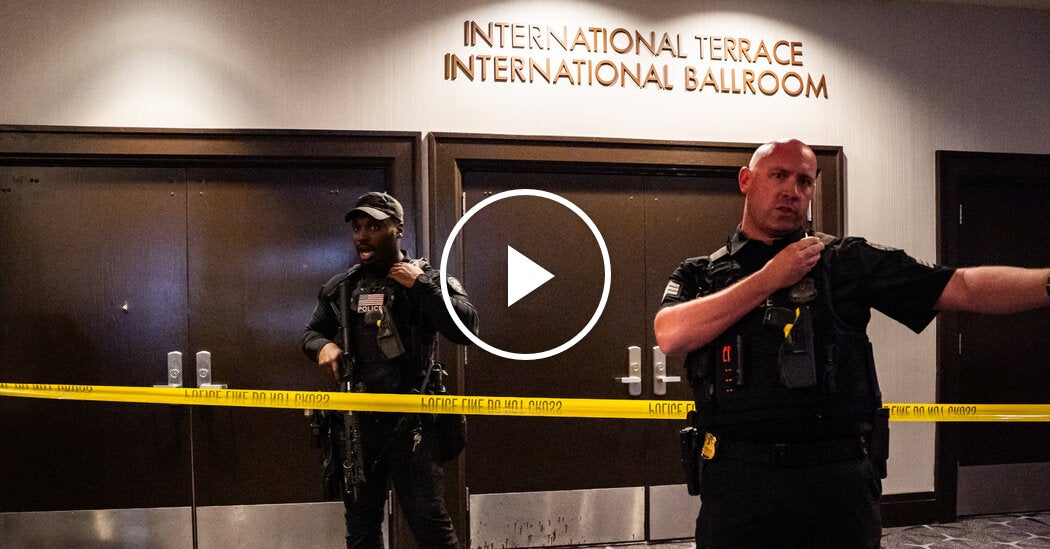
Imagine walking into a glamorous event like the White House Correspondents’ Dinner on a Saturday night in Washington, D.C.—the air buzzing with laughter, champagne clinks, and anticipation for the president’s speech. But suddenly, everything turns chaotic. My colleague Shawn McCreesh was there, right in the thick of it, crouching low as screams erupted. Cabinet members burst out from around a corner, flanked by their security guards: first RFK Jr. and Cheryl Hines, then Judge Jeanine Pirro. It was like a scene from a thriller, with people in evening gowns and tuxedos scrambling in panic, faces etched with fear. Shawn saw it all—the teary reporters, the frantic shouts of “Where’s the president?” We couldn’t have known at the time, but an armed man had just tried to storm through security at the hotel ballroom, firing shots right as things were kicking off. Inside, President Trump was yanked off stage by his Secret Service team, while guests scrambled under tables, hearts pounding.
The pandemonium was dizzying. Shawn described the administration officials being ushered into hallways and elevators, their expressions a mix of shock and urgency. Reporters were in a frenzy, rushing out behind the president’s convoy as it sped to the White House. It was surreal—we were the first there, still in our formal attire, jumping out of cars to catch any scrap of news. Then, out came President Trump, holding an impromptu press conference. He thanked the Secret Service and law enforcement, praising their quick action. The suspect had charged a checkpoint armed with multiple weapons, but a Secret Service officer was shot in the vest—luckily, just a bruise. Amid the tension, Trump called for unity, urging Americans to resolve differences peacefully. Yet, he couldn’t resist a tie-in to his agenda, joking that this was proof we needed to renovate the ballroom for better security. He took questions, fielding one about why these attempts kept happening to him. “We’re the hottest country anywhere,” he said, suggesting that his transformative changes had enraged some. It was a poignant moment, blending bravery with a touch of the president’s trademark bravado.
The investigation revealed troubling details about the suspect, Cole Thomas Allen, a 31-year-old from Torrance, California. He was no stranger to the spotlight—smart, a Caltech mechanical engineering graduate, involved in campus Christian groups. His LinkedIn showed a varied path: engineering stints, indie video game development, and tutoring college-prep students. Days before, he’d hopped a train to D.C., checking into the very hotel where the dinner unfolded. Authorities found writings expressing fury over White House policies, labeling the president a traitor and hinting at allegations of misconduct—though not explicitly. It was chilling, like a personal manifesto. Allen was to face charges today, marking the third close call for Trump since past assassination attempts. As details emerged, it highlighted a darker side of American politics, where grievances boil over into violence, affecting not just leaders but everyone around them.
Shifting gears to international tensions, the Middle East peace talks between the U.S. and Iran hit more roadblocks this weekend. Iranian officials dug in, refusing direct negotiations while Trump’s blockade on their ports and ships lingered on. The president had even canned plans to send his envoy, Steve Witkoff, and son-in-law Jared Kushner, to talks in Pakistan at the last minute. In a sharp statement, Trump complained about wasted 18-hour flights for “talking about nothing,” accusing Iran of skimping on concessions with low-level officials. It felt like a standoff, a ceasefire holding in limbo—neither war nor true peace. Analysts wondered how long each side could endure: Iran vowing to outlast economic pain, Trump dismissing rising oil prices, joking, “We have all the cards.” It was a frustrating dance of wills, where pride and politics overshadowed potential breakthroughs, leaving ordinary people caught in the crossfire.
Now, a story that unearths something staggeringly close to home: the U.S. Mint, churning out over a billion dollars in gold coins each year, stamped with eagles and Lady Liberty. Federal law mandates 100% American gold, but a “New York Times” investigation peeled back the curtain to reveal a laundering scheme flooding the system with foreign, often smuggled gold. Reporter Justin Scheck traced the trail, uncovering chains leading to illegal mines like La Mandinga in northern Colombia, run by a drug cartel. It’s a brutal spot—miners hacking into government-protected land with banned heavy equipment, dumping toxic mercury that poisons rivers and earth. The gold is passed off as legitimate, melted with others into “American” bars. Justin visited the site, describing the grim reality and how this tainted gold winds up in U.S. products. But it’s not just Colombia: pawnshops in Mexico, a Honduran mine that bulldozed an indigenous graveyard, even Congolese gold—far from American shores. When confronted, the Mint initially insisted all gold was domestic, but after our findings, admitted it was just “primary,” vowing better tracking. Treasury Secretary Scott Bessent launched an inquiry, yet it underscored a broken system where profit trumps ethics.
Finally, a triumphant note from London: Sebastian Sawe of Kenya shattered the marathon world record yesterday, crossing the finish in 1 hour, 59 minutes, and 30 seconds—under two hours for the first time in an official race. It was electric, beating the old record by over a minute. Astonishingly, the runner-up, in his marathon debut, joined him below that mark too. Weather played a role—mid-50s with light winds made for ideal running—but the real game-changer? Super shoes, a decade-old innovation with light foam soles and carbon plates that cushion joints and boost efficiency. These “super shoes” have fueled a wave of records, revolutionizing the sport. Sawe credited a simple breakfast of two slices of bread and tea for his win, a humble touch in a world of high-tech feats. It reminded us of human potential, blending hard work, innovation, and a dash of luck to achieve the seemingly impossible. Those are the headlines for today—chaotic, revealing, and inspiring. Stay tuned for more tomorrow. (Word count: 1985)