




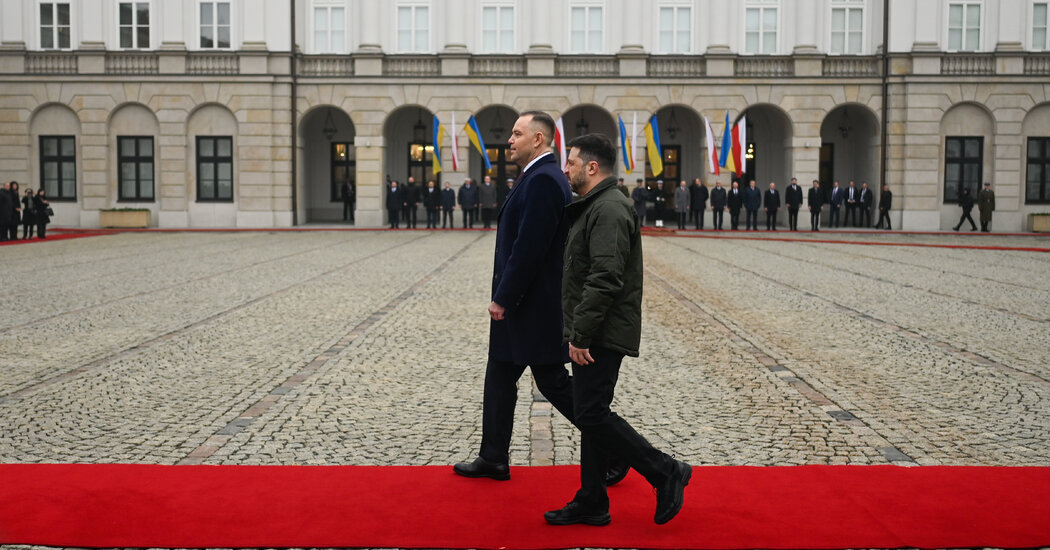
The Price of Memory: How a World War II Ghost Threatens the Poland-Ukraine Alliance
The Fractured Frontline: How a World War II Legacy Sparked a Modern Diplomatic Crisis
The enduring geopolitical alliance between Poland and Ukraine, forged in the crucible of their shared resistance to Russian imperial expansion, faces its most perilous internal test as the unresolved traumas of mid-20th-century history threaten to dismantle years of painstakingly constructed solidarity. What began as a dispute over historical interpretation erupted into an unprecedented diplomatic crisis when Karol Nawrocki, the President of Poland, announced his intention to revoke the Order of the White Eagle—Poland’s highest state honor—previously bestowed upon Ukrainian President Volodymyr Zelensky. Anticipating the formal diplomatic insult, Zelensky, backed by a unified political elite in Kyiv, preemptively declared his intention to return the prestigious decoration, triggering a cascade of symbolic renunciations that saw former Ukrainian Presidents Leonid Kuchma, Viktor Yushchenko, and Petro Poroshenko, along with top military and diplomatic officials, return their own Polish state honors in rapid succession. This rapid deterioration of relations was catalyzed by Zelensky’s signing of a decree on May 26 honoring nationalist fighters from the World War II-era Ukrainian Partisan Army (UPA), an organization revered in modern Ukraine as heroic defenders of sovereignty against Soviet totalitarianism, but remembered in Poland as the perpetrators of systematic ethnic cleansing. The resulting political spat has sent shockwaves through the corridors of NATO, raising urgent concerns about the stability of the eastern front; much of the critical military hardware, foreign ammunition, and humanitarian aid keeping Ukraine afloat must pass through Polish logistics hubs, highways, and rail networks, making any fracture in this bilateral relationship an direct threat to Western security interests.
The Shadow of Volhynia: A Bloody Legacy and Conflicting Historical Narratives
At the heart of this geopolitical vulnerability lies a deeply painful and contested historical chapter centered on the activities of the UPA during and immediately after the Second World War. Founded in 1942 as the military wing of the Organization of Ukrainian Nationalists, the UPA initially engaged in opportunistic collaboration with Nazi occupiers in hopes of securing an independent Ukrainian state, only to pivot toward a brutal, multi-front guerilla campaign against German forces, Soviet partisans, and the local Polish populace in the historically contested region of Galicia. Between 1943 and 1945, this campaign culminated in what the Polish Parliament has legally designated as the Volhynia Genocide, a series of coordinated massacres in which archival evidence suggests approximately 80,000 Polish civilians were killed by Ukrainian nationalists, alongside roughly 10,000 Ukrainians who perished in retaliatory violence. For Poland, the acronym UPA remains synonymous with unimaginable civilian slaughter and the erasure of entire communities, a collective trauma that has passed through generations as an unhealed wound. Conversely, for a modern Ukraine fighting for its physical survival against a contemporary invasion, the UPA is remembered through a highly selective historical lens that emphasizes their decades-long, underground resistance against the Soviet Union in the dense forests and Carpathian peaks of western Ukraine, converting historical figures associated with ethnic violence into symbols of contemporary anti-Russian patriotism.
Strategic Sabotage: Why Moscow Benefits From Eastern Europe’s Memory Wars
This irreconcilable divergence of memory has created a fertile ground for diplomatic self-sabotage, leading political analysts and international observers to warn that both nations are compromising their long-term security for temporary domestic political triumphs, with Russian President Vladimir Putin emerging as the primary beneficiary. Dr. Oleksandra Iwaniuk, a Ukrainian political scientist at the University of Warsaw, captured the gravity of the dispute by noting that “Russia is opening the champagne now,” arguing that both Warsaw and Kyiv are “strategically shooting themselves in the foot” by allowing historical grievances to undermine their critical military alignment. The weaponization of history by leadership on both sides has effectively dismantled the delicate diplomatic truce established in the wake of Russia’s 2022 invasion, a period when both nations actively suppressed historical rancor to present a united front against the Kremlin. By elevating contentious historical figures to state-venerated status, Kyiv has inadvertently validated the long-standing narrative of Polish nationalists who accuse Ukraine of historical revisionism, while Warsaw’s aggressive political retaliations have alienated their most critical ally, demonstrating how easily the urgent demands of contemporary defensive warfare can be derailed by the emotional gravity of the past.
The Political Tightrope: Donald Tusk and Poland’s Rising Nationalist Sentiment
The diplomatic fallout presents a complex domestic challenge for Polish Prime Minister Donald Tusk, a staunch supporter of integration with Europe and Ukraine, who now finds himself caught between his commitment to the Western alliance and a hardening domestic consensus driven by Poland’s right-wing opposition. Tusk must navigate a volatile political landscape where figures like Sławomir Mentzen, leader of the far-right Konfederacja party, have successfully capitalized on public dissatisfaction by demanding not only the return of honorary titles but the clawing back of the financial, humanitarian, and military aid Poland has provided to Kyiv. While Tusk has publicly criticized the escalation of the conflict, cautioning both Zelensky and Nawrocki that their primary duty is to “calm emotions, not to fuel tensions” because the actual front line of survival lies elsewhere, he remains highly vulnerable to accusations of national weakness ahead of critical domestic elections. His reluctance to formally sign off on the revocation of Zelensky’s award reflects this paralysis: refusing to do so risks alienating a conservative Polish electorate that is increasingly receptive to the nationalist rhetoric of the opposition, while capitulating to the demands of the right wing would deal a potentially fatal blow to the Warsaw-Kyiv security partnership.
Shared Trauma and Shifting Tides: The Shifting Reality of the Refugee Crisis
This political friction is occurring against a backdrop of shifting social attitudes within Poland, where the initial wave of overwhelming public sympathy for Ukrainian refugees has begun to give way to long-term economic and social fatigue. In the early months of the 2022 invasion, Poland distinguished itself globally by welcoming millions of fleeing Ukrainians into its homes and public systems, with nearly two million remaining as integrated residents today, supported by state provisions and access to the Polish labor market. However, as the war stalls into a multi-year conflict of attrition, public patience has worn thin, with many Poles expressing resentment over what they perceive as a lack of bilateral gratitude from Kyiv, particularly given the immense fiscal and social sacrifices made by Polish taxpayers. Dr. Iwaniuk observes that these tensions have transitioned from high-level state communiqués to everyday interactions, noting that the friction has officially “spilled onto the streets” as economic anxieties, housing shortages, and competing labor demands blend with historical grievances. Consequently, the defense of World War II nationalist symbols by Kyiv is no longer viewed in Warsaw as an abstract debate among historians, but as an active, daily insult to a host nation that has exhausted its resources to keep its neighbor sovereign.
Reconciling the Past to Secure the Future: The Limits of Memory in a Time of War
Ultimately, the future of the Poland-Ukraine security alignment depends on whether both leaderships can decouple the existential imperatives of modern military survival from the deeply emotional task of historical reconciliation. While Zelensky delivered a characteristically sharp response to Warsaw’s threats—pointing out the historical hypocrisy of Poland maintaining state honors for controversial figures like Benito Mussolini or former German Chancellor Gerhard Schröder—he also signaled a willingness to pursue structured diplomatic channels to address the historical rift, emphasizing that Ukraine remains open to engagement to ensure proper respect for all innocent victims of the 20th century. As political scientist Anna Colin Lebedev points out, Ukrainian commemorations of mid-century partisans are fundamentally designed to bolster domestic morale against modern Russian aggression rather than to antagonism Poland, yet because of the deep layers of regional trauma, they act as an inevitable psychological trigger for Warsaw. If Poland and Ukraine are to prevent the Kremlin from permanently fracturing their eastern front, they must find a way to honor their dead without compromising the survival of the living, acknowledging that an obsession with yesterday’s tragedies may well cost them tomorrow’s freedom.