


1.
On a cloudless September morning in 2001, a group of strangers stepped into an express elevator at the World Trade Center’s North Tower, expecting nothing more than a quick commute to work. They were a handful of ordinary people—a window cleaner, a couple of Port Authority managers, and other working men—each with places to be, deadlines to meet, and plans for the day they had no idea would inevitably be interrupted by history. The elevator climbed smoothly toward its first stop, the 67th floor, when at 8:46 a.m. American Airlines Flight 11 slammed into the tower. The force of that collision sent a shockwave down through the building, and in an instant, the elevator’s machinery failed. The car jolted violently and began to fall, not all the way to the ground, but far enough to give everyone inside the stomach-lurching, mortal certainty that they were about to die. One of the men slammed a hand against the emergency button, a sea of instinct, but the elevator had already plunged nearly fifteen stories before grinding to a stop somewhere around the 50th floor. When the doors wouldn’t open, the air filled with something far worse than suspense: a thick, chemical-scented white smoke began seeping into the cabin, thickening by the second. Then, momentary because this was no nightmare already alive, the reality of being trapped inside a wounded skyscraper began to settle in. But inside that tiny metal tomb, panic was not just useless—it was lethal. The men had less than an hour before the building would collapse into dust, and inside the dark, crowded elevator car, they had no way of knowing if rescuers were actually coming at all. In that suspended moment between life and death, six strangers made the first and most important decision any human can make in crisis: they refused to give up, and they chose to trust one another.
2.
As a choking cloud of thick white smoke filled the cabin, the smell of burning chemicals staining their clothes and throats, the six men understood that fear could only speed up the clock, not stop it. So instead of surrendering to panic, they did what generations of people in dangerous places have always done—they pooled not just their strength but their ordinary instincts, their patience, and their ideas. The group included Port Authority officials, men whose daily jobs revolved around the operations of that exact building, so there was a sense of focused urgency, and they quickly bent to the task of prying open the stuck automatic metal doors. It wasn’t elegant; they used their hands, the edges of their boots, whatever force they could muster. But after a struggle, they pried the doors apart wide enough to look beyond them. What they found instead of a path to safety was a dead ending—not a hallway or stairs, only a blank wall with the number “50” stenciled on it, as if the tower were shrugging them. In that moment, the situation turned from a rescue story into a what now moment, and for some it might have been over. But among them was Jan Demczur, a Polish immigrant and window cleaner, a man whose job had placed him on the outside of this same tower year after year, scrubbing its glass face and studying its bones. It was his peculiar, almost MacGyver-like insight that emerged: instead of trying to break through solid stone or steel, he reached down into the bucket by his feet, pulled out the brass squeegee he used for washing, and began pecking at the drywall in a frantic circular motion. It was not a tool designed for rescue, but it was the one tool he knew best. The others joined him, their fists and feet smashing into the patch of drywall, until a small opening widened into a hole large enough for a man to climb through. It wasn’t graceful or easy—nothing about that day was—but together, one stranger at a time, the men clawed themselves out of the elevator’s darkness and into a men’s bathroom, where they met firefighters already making their way upward, pleading with them to get out of the building immediately.
3.
The bathroom was not a destination; it was a waystation. With the building already in free fall and the world outside burning, the six men could only do the other thing that mattered as much as their courage: they were able to move, and they did it—down. There was no escalator or elevator an as escape route now, no easy transportation. It was a 50-floor staircase descent, one step after another, driven by the same natural high-level force that had saved them in the elevator. All around them, rescue workers were moving upward in the opposite direction, into flames and smoke, and the floors they passed were filling with the silencing that only great disaster makes possible. Along the way, there were emergency instructions, human bodies, noise; by the time the exhausted, choking group tumbled out of the North Tower and onto the street, the time had changed, but not the danger. It was 10:23 that morning. They had spent more than an hour and a half climbing, running, praying, and breathing on in a single terrible arc. And then, such a stroke of timing that it would seem if it were a piece of fiction, just five minutes later—at 10:28 a.m.—the South Tower groaned, then collapsed, and then the North followed; in the time it takes to exhale, the skyline that had defined Manhattan was reduced to a silent, enormous dust cloud. The men lay collapsed in the street, alive and trembling, covered in the dust of the building they had grown up in. When the cloud finally lifted, the reality was nothing less than staggeringly simple: they had survived. But with that survival came a weight that would never be fully gone, the weight of the thousands of people who no longer had their plans, their jobs, their tapers. In the weeks after, in front of the ash, none of them knew how to make normal life normal again. They went home, took the family, and in the silence of their own private rooms, they carried the entire story of those unbelievably small decisions in the elevator, the squeegee, the hole in the wall, the stairs. But somehow, for years, they never found a way back to each other.
3.
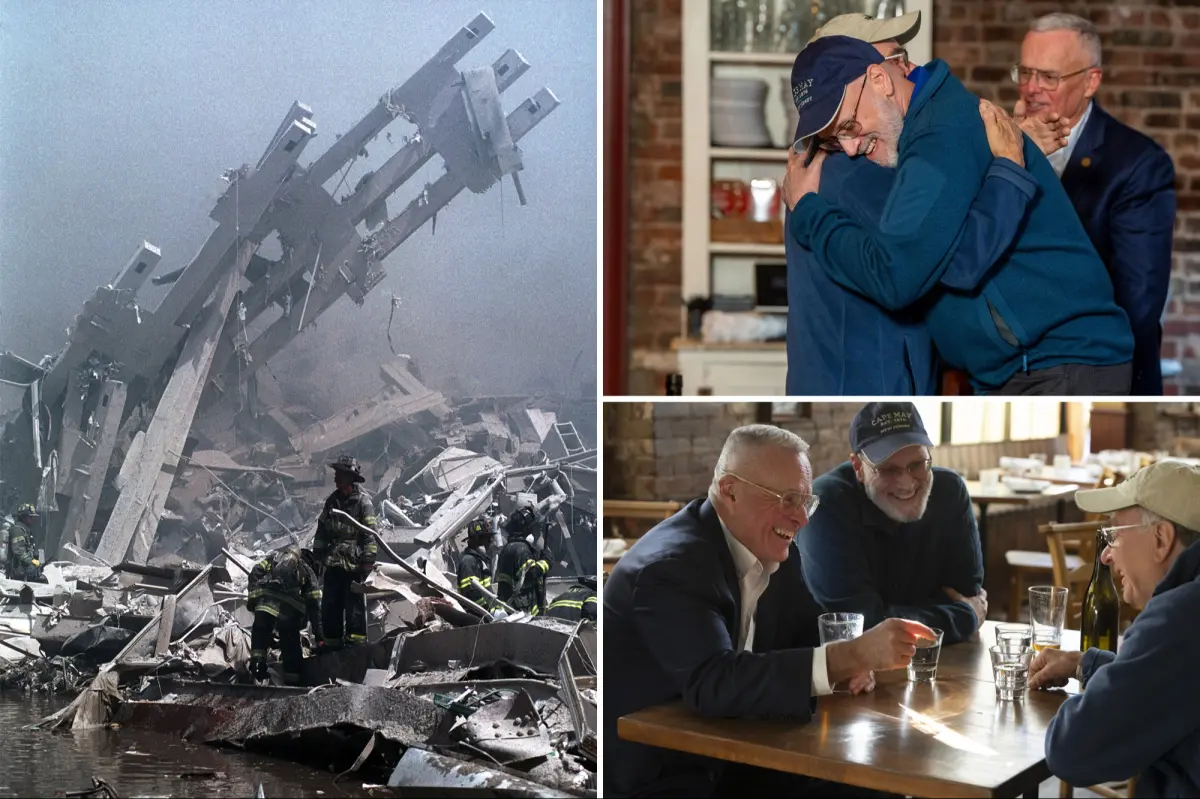
Nearly a quarter of a century later, the small group of strangers who had once saved each other in that elevator would meet again—not in the wall cavity or burning tower, but in a warm bar in Manhattan, in front of a camera crew, and with tears of gratitude that the audience could feel in their own houses. John Paczkowski and George Phoenix, both former Port Authority officers who worked in the towers, embraced Jan Demczur, the window cleaner with the titanium squeegee, and the meeting was a small piece of emotional bookkeeping that had been waiting for decades to be settled. Paczkowski said that seeing Jan and George again after all those years reminded him not only of the tragedy of that day and the unbearable sadness that one still feels for the lives lost, but also of the raw humanity of the bond they had forged. He spoke of how blessed he felt to be alive, and how the survivors now carry the responsibility to live their lives to the full, because the dying want full lives for them. The meeting was a piece of a larger project, National Geographic’s new documentary series “9/11 ReUnité,” which premieres August 21st at 8 p.m. and can be streamed in its executive months the following day on Disney+ and Hulu. The series, filmed for more than 25 years after the attacks, tracks down 14 survivors of the worst terrorist attack on U.S. soil—an attack that killed almost 3,000 people—and tries to reunite them with the strangers, the rescuers, and the everyday heroes whose actions changed the course of their lives. In many of those reunions, nothing dramatic happens: there are no chase scenes, no music swell; there is just human face to human face, a nod, an embrace, the comfort of saying, “You’re here; I’m here; you were alive; you mattered.”
The same sense of awe runs through the first installment documentary, but it wasn’t just the men from the elevator who were part of this hidden giving. The episode also includes the story of Deborah St. John, who was walking at the World Trade Center plaza when the second plane hit the tower, and the flight debris struck her, leaving her badly injured among the chaos and panic in a streetscape that had become a battlefield. Her life might have ended in a sidewalk rubble if not for Stefan Horlacher, a stranger who found her, knelt down, and did the other small but extraordinary work of laying her first aid, trying to keep her conscious and calm, while he flagged down volunteers and an ambulance to take her away. Such moment of connection amid the horror—random, unplanned, and almost invisible among the global catastrophe—is exactly what director Julian Jones had in mind when he created the series in collaboration with the National September 11 Memorial & Museum and production company 72 Films. The director told the Post that they knew many survivors had made deeply meaningful, unexpected connections on September 11, but then, for many reasons of distance, time, or trauma, they’d lost sight of each other. When production started reaching out to them, the filmmakers discovered something even more under the surface: many people had carried gentleness in their hearts for decades—things they wanted to say, forgiveness, gratitude, and grief—but had never said it to the right person across the table. After 25 years, the reunion offers those survivors a chance to say “thank you,” to honor the dead, and, finally, the reckon with the complicated emotional of that day. In that way, “9/11 Reut” isn’t a documentary about terrorism or paranoia; it’s a documentary about the small, ordinary grace that appears in absolute horror—the single handker the unknown hand, the stolen light.
Before they were survivors, though, they were truly people with ordinary memories of a building that was more than the office. Paczkowski, who worked as the assistant director of operations for the Port Authority on the 67th floor, no less recounted in the film that working at the Twin Towers was for him a “dream come true”—a job that carried a personal pride that made every daily arrival one day feel like a small ceremony. Phoenix, a senior engineer for the Port Authority, also remembered the towers as a place of love story: it wasn’t just technology or security in the building, it was his own date with the woman who would become his wife, Martha, who fell in love with him on an observation deck at the summit. This familiarity with the building as a home, as a workplace, as a backdrop for everyday encounters, makes the fate of the man in the elevator impossible to summarize as a simple rescue story. They did not just escape from huge fall piece of infrastructure; they escaped from the tomb of the world they had once trusted, and they had to rebuild their whole identity around the very system that no longer existed. The documentary shows that special relationship delicate detail, and that is why the meeting between Demczur, Paczkowski and Phoenix felt more than nostalgia; it was a ritual of disappearance and renewal, a gesture to missing friends. There is no comedy in their reunion, but there is a sense that place of peace comes from remembering at all—and no one in the fil believes that the memory can be all enough without honoring the thousands who had not reached the staircases, who had not gotten out through the hole in the wall, who had remained up in the smoke and in the burning sky. So when the six men rejoined, they were one small cell of a much larger immune system of memory, holding on to a City that was destroyed and rebuilt.
Some might ask why after all of these years, why cameras? Why Face new age contradictions and revisit this wound? The answer that emerges through 9/11 is not just enough to be true: because trauma is not ever finished when it’s not shared. The people who survive not in singular way, but together, and need to see each other to navigate the way they have been to the present. In a global cascade of events that celebrate spectacle—the towers falling and falling in every streaming loop—the documentary brings the camera back to the smallest scale of human interaction: a hug, a quiet handshake, the admission of “I saw you die” or “I was afraid you didn’t make it,” but then “here you are.” The director Julian Jones’ collaboration with the 9/11 Memorial Museum gives the film a weight and an archival authenticity, but the true truth of the series comes from the simple, raw honesty of the subjects as they begin to speak after in some cases 25 years of silence. It is easy to forget, in the political and historical script of September 11, that on the ground, it was a matter of minutes, and sometimes at the right minute someone emerged with a clean shirt and a squeezedge. It is easy to forget that so many first responders died in the stairwells, that so many ordinary civilians became unwilling heroes, and that what made survival truly difficult, an accident of time and place—but the choices of people who refuse to let each other be handled by the dark. “9/11 Untied” is not trying to offer closure, as if such a thing were possible after the scale of violence; it offers something more useful: continuation. A continuation of the relationships, of the acts of caring that had once been interrupted by collapse and falling smoke. In seeing the six men who had climbed through a bathroom of a doomed building beauty, the audience is not watching dry history reports—they are witnessing a ceremony of community; they are acknowledging that in the single worst loss of life, the possibility of human decency was not assassinated; it wobbled, but it could not be brought down. The survivors go on to live, with a profound duty to remember, to thank, and to stand in the ordinary daybreak, under ordinary flags, in a real world, refusing to let the dead have died for nothing.