


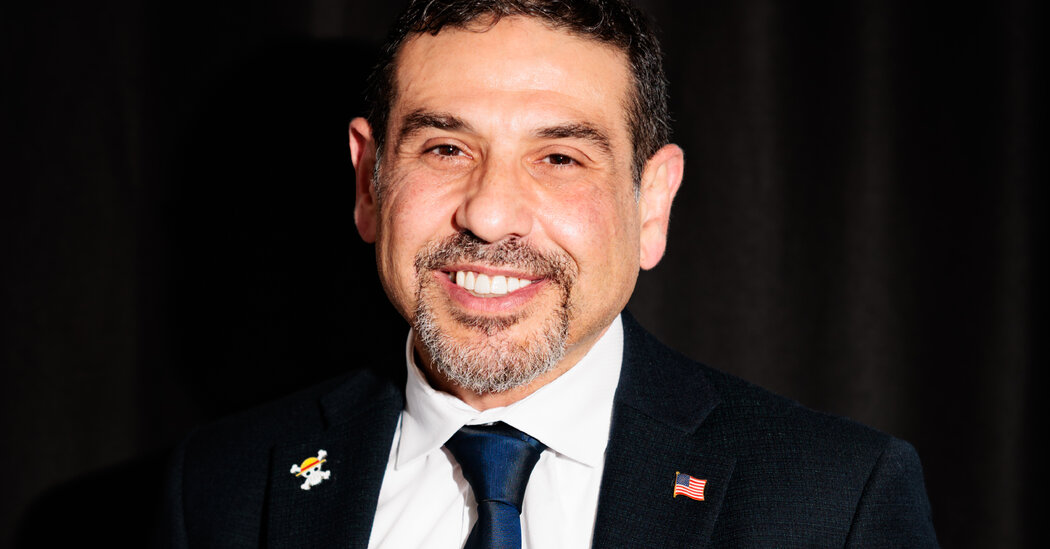
In the vibrant, politically charged landscape of New Jersey’s 12th Congressional District, a unique candidate has emerged who views the toxic divisions of modern governance through the lens of a medical professional. Dr. Adam Hamawy, an accomplished plastic surgeon and decorated U.S. Army veteran, is pitching himself to voters not as a conventional politician, but as a systematic healer. Born in Egypt and brought to the United States by his immigrant parents when he was just seven months old, Hamawy has lived a life defined by service in high-stakes environments, from operating on wounded soldiers as an Army combat surgeon during the Iraq War to volunteering his medical expertise in the blockaded clinics of present-day Gaza. His campaign centers on a bold ideological redirection: he argues that the staggering volumes of capital the United States routinely partitions for overseas warfare and foreign military alliances should be structurally reallocated to heal the nation from within. At the absolute core of his platform is a passionate advocacy for universal Medicare, a system he believes is essential to rescuing countless Americans from the crushing realities of medical bankruptcy and systemic neglect. Looking toward the halls of Congress, Hamawy views the legislative branch as a chaotic trauma ward desperately in need of triage, stating that his career of entering disaster zones has prepared him unique among his peers to step into the political breach and restore order to a fractured system.
This message of structural healing has catapulted Hamawy of Trenton into the definitive front-runner position in an extraordinarily crowded and high-stakes Democratic primary to succeed the retiring congressional titan, Bonnie Watson Coleman. The race, which at one point featured an overwhelming field of seventeen hopefuls, has since distilled into a intense battle among a dozen active candidates, each representing a different facet of the state’s complex political mosaic. Among his rivals are a prominent former leader of the state’s Working Families alliance, an influential state assemblywoman, two sitting mayors, an intellectual property lawyer, a fitness center entrepreneur, and a distinguished Princeton University neuroscientist renowned for analyzing the systemic impacts of political gerrymandering. Despite the formidable pedigree of his opponents, Hamawy has maintained a decisive lead in campaign fundraising, bolstered by endorsements from progressive heavyweights. Senator Bernie Sanders of Vermont has lent his considerable political capital to Hamawy’s bid, while popular leftist internet broadcaster Hasan Piker has mobilized a younger generation of voters, campaigning alongside the surgeon at enthusiastic rallies. Additionally, a newly formed pro-Palestinian political action committee named American Priorities has injected over $1.5 million into the race, flooding local media markets with advertisements highlighting Hamawy’s heroic history at the operating table, establishing a financial presence that completely eclipses the individual campaign budgets of his closest rivals in this safely Democratic district.
However, as Hamawy’s momentum has grown, desperate political rivals and conservative commentators have increasingly turned their focus to a controversial chapter of his youth, seeking to define him by associations forged over three decades ago. The controversy centers on the gap year Hamawy took between graduating from Rutgers University-New Brunswick in 1991 and enrolling in medical school the following year, during which the young, impressionable graduate crossed paths with Sheikh Omar Abdel Rahman. Abdel Rahman, a blind, highly militant Islamist cleric who preached in northern New Jersey, would later gain infamy as the “Blind Sheikh” and be convicted in 1995 for inspiring the 1993 World Trade Center bombing and plotting wider terror campaigns across New York City. During the cleric’s high-profile federal trial, a 26-year-old Hamawy was called to the stand by the defense to challenge the integrity of the prosecution’s star informant, Emad Salem, who had received a million-dollar payout from the FBI and admitted to lying under oath. Hamawy, who had traveled in a van with the two men to a speaking engagement, testified under oath that he did not recall Abdel Rahman ever instructing Salem to assassinate Egyptian President Hosni Mubarak, as the informant had claimed. While Hamawy’s testimony was centered strictly on the factual details of his recollections from that trip, he also admitted to jurors that he had assisted the blind cleric by translating faxes from Egypt, visiting his residence, and listening to his sermons at New Jersey mosques, painting a picture of close proximity that his modern critics are now using to question his character.
Yet, those who know Hamawy best argue that a lifetime of heroism, patriotism, and medical service far outweighs any guilt-by-association narratives manufactured from his youth. Following his medical training, Hamawy joined the U.S. Army, serving as a combat surgeon in Iraq where he famously operated on and saved the life of Tammy Duckworth, who is now a Democratic U.S. Senator representing Illinois and a vocal supporter of his congressional run. On the morning of September 11, 2001, Hamawy was a young resident at NewYork-Presbyterian Hospital; when the towers fell, he did not hesitate to rush directly to Ground Zero, spending grueling hours treating the severely injured victims of the nation’s worst terror attack. In response to recent critical essays written by the blind sheikh’s prosecutorial team—including lead prosecutor Andrew C. McCarthy and federal judge Michael B. Mukasey, who labeled Hamawy a sympathizer—the doctor has strongly defended his life’s work, declaring that his decades-long career has been dedicated exclusively to saving human lives rather than taking them. Campaign staff clarify that Hamawy cut off all contact with Abdel Rahman immediately following the cleric’s arrest, and Hamawy himself has strongly denounced the sheikh’s violent rhetoric. He explains that, as a young man, he saw the sheikh not as an international terror strategist, but as a vulnerable, elderly blind man who relied on local Muslim youth to help him perform everyday tasks.
Nonetheless, this historic association has become a primary target for rival candidates trying to slow Hamawy’s rise, particularly as it intersects with his modern, outspoken critiques of Israel’s military operations. Plainfield Mayor Adrian Mapp has led the charge, linking Hamawy’s decades-old association with the Blind Sheikh to his contemporary foreign policy stances, arguing that the association indicates a deeply troubling pattern of behavior and character. Mapp, while acknowledging the human suffering of Palestinians, has publicly labeled Hamawy’s contemporary criticisms of the Israeli state as “radical extremism” and slammed his accusations of genocide against Israel as inflammatory. Other primary opponents, such as Somerset County Commissioner Shanel Robinson and East Brunswick Mayor Brad Cohen, have also publicly questioned the candidate’s developmental choices during his twenties, suggesting that voters must evaluate a candidate’s entire adult life and association history. Hamawy, on his part, has refused to moderate his stance on American foreign policy, telling progressive commentators that the United States must stop providing offensive weaponry and systems to countries violating international humanitarian law. He defends himself against the political attacks by pointing out the deeply rooted Islamophobia that often targets Muslim-American candidates, noting that throughout his life, political opponents have sought to weaponize his religious identity and find historical angles to undermine his patriotism.
Ultimately, the resolution of this primary election will serve as a critical indicator of the direction of the Democratic electorate in New Jersey and their comfort with progressive rhetoric regarding the Middle East. Earlier this year, a neighboring congressional district saw a progressive candidate secure a primary victory after labeling the conflict in Gaza a genocide, suggesting that New Jersey’s reliable Democratic base may be shifting toward a more progressive stance on foreign military aid. On the streets of Trenton and throughout the leafy suburbs of Princeton, the controversies surrounding the 1990s trial feel incredibly distant to everyday voters, who are far more consumed by immediate, material concerns like the escalating cost of living and the national political threat of a second Donald Trump presidency. Local voters, such as retired bus driver Rickey Sanford, express appreciation for Hamawy’s directness and his self-professed willingness to stand toe-to-toe with conservative forces in Washington. Even among Jewish Democrats in the district, like South Brunswick resident Louise Walpin, there is strong support for Hamawy; she insists that criticizing foreign governments is not antisemitic and praises the surgeon for bringing a fierce, authentic fight to the Democratic ticket. If Hamawy emerges victorious, it will prove that a lifetime of saving lives, combined with a progressive domestic agenda, can successfully overcome decades-old controversies, paving the way for a new kind of doctor-statesman on Capitol Hill.