






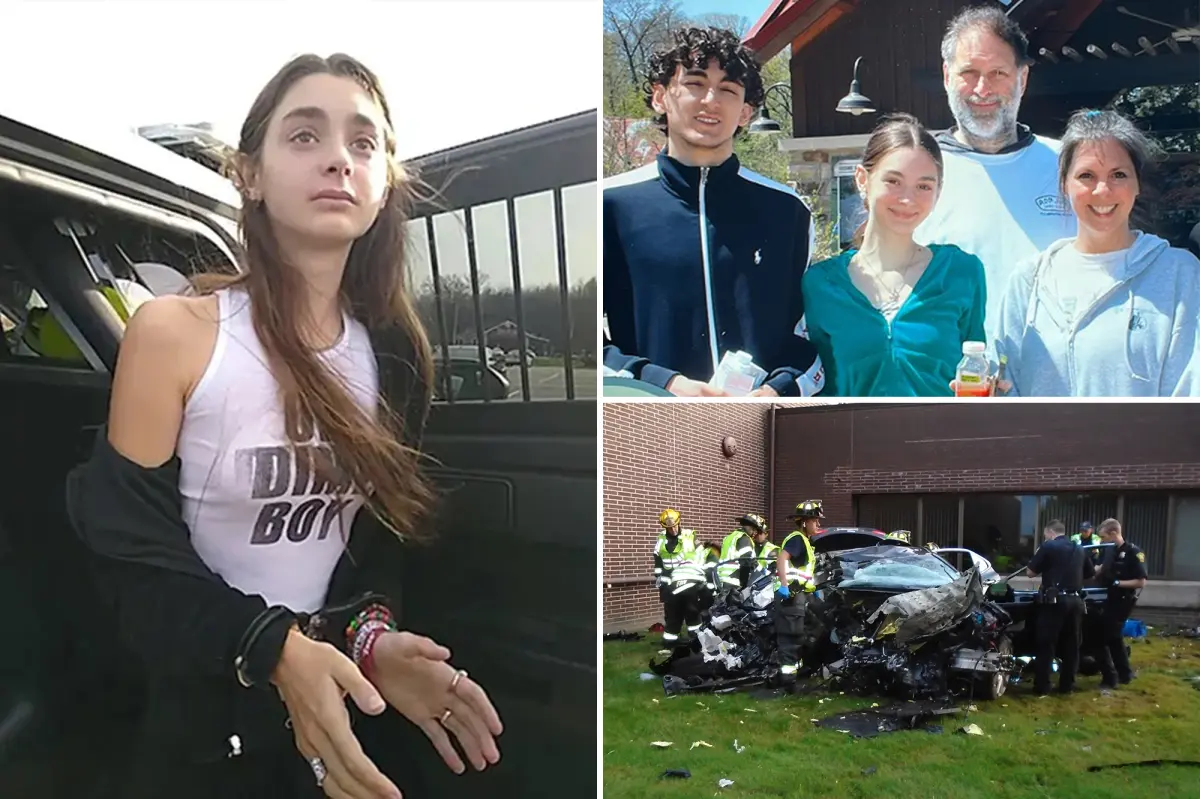
In the quiet, tight-knit suburban community of Strongsville, Ohio, a devastating event unfolded in July 2022 that would permanently shatter the lives of multiple families, leaving a community grasping for answers amidst an overwhelming wave of grief and disbelief, which still lingers today. Mackenzie Shirilla, then a nineteen-year-old on the absolute precipice of adulthood, drove her Toyota Camry at a terrifying, intentional speed of 100 miles per hour directly into the unforgiving brick facade of a local commercial warehouse. Inside the vehicle with her were her ex-boyfriend, twenty-year-old Dominic Russo, and their joint friend, nineteen-year-old Davion Flanagan, both of whom were entirely unaware of the fatal trajectory they were about to experience. The impact was catastrophic, instantly claiming the lives of both young men, who were pronounced dead at the dark scene, while Shirilla was found unconscious by rescue workers, bizarrely still wearing her fuzzy Prada slippers, which remained pressed firmly against the vehicle’s accelerator pedal. This tragic moment of severe vehicular violence, later thoroughly documented in Netflix’s gripping documentary series The Crash, was eventually ruled by the court not as a reckless accident of adolescent misjudgment, but as a deliberate and malicious act of murder. The legal proceedings exposed a deeply troubled relationship and an act of unimaginable desperation, resulting in Shirilla’s conviction. Now twenty years old, she finds herself stripped of her youth, comfort, and freedom, serving two concurrent sentences of fifteen years to life at the bleak, regimented Ohio Reformatory for Women in Marysville. To look beyond the shocking tabloid headlines of the “Hell on Wheels” killer is to confront the stark, heartbreaking reality of two promising young men whose futures were violently and prematurely stolen. Dominic and Davion were sons, brothers, and beloved friends, individuals full of life, aspirations, and potentials that were extinguished in a single moment of terrifying impact, leaving their families with a lifetime of profound sorrow.
Behind the towering, sterile walls of the Cuyahoga County Jail, where Shirilla was held prior to her highly publicized trial and eventual conviction, the gravity of her actions seemed to struggle to pierce her youthful, albeit profoundly self-absorbed, bubble of reality. In a series of leaked jailhouse phone calls recorded by the facility, a striking disconnect emerged between the grim finality of her legal situation and her immediate, trivial desires, illustrating the complex psychology of a teenager suddenly detached from her comfortable suburban life. Rather than expressing remorse, grief, or terror regarding the deaths of Dominic and Davion, Shirilla was captured on audio whining to her mother, Natalie, about the loss of her material comforts, most notably her electronic entertainment tablet. “I really want my iPad, though,” she pleaded repeatedly, her voice carrying a childlike, anxious desperation that contrasted sharply with the deadly nature of the crimes for which she was accused and stood trial. Despite being in a maximum-security environment where such personal electronics are strictly regulated, she continually begged her mother to intervene with jail authorities, pleading, “Can you call and ask? Please. Please.” When met with her mother’s realistic and blunt explanation that jail officials would treat such an unusual inquiry as an extraordinary, highly unlikely “special request,” and the stern warning that she would get it only when they decided to provide it, Shirilla’s frustration boiled over. “Why the f–k man?” she shrieked over the recorded line, demonstrating a profound inability to grasp that her incarceration was a direct, deserved consequence of a horrific tragedy, rather than an inconvenient, unfair interruption of her social life. This petulant demand, whispered through a static-heavy jail phone, humanizes a chilling aspect of modern youth: an extreme dependency on technology and instant gratification so deeply ingrained that even the shadow of a life sentence cannot immediately break its hold, exposing the psychological defense mechanisms of a young mind desperately clinging to superficial normalcy.
The recorded dialogue between Mackenzie and her mother, Natalie, reveals a complex, deeply complicated mother-daughter dynamic that became a primary emotional lifeline during the isolating, high-stakes months of pre-trial detention, offering a rare window into the domestic environment that shaped the young woman before and after the crash. This bonding time, mediated by institutional phones and punctuated by robotic automated warnings, often drifted into bizarre, tone-deaf conversations about social media and growing public infamy, rather than addressing the heavy reality of the upcoming double-murder trial. In one illustrative exchange, Natalie informed her daughter that her case had caught the attention of national media, announcing with a sense of gravity, “Kenzie, it’s on the Today Show.” Shirilla’s immediate reaction was a mix of shock and implicit validation, though her excitement was quickly dampened upon discovering that the segment had not aired on live national television but was instead published as an online story on the NBC program’s website. This hunger for external validation, nurtured in an era where digital notoriety is easily conflated with personal worth, showed a troubling desire to find some form of status within her own self-inflicted tragedy. Natalie’s role in these recorded calls reflects the harrowing, tragic struggle of a mother desperately trying to soothe a frantic child while simultaneously dealing with the public shame and private horror of what her daughter had done. She constantly walked a fine line between parental indulgence—pacifying her daughter’s relentless complaints—and the cold, hard truths of the penal system, trying to ground a teenager who seemed mentally and emotionally unprepared to face the consequence of her actions. Through these conversations, we witness a maternal figure attempting to navigate an unmanageable crisis, maintaining a fragile, enabling connection to a daughter who seemed far more concerned with her media footprint than with the absolute devastation of her victims’ grieving families, illustrating the painful isolation of maintaining family bonds in the wake of unspeakable crime.
This consuming desire for online relevance and the careful curation of her public image did not stop with media coverage; it extended directly to her digital identity, which she desperately sought to manipulate even from her jail cell. Shirilla aggressively demanded that her mother gain access to her personal social media accounts to update her Instagram biography to read “#freekenzie,” a desperate bid to kickstart a public campaign for her release despite her mother’s palpable hesitation and pushback. “And please don’t forget to change my Instagram bio. Try and get into that one Instagram account and change my name,” she insisted, illustrating a disturbing detachment from the gravity of a double homicide in favor of maintaining an idealized online persona. Beyond the digital realm, her aspirations took an even more delusional turn during later phone conversations, where she was recorded fantasizing about leveraging her newfound infamy to launch a glamorous career in Hollywood. She openly discussed capitalising on the media sensation surrounding the murders, dreaming of a life under the spotlight as an influencer, actress, or media personality if she were somehow to be released early from prison. This haunting disconnect—where a double tragedy is viewed not as a life-shattering catastrophe but as a potential launching pad for show-business fame—highlights a modern sociological crisis. It exposes how deeply the lines between reality, responsibility, and digitized entertainment have blurred for a generation raised on true-crime documentaries, reality television, and social media validation. By viewing her horrific crime through the lens of a marketable story rather than a permanent loss of human life, Shirilla exemplified a chilling form of modern narcissism, one that prioritizes personal branding, clicks, and public fascination over authentic remorse, empathy, and the quiet, solemn dignity that justice demands for her victims, Dominic and Davion, whose voices were so cruelly silenced.
The stark contrast between Shirilla’s Hollywood delusions and the concrete reality of her daily life became painfully evident as she transitioned from local lockup to the Ohio Reformatory for Women in Marysville. In this sprawling correctional facility, the trivial comforts she once took for granted, such as edible food and personal freedom, were entirely replaced by strict institutional regimes. Information shared by her former prison girlfriend, Shyann Topping, revealed that Shirilla’s dissatisfaction with the standard-issue prison meals drove her to rely on commissary food, utilizing her own funds to bypass the underwhelming food served by the facility. This transactional survival tactic underscores a difficult truth: inside the prison walls, her previous identity as a glamorous, middle-class teenager is entirely irrelevant, replaced by a drab state-issued uniform and standard prisoner number. The Ohio Reformatory for Women, known for housing some of the state’s most serious offenders, offers a bleak environment where the passage of time is marked not by social media updates or television appearances, but by headcounts, locked steel doors, and the heavy silence of confinement. For a young woman who once prioritized fuzzy designer slippers and luxury electronics, the transition to concurrent sentences of fifteen years to life represents an absolute stripping away of vanity. This harsh environment acts as an unyielding equalizer, forcing her to confront the grim reality of her long-term confinement far away from the cameras and digital stages she so desperately craved. It is here, amidst the monotony of prison life, that the illusion of her digital persona inevitably crumbles, leaving behind a young adult who must navigate the grueling psychological weight of her sentences, surviving day-to-day in a world that operates entirely without sympathy for her self-inflicted plight, a world where her demands for luxury are met only by the indifferent concrete walls of a cold prison cell.
Ultimately, stripping away the tabloid sensationalism of the “Hell on Wheels” moniker and the shocking jailhouse audio recordings reveals a deeply human tragedy that extends far beyond the secure brick walls of Marysville. The true weight of this horrific case lies with the families of Dominic Russo and Davion Flanagan, whose lives were cut short in their absolute prime, leaving behind an agonizing void that no court verdict, prison sentence, or retrospective media coverage can ever hope to fill. For the community of Strongsville, the crash remains a traumatic scar on their collective memory, serving as a stark warning of how quickly youthful relationships can turn deadly when fueled by unchecked manipulation, emotional instability, and a reckless disregard for human life. While Shirilla spends her days grappling with the loss of her superficial luxuries and dreaming of highly improbable Hollywood redemption, the parents, siblings, and friends of Dominic and Davion are left to navigate the quiet, painful reality of birthdays never celebrated, graduations never attended, and bright futures permanently stolen. This narrative serves as a sobering reminder of the devastating consequences of toxic behaviors, emphasizing that behind every viral true-crime phenomenon are real human beings who suffer the enduring consequences of a single, catastrophic choice. By refocusing our attention away from the sensationalized antics of the perpetrator and toward the profound, quiet grief experienced by those left behind, we honor the memory of the victims, reminding a media-obsessed society that human life is infinitely more precious than any digital profile, followers, or sensational footnote in legal history. We must never forget that in the race for digital relevance, the real world suffers real, unhealable scars, and true justice begins with acknowledging the humanity of those who were so cruelly taken from us. These young men had entire communities that loved them deeply, proving that behind the headlines lies a profound, unmatched human sorrow.