





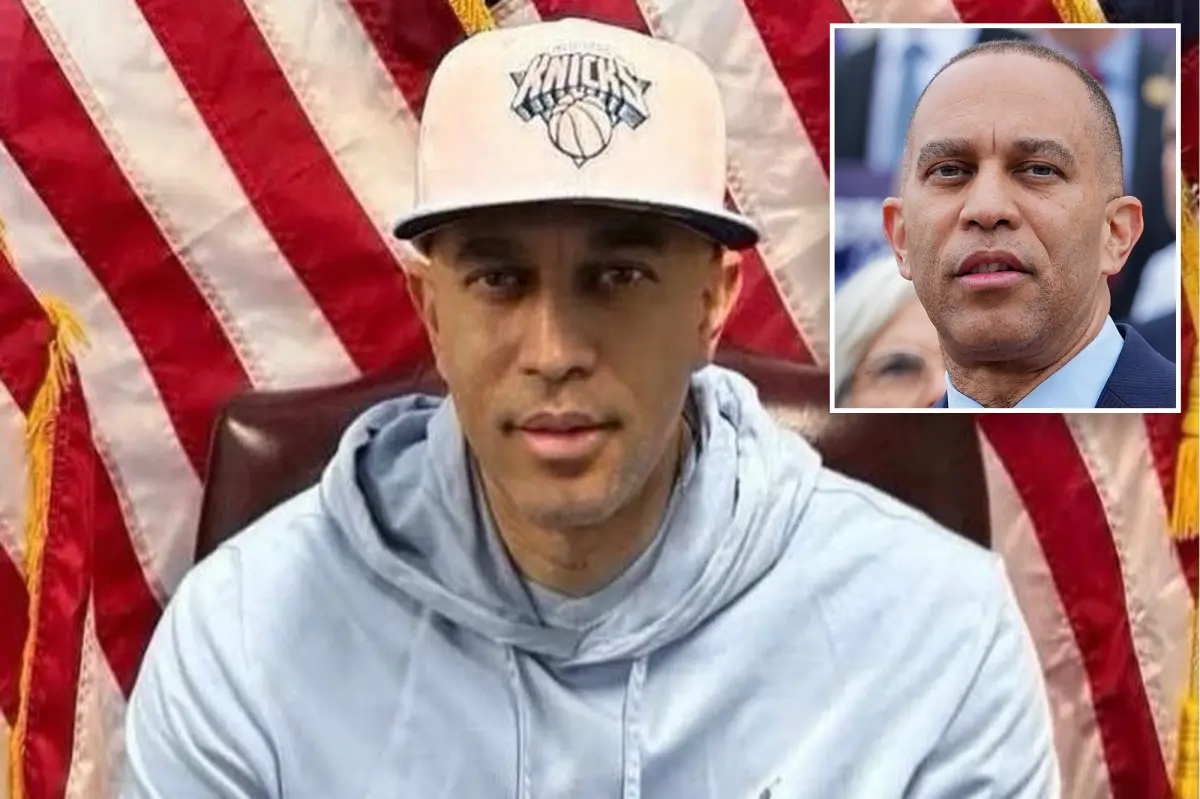
In the hyper-visible and often unforgiving theater of modern American politics, leaders are constantly tasked with walking an impossibly fine line between commanding public authority and maintaining a relatable, down-to-earth charm. For House Minority Leader Hakeem Jeffries, a proud native son of Brooklyn, sports fandom has long served as a natural, uncalculated bridge to the everyday citizens of New York—a city where sports loyalty is not just a casual pastime, but a sacred identity woven into the very fabric of daily life. Thus, when the New York Knicks made their highly anticipated and triumphant return to the NBA Finals after a grueling, twenty-seven-year drought filled with heartbreaking seasons, it seemed like the absolute perfect opportunity for the high-profile Democrat to celebrate alongside his passionate constituents on the vibrant streets of his home city. Taking to his social media platforms with the enthusiasm of a lifelong fan, Jeffries shared a portrait of himself looking directly into the camera, crowned with a stark, pristine white Knicks baseball cap, intending to capture the joyful essence of a die-hard supporter savoring a historic victory. In the digital age, however, sports fandom is territory fiercely protected by the public, and any hint of artificiality or corporate sanitization can instantly spoil the organic camaraderie. Instead of scoring easy points for authenticity, the veteran politician inadvertently ignited a wildfire of online amusement and intense criticism as eagle-eyed observers bypassed the celebratory sentiment of his message entirely, choosing instead to focus on the remarkably uncanny, flawless, and curiously pristine quality of the image itself. What was originally meant to be a simple, lighthearted tribute to the resurgence of New York basketball quickly devolved into a masterclass in how easily a carefully curated digital persona can alienate the public, proving that in the court of public opinion, the medium and the filters often completely overshadow the intended message. This minor digital slip-up highlights the challenging tightrope walk that contemporary political figures must navigate daily, where a single click of a filter button can turn an intended public relations victory into a widely mocked internet meme.
The primary catalyst for this swift and merciless digital uproar lay not in Jeffries’ basketball opinions, but in the highly conspicuous anomalies of the photograph he uploaded to his feeds. To the casual scroller, it was a simple portrait, but to an internet audience whose eyes have been trained through years of exposure to spot the subtle, telltale hallmarks of mobile photo editing, the image practically screamed of heavy-handed digital manipulation. Observers quickly pointed out that the Democratic leader’s face appeared to have undergone a comprehensive, albeit clumsy, virtual makeover that defied the natural laws of human anatomy. The soft, natural lines of experience and maturity that naturally grace the face of a busy, fifty-five-year-old lawmaker were entirely absent, replaced by a strangely smooth, poreless canvas that looked almost synthetic. His cheekbones, normally defined but grounded in human reality, looked oddly airbrushed and softened to an unnatural degree, while his jawline presented an unnaturally sharp, almost architectural edge that defied the physics of ambient lighting and natural bone structures. This specific visual style is colloquially associated with “Facetune” and other beauty-filter applications that are wildly popular among teenage beauty influencers seeking digital perfection, but are strikingly out of place on the official social media feed of one of the country’s most powerful, high-ranking legislators. This stark juxtaposition of a hard-working civil servant attempting to look like an airbrushed cover model generated a unique blend of humor and bewilderment, highlighting a vulnerable human truth: the universal desire to look youthful, rested, and flawless, even when occupying an office of immense gravity and immense stress. By trying to smooth out his physical imperfections, Jeffries unwittingly created a visual caricature of himself, sparking an engaging national conversation about the quiet insecurities that plague even our most formidable public servants when confronted with the unyielding reality of aging in the high-definition era.
Naturally, in the deeply polarized and highly reactionary ecosystem of contemporary Washington, political adversaries are always poised to pounce on the slightest aesthetic missteps, and Jeffries’ minor blunder provided his rivals with an absolute goldmine of comedic ammunition. The National Republican Senatorial Committee was among the very first to sound the digital alarm, with committee aide Sarah Gallagher taking to the social media platform X to playfully alert the internet with a wry, internet-native command: “babe wake up hakeem jeffries is using facetune again.” This swift, cultural-insider jab set off a massive chain reaction across conservative circles, successfully transforming a minor vanity slip into a viral campaign asset within a matter of minutes. Soon, other senior GOP consultants and communications strategists eagerly joined the fray, offering their own colorful, satirical analyses of the politician’s surprisingly polished and youthful appearance. Alex Pfeiffer, a seasoned Republican consultant and former White House deputy communications director, jokingly remarked that the heavily edited image made Jeffries look less like a sophisticated congressional leader and more like a junior varsity baseball coach grappling with the existential dread of ongoing marital discord. Meanwhile, Edgar A. Barrios, representing House Speaker Mike Johnson’s rapid response team, chimed in with a tongue-in-cheek lament about the unrealistic and oppressive beauty standards that were apparently weighing heavily on the minority leader’s mind. Through these sharp, lighthearted barbs, the political opposition succeeded in humanizing the political battlefield, using humor to paint their rival not as a formidable adversary, but as a deeply self-conscious individual striving to project a youthful vigor that his own camera couldn’t naturally support, proving that in modern campaigns, humor is often the most effective weapon.
Beyond the structured and highly partisan confines of professional Washington politics, the general public and passionate New York sports fans delivered their own unfiltered, devastatingly candid feedback directly to the congressman’s Instagram comments section. For sports enthusiasts, team loyalty is an earthy, grit-and-sweat affair that actively resists the polished, clinical veneer of corporate public relations, and many users felt Jeffries was bringing a plastic, focus-grouped aesthetic to a gritty, historically resilient New York institution. One particularly passionate user pleaded with the representative to distance himself from the team’s historic run, writing: “No. Do not do this. Do not put your lobbyist-approved, corporate liberal, cheugy ass stink on this team. Leave it alone congressman.” This specific sentiment captured a profound cultural divide, articulating the weariness that many regular citizens feel when politicians attempt to latch onto popular cultural moments using highly sterilized, focus-group-tested aesthetics. Other commenters opted for simpler, more direct bewildered queries, with some asking bluntly how many artificial intelligence-generated photos he planned on posting in the future, while others succinctly declared the entire image to be “just bizarre.” This groundswell of consumer-level backlash demonstrated that modern audiences possess a highly sophisticated radar for artificiality; they can easily sense when a moment is being manufactured for social capital, and they harbor a distinct distaste for public servants who appear to prioritize a flawless digital complexion over raw, unvarnished human connection with the people they represent. The visceral reaction from fans underscores a timeless truth in both sports and politics: authenticity is a non-negotiable currency, and when people suspect they are being sold a synthetic version of reality, they will push back with uncompromising honesty.
Adding to the public’s widespread amusement was the lingering collective memory of Jeffries’ past digital indiscretions, which made this latest photo-editing fail feel like part of a recurring pattern of cosmetic anxiety rather than a simple, isolated incident. Scarcely a full year prior to this Knicks-themed controversy, the congressman had faced a remarkably similar wave of public mockery after posting an obviously doctored photograph on Instagram that defied the basic laws of physical geometry and background linear perspective. In that previous image, Jeffries was depicted standing confidently against what should have been a normal park bench, but viewers immediately noticed that the solid wooden slats of the bench were wildly warped, curved, and bent inward around his hips. The clumsy distortion was a telltale sign of an amateur attempt to digitally slim his silhouette and vertically elongate his frame to appear taller and more physically imposing to his followers. The subsequent public fallout from that incident was swift and memorable, leaving a lingering reputation for digital vanity that made his recent Facetuned basketball portrait feel like an inevitable, comedic sequel. When public figures are repeatedly caught altering their physical appearance in such a visible, low-skill manner, it reveals a fascinating, deeply human psychological dynamic regarding the profound pressure of the political spotlight. It showcases how even those who wield immense legislative power and command the attention of the entire nation are still ultimately susceptible to the very same physical insecurities and digital temptations that drive ordinary teenagers to download filter apps before showing their faces to the world. It reminds us that behind the grand titles and legislative battles, politicians are still remarkably human, prone to the same vanity and insecurities as the rest of us.
Ultimately, the lighthearted controversy surrounding Hakeem Jeffries and his overly polished sports portrait serves as a poignant, modern parable about the supreme, irreplaceable value of authenticity in an increasingly artificial world. In an era dominated by deepfakes, algorithmic feeds, and carefully managed political brands, what the public truly craves from their leaders is not an unattainable, plastic perfection, but the messy, endearingly flawed reality of raw humanity. When a political leader filters out their wrinkles, sharpens their jawlines, or accidentally warps the benches behind them, they inadvertently signal a deep-seated fear of being seen as they truly are: human, aging, and imperfect. Yet, it is precisely those imperfections—the laugh lines earned through years of public service, the graying hair of leadership, and the genuine, unpolished passion of an everyday sports fan—that foster deep, meaningful trust with an electorate. As the digital dust settles on the minority leader’s latest viral slip-up, the lesson remains clear for public figures across the ideological spectrum: the most powerful connection code is honesty, and no amount of Facetune can ever match the enduring beauty of a leader who is entirely comfortable in their own skin. In a world of synthetic perfection, the most radical act a leader can perform is simply allowing themselves to be seen as they are, proving that vulnerability, rather than an airbrushed facade, is the true key to capturing the hearts and minds of the public.