

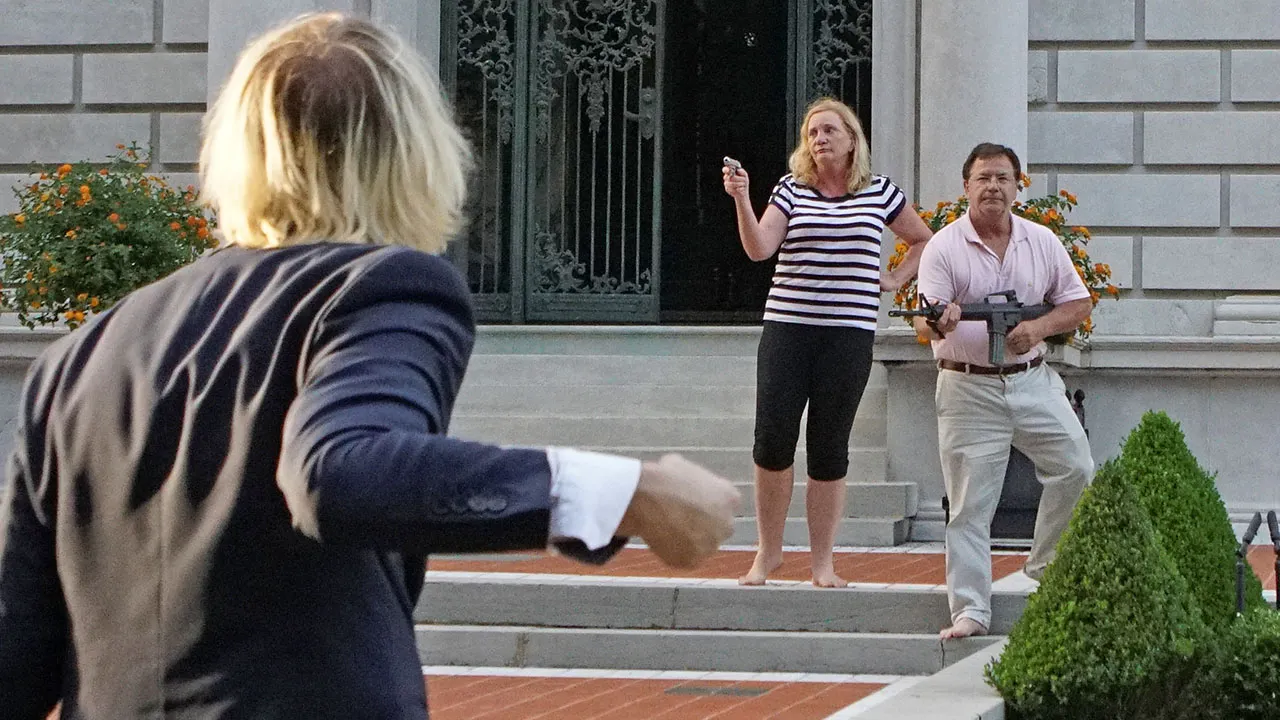
On a humid June evening in 2020, amidst a summer of profound civil unrest, the quiet sanctuary of Portland Place—a private, gated enclave of historic mansions in St. Louis, Missouri—was suddenly punctured by the roaring echoes of a passing protest. Mark and Patricia McCloskey, successful personal injury lawyers who had spent thirty years meticulously restoring their dream home, found themselves thrust into a terrifying, split-second confrontation that would irrevocably alter their lives and become an indelible image of a deeply divided nation. As a crowd of demonstrators bypassed a private gate and marched toward the home of the city’s mayor, the couple stepped onto their front lawn holding firearms—Mark with an AR-15-style rifle and Patricia with a semi-automatic handgun. Captured in dramatic photographs that went viral within minutes, the image of the barefoot homeowners standing defensively on their porch ignited a relentless national firestorm. To their supporters, they were the ultimate symbol of American self-reliance, brave citizens standing up to defend their private property when public safety felt deeply compromised. To their critics, they were reckless, privileged agitators who had unnecessarily escalated a peaceful racial justice march by brandishing deadly weapons at unarmed citizens. Six years later, the profound legal, financial, and emotional ripple effects of that single evening continue to reverberate through the lives of the McCloskeys, laying bare the immense personal cost of being swept up in the vortex of America’s culture wars.
Following that fateful encounter, the McCloskeys were quickly pulled into a grueling and highly politicized legal crucible that threatened to completely dismantle their freedom. St. Louis Circuit Attorney Kim Gardner filed charges of unlawful use of a weapon against the couple, initiating a high-stakes legal feud that quickly caught the attention of the highest offices in the state. Missouri’s then-Attorney General Eric Schmitt, who is now a U.S. Senator, aggressively intervened on the couple’s behalf, arguing that Gardner’s prosecution was a blatant weaponization of the justice system designed to appease a progressive political base rather than uphold the law. Schmitt argued that during a period when violent crimes were skyrocketing and rioters were targeting businesses, the city should have been prosecuting criminals rather than targetting law-abiding homeowners acting within their rights under the Castle Doctrine. Caught in the crossfire of this intense ideological warfare, the McCloskeys eventually chose to resolve the exhausting ordeal in 2021 by pleading guilty to misdemeanor charges, only to be swiftly pardoned by Missouri Governor Mike Parson. Though a state appeals court later ordered their records fully expunged—legally erasing the convictions as though they had never occurred—the psychological and physical toll of having their own government attempt to criminalize their self-defense actions left permanent scars on their sense of safety and trust.
While the legal battle eventually concluded with pardons and expungement, the devastating blow to their personal lives and professional livelihoods was severe and irreversible. For decades, the McCloskeys had operated a successful legal practice, but almost overnight, their lifetime of hard work was virtually demolished by a digital crusade of public outrage. Mark McCloskey recalls with immense frustration how Google searches for their law firm suddenly listed the business as “permanently closed,” while online platforms falsely designated him as a “former” attorney, effectively executing a digital execution of his career and forcing him into an involuntary retirement in the public eye. Their former defense attorney, Al Watkins, revealed that the critical factor leading to the confrontation was not the protest itself, but a deliberate decision by top city officials to order local law enforcement to maintain a strict “hands-off” policy toward protesters, leaving neighborhood residents entirely vulnerable and abandoned by the state. This sudden breakdown of public security forced the McCloskeys to make a desperate choice when the gates of their street were breached. There was a painful, deep irony in how they were portrayed as racially biased elites, considering they had consciously chosen decades earlier to buy, restore, and live in a historically diverse urban neighborhood in St. Louis rather than retreat to the quiet, homogenous suburbs.
The struggle to reclaim their lives was mirrored by a long, exhausting crusade to recover the tangible symbols of their ordeal: the very firearms they had held on their front lawn. Mark McCloskey embarked on a relentless five-year legal battle against the state of Missouri to secure the return of his AR-15 rifle and Patricia’s handgun, a process that came to symbolize his refusal to let the administrative state quietly confiscate his property. The legal saga dragged on for 1,847 days, requiring three separate lawsuits and two trips to the Missouri Court of Appeals before the state finally relinquished the rifle in 2025, with the pistol following roughly two months later. For Mark, this grueling, multi-year endeavor was never simply about the physical utility of the weapons; it was a deeply personal matter of principle and an arduous test of endurance against bureaucratic obstinacy. He noted that the experience taught him the absolute necessity of tenacity, demonstrating to the public that holding government institutions accountable requires an extraordinary expenditure of personal and financial resources. This prolonged fight illustrated a chilling modern reality: that even when citizens are completely vindicated by the highest authorities in their state, reclaiming their constitutional rights from the hands of hostile local agencies can still require years of relentless, exhausting litigation.
Rather than allowing the trauma and public scrutiny of 2020 to retreat them into isolation, the McCloskeys chose to lean into their public identity, transforming their shared ordeal into a platform for political activism and conservative advocacy. Mark became a prominent and highly visible figure in national conservative circles, delivering a speech at the 2020 Republican National Convention and launching a campaign for the U.S. Senate in Missouri in 2022. In the years that followed, his focus shifted toward helping others who he believed were facing similar political persecution, representing several defendants charged in connection with the January 6, 2021, Capitol riot and advocating for their financial compensation through proposed federal funds. This intense drive to fight against what he views as a weaponized justice system became even more urgent in the face of profound personal adversity. Earlier this year, Mark revealed that he had been diagnosed with an undisclosed, incurable, and fatal medical condition, a devastating diagnosis that briefly forced him to step back from his demanding legal work. This heartbreaking personal revelation added a layer of profound human vulnerability to a man who had spent the last six years projecting an image of absolute, unyielding defiance to the world.
Today, nearly six years after they stepped onto their front porch and into the center of a national media storm, the McCloskeys continue to navigate the complex legacy of those fateful few minutes. They still face the persistent reality of occasional death threats and hate mail from a public that remains deeply polarized over their actions. Yet, despite the lingering negativity and the physical fragility of his health, Mark and his wife continue to travel the country, utilizing their unexpected public platform to speak passionately about the first-hand importance of the First and Second Amendments. Al Watkins expressed a hope that the couple might finally find peace, allowing them to live out the remainder of their lives without being demonized or prosecuted for simply trying to preserve their home and protect their vision of the American dream. For Mark McCloskey, however, the ultimate lesson of their long and painful journey remains simple, stark, and deeply personal. It is the realization that when the systems designed to protect society fail and you are left vulnerable on your own doorstep, you cannot rely on others to save you; you must have the courage, the readiness, and the personal strength to stand up, face the storm, and defend your own livelihood.