


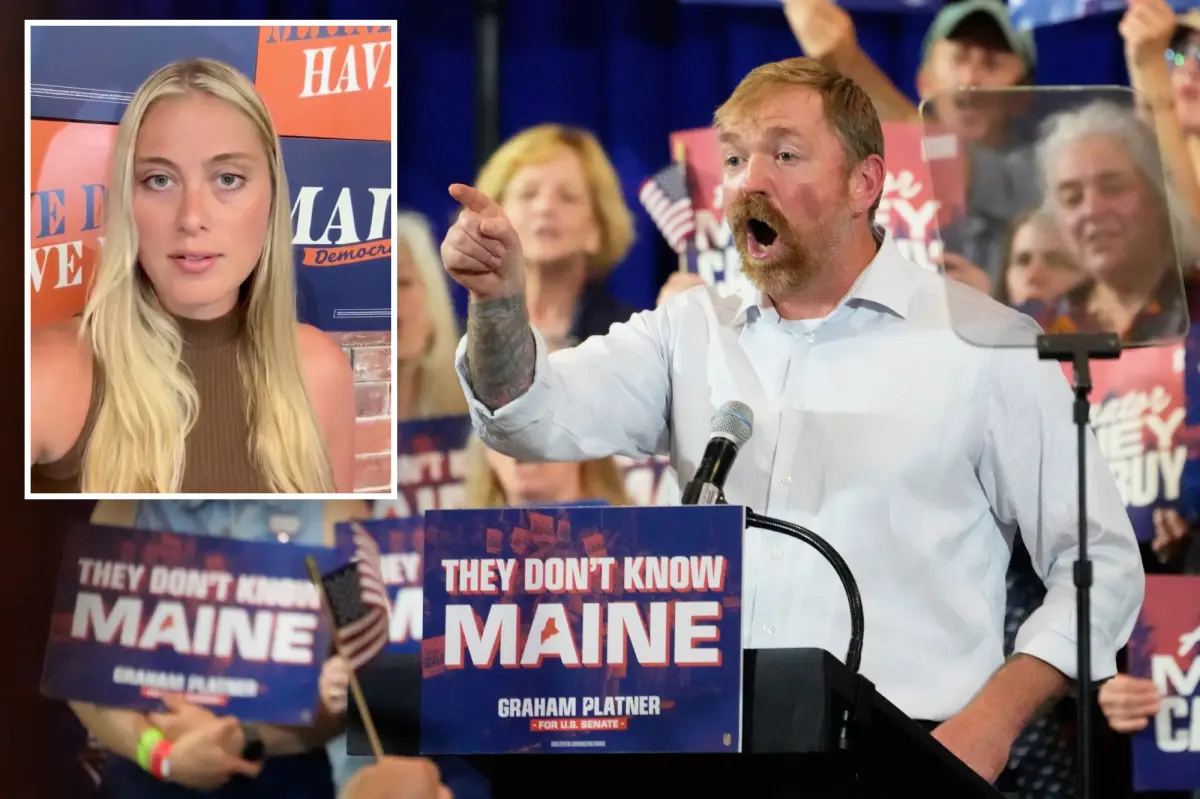
The upcoming November midterm elections have been thrown into a state of intense turbulence in Maine, as the state’s Democratic Party finds itself locked in a tense, highly public standoff with its own Senate nominee, Graham Platner. The escalating conflict erupted into the open after Devon Murphy-Anderson, the executive director of the Maine Democratic Party, released a video statement on the social media platform X, accused Platner’s campaign of attempting to inappropriately influence the selection of his potential successor. This political crisis was triggered by grave personal allegations against Platner, which have effectively paralyzed his campaign and forced the party into an urgent, high-stakes scramble to find a viable replacement candidate who can challenge the formidable Republican incumbent, Senator Susan Collins, in the looming general election.
According to Murphy-Anderson, the state party hierarchy has been working tirelessly behind the scenes to establish a replacement framework that is scrupulously open, inclusive, transparent, and fair to all stakeholders. In her public address, she emphasized that maintaining the absolute integrity of this emergency selection process is just as vital as the eventual electoral outcome, noting that Maine Democrats must have complete confidence in both the journey and the destination. However, she revealed that the party’s efforts have been repeatedly disrupted by Platner’s team, whom she accused of attempting to put their “thumb on the scale” to shape the replacement process to their own liking, forcing party leadership to firmly remind the embattled candidate that he has absolutely no say in determining the future of the nomination.
The party’s leadership has drawn a hard line, explicitly instructing Platner and his advisors that they will play no role in choosing the next Democratic Senate nominee or designing the mechanism of selection. Murphy-Anderson reiterated that the party has repeatedly demanded Platner’s immediate and formal withdrawal from the race so that Maine Democrats can finally move past this damaging distraction and focus their collective energy on the monumental task of defeating Susan Collins in November. To underscore this point, she made it clear that the party is fully prepared to make its highly anticipated replacement plan public, but will refuse to do so until Platner officially steps aside and submits his formal paperwork to exit the race.
In swift response to these sharp public accusations, Platner’s campaign team issued a strong rebuttal denying any underhanded or inappropriate behavior. A campaign spokesperson characterized their communication with the Maine Democratic Party as a standard, good-faith effort to simply understand what the transition process would look like, rather than an attempt to manipulate it behind closed doors. The campaign pushed back against the state party’s top-down narrative, arguing that they were merely seeking clarity on behalf of the tens of thousands of grassroots supporters who had fueled their primary victory, rather than trying to exert backroom influence over party officials.
Framing their defense in populist terms, Platner’s team asserted that over 150,000 Mainers had voted for their movement, with an additional 15,000 volunteering their time and energy to the campaign. The spokesperson argued that while Platner himself has no desire to personally dictate the party’s next steps, he feels a deep responsibility to ensure that the vital decision of choosing a new nominee is left to these everyday voters and passionate volunteers, rather than being controlled entirely by the state’s political establishment. This counter-argument highlights a deep ideological chasm between a grassroots faction protective of its democratic input and party leaders who feel a pressing need to control the damage and stabilize a chaotic situation.
The entire controversy stems from grave personal turmoil, as Platner recently announced he would be taking a step back from the active campaign trail to reflect on the best path forward following public accusations of rape made by an ex-girlfriend. Although the Senate hopeful has vehemently denied the allegations of sexual assault, the political fallout has been swift, devastating, and seemingly irreversible, with a rapidly growing chorus of local and national Democrats demanding his immediate resignation. As the clock ticks down to the November midterms, the bitter deadlock between the candidate’s defiant, grassroots-backed campaign and an anxious party establishment threatens to leave Maine Democrats intellectually divided and logistically unprepared for one of the most critical Senate battles in the nation.