


America’s Shifting Political Landscape: The Blue State Exodus
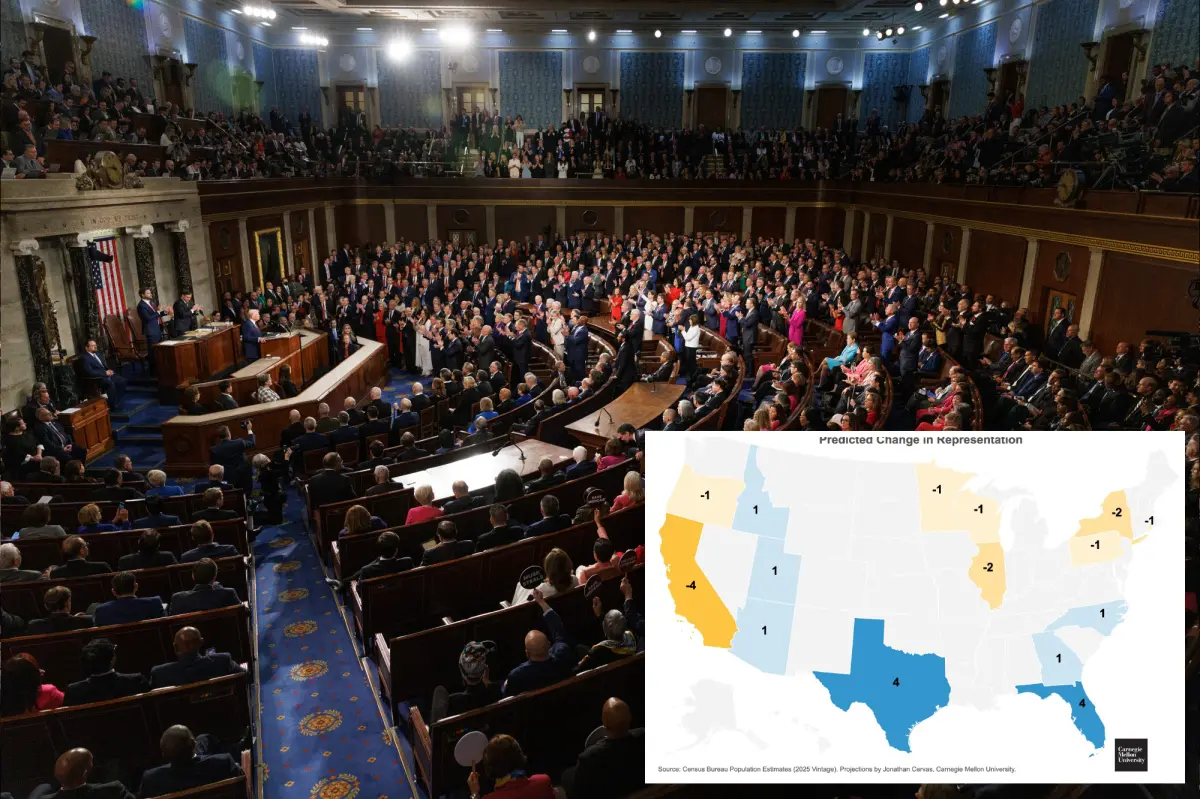
In a dramatic shift that’s reshaping America’s political map, Democratic strongholds New York and California are projected to lose significant congressional representation by 2030, while Republican-leaning southern states gain power. This “blue state blues” phenomenon, revealed in a recent analysis of Census Bureau data by redistricting expert Jonathan Cervas of Carnegie Mellon University, highlights deeper demographic and economic trends affecting the nation’s political future.
New York, once wielding tremendous influence with 45 House representatives in the 1940s, now faces another steep decline. Already reduced to just 26 seats today, the Empire State is projected to lose two more congressional seats in the next decade due to stagnant population growth. Critics point to this as further evidence of New York’s decline under Democratic leadership. California’s situation appears even more dramatic – after a century of population gains that made it America’s most represented state with 52 House seats, the Golden State could lose four seats by 2030, continuing a reversal that began when it lost its first seat in 2020. This represents a significant shift for a state long seen as the embodiment of the American dream.
The contrast with Republican-dominated states couldn’t be more striking. Texas and Florida – sunbelt states with lower taxes and cost of living – are each projected to gain four congressional seats in the coming decade. This population surge reflects what some call “voting with their feet” – Americans relocating from highly regulated, high-tax states to areas offering more affordable living and different political environments. Illinois, another Democratic stronghold, isn’t faring any better, with projections showing a loss of two more House seats, reducing its delegation from 17 to 15 representatives. These shifts will significantly impact the balance of power in Washington D.C., potentially giving Republican-leaning states more influence in federal policymaking and presidential elections.
The implications extend beyond simple partisan politics. Jeff Wice, a New York Law School expert who has assisted with redistricting, warns the situation could worsen for blue states if a citizenship question appears on future census forms. While the Constitution mandates counting all residents regardless of legal status, such questions might discourage participation among immigrant communities, potentially reducing reported populations in Democratic-leaning states with large immigrant populations. This possibility adds another layer of complexity to an already politically charged redistricting process, highlighting how census methodology itself has become a battleground in America’s increasingly polarized political landscape.
New York Republicans have seized on these projections as evidence of failed Democratic policies. Party spokesman David Laska didn’t mince words, stating: “Americans continue to vote with their feet, fleeing blue states and moving to red states. Who could blame them? One-party Democrat rule has made New York the most taxed, least affordable, least free state in America.” This sentiment captures the Republican narrative that Democratic governance drives out residents and businesses through high taxes and excessive regulation. The GOP sees these population shifts as vindication of their political philosophy and a harbinger of future electoral success as traditionally Democratic states lose influence while Republican strongholds gain power.
These demographic shifts reflect profound changes in how Americans perceive opportunity and quality of life. The traditional centers of American economic and cultural power – coastal cities like New York and Los Angeles – appear to be losing their appeal for many citizens seeking affordability and different political environments. The COVID-19 pandemic accelerated these trends as remote work freed many professionals from geographic constraints, allowing them to relocate to lower-cost regions. Whether this represents a temporary adjustment or a fundamental realignment of American society remains uncertain, but the political consequences are already becoming clear. As the nation approaches 2030, these population shifts will reshape congressional maps, electoral college calculations, and ultimately, the balance of power in Washington for decades to come.